Tips for JLPT from the Native Japanese Teacher

Tips to efficiently pass the JLPT - Advice from the native Japanese teacher - 1) Know the structure 2)Time managing 3) Daily training

→ Free Learning Platform ←

2026-03

article-jlpt-grammar

Mastering Your Plans and Intentions with 〜ようと思っている

〜ようと思っている is used to describe an intention that the speaker has had for some time. It suggests that you have been thinking about a certain action for a while.
article-jlpt-grammar

【JLPT N4】〜ことになる for Natural Conversation

「〜ことになる」 translates roughly to: "It has been decided that...", "It turns out that...", or "It is scheduled to be...".
article-jlpt-grammar

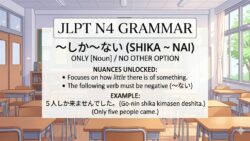
【JLPT N4】Unlocking the Nuances of “〜しか〜ない”

〜しか〜ない is a structure used to express limitation, restriction, or exclusivity. This pattern carries an emotional weight: a tone of dissatisfaction, regret etc.
article-jlpt-grammar

【JLPT N4】“〜させてください” for Seeking Permission and Making Requests

〜てもいいですか (〜te mo ii desu ka) is useful for casual inquiries, but 〜させてください carries a weight of formality and implies a deeper desire to perform the action.
article-jlpt-grammar

【JLPT N4】Understanding JLPT Grammar Point 〜たらどうですか

〜たらどうですか functions as a polite and thoughtful suggestion implying the speaker believes the suggestion is a good, practical solution to a problem.
article-jlpt-grammar

【JLPT N4】Mastering the Art of Continuity 〜続ける(Tsuzukeru)

「〜続ける」(〜tsuzukeru) doesn't just mean "continue"; it conveys a specific, focused sense of uninterrupted action, persistence, and often, effort.
article-jlpt-grammar

【JLPT N4】〜つもりだ (tsumori da) to Express Intent and Plans

〜つもりだ (tsumori da) is foundational for clearly communicating your intentions, setting goals, and even describing complex personal assumptions.
article-jlpt-grammar

【JLPT N4】〜て for Cause and Reason

The fundamental principle when 〜て expresses cause is this: The first clause (the reason) led naturally and often unavoidably to the second clause (the result).
article-jlpt-grammar

【JLPT N4】〜ていく (Te Iku)

When いく (iku) attaches to the te-form, it stops functioning as the verb "to go" and starts acting as a tool that modifies the flow or manner of the action.
article-jlpt-grammar

【JLPT N4】Unlocking the Power of 〜ておく(Te Oku)

The structure 「〜ておく」 is formed by combining the te-form of a verb with the verb おく (oku), which literally means "to put" or "to place."
Back to top
Copied title and URL