
Tips for JLPT from the Native Japanese Teacher

Tips to efficiently pass the JLPT - Advice from the native Japanese teacher - 1) Know the structure 2)Time managing 3) Daily training

→ Free Learning Platform ←

article-jlpt-grammar

article-jlpt-grammar

“Ikura…Temo” and “Donnani…Temo” to Express Determination

いくら〜ても and どんなに〜ても allow you to add emphasis to your sentences, showing that an action or a condition is being pushed to its limit without changing the outcome.

article-jlpt-grammar

Suffix ~Au: The Secret to Expressing Mutual Connection

When you attach 合う to the end of another verb, it transforms that verb into a reciprocal action. In English, this means "each other" or "to one another."
article-jlpt-grammar

How to Use 〜がきっかけで to Describe Your Turning Points

きっかけ (kikkake) means a chance, a start, a cue, or a trigger. When we add the particle が (ga) and で (de), we create a phrase that means "with [X] as the trigger"
article-jlpt-grammar

Understanding the Nuances of Rashii for Conjecture

~らしい is the element of objectivity and distance, and it relies on indirect information. This could be a rumor, a news report, or something you read online.
article-jlpt-grammar

A Comprehensive Guide to Using ~予定だ (~yotei da) 

~予定だ is "I plan to..." or "It is scheduled to...". Unlike "tsumori," which is about what you want to do in your heart, "yotei" is about what is on the calendar.
article-jlpt-grammar

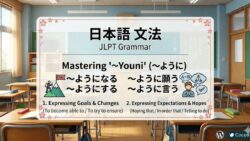
Change in state: How to Use 〜ようになる (Youni Naru)

〜ようになる expresses a change in state or ability. It describes a transition from State A to State B, going from "not being able to do A" to "being able to do it".
article-jlpt-grammar

Mastering the Making an Effort: A Guide to ~Youni Suru

〜ようにする is used when you are making a conscious effort to do something. It implies you are aiming for a certain result, often by being mindful of your actions.
article-jlpt-grammar

Mastering the Art of Conscious Effort with Youni Shite Iru

〜ようにしている is used to describe an ongoing effort to do (or not do) something. It implies the action isn’t easy, but you are working hard to make it happen.
article-jlpt-grammar

~Youni for the JLPT: Expressing Your Goals and Expectations

ように is used when you are aiming for a certain state or outcome. You are doing an action now so that a specific situation becomes possible later.
article-jlpt-grammar

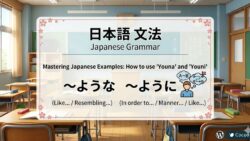
Mastering Japanese Examples: How to use “Youna” and “Youni”

〜ような & 〜ように are used to point at a specific example that represents a broader category. Think of it as a bridge between a general idea and a concrete instance.
\Share IPPO with friends/
Back to top
Copied title and URL