Tips for JLPT from the Native Japanese Teacher

Tips to efficiently pass the JLPT - Advice from the native Japanese teacher - 1) Know the structure 2)Time managing 3) Daily training

→ Free Learning Platform ←

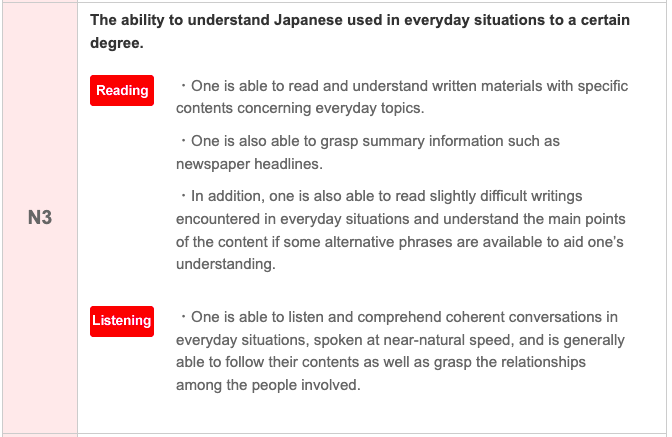
N3

article-jlpt-grammar

Suffix ~Au: The Secret to Expressing Mutual Connection

When you attach 合う to the end of another verb, it transforms that verb into a reciprocal action. In English, this means "each other" or "to one another."

2026.03.26
article-jlpt-grammar

How to Use 〜がきっかけで to Describe Your Turning Points

きっかけ (kikkake) means a chance, a start, a cue, or a trigger. When we add the particle が (ga) and で (de), we create a phrase that means "with [X] as the trigger"
2026.03.26
article-jlpt-grammar

Understanding the Nuances of Rashii for Conjecture

~らしい is the element of objectivity and distance, and it relies on indirect information. This could be a rumor, a news report, or something you read online.
2026.03.26
article-jlpt-grammar

JLPT N3 Tips: Unlocking Intermediate Japanese Language Proficiency

The Japanese Language Proficiency Test (JLPT) N3 marks the transition from beginner to intermediate Japanese language skills. As you prepare for the N3 exam, you’ll need to build on the foundations established at the N4 level while further developing your grammar, vocabulary, kanji, listening, and reading comprehension skills.
2026.03.26
article-jlpt-grammar

【JLPT N3】Study Tips of “Letters and Vocabulary/言語知識(文字・語彙)”

We will be writing about how to study for each section of JLPT N3.
2026.03.26
article-jlpt-grammar

How to Pass JLPT N3: Complete Study Guide, Exam Format & Strategies

How to pass JLPT N3? This is the complete guide for everyone. If you know these tips, you can study for the JLPT in the most effective way.
2026.03.26
\Share IPPO with friends/
Back to top
Copied title and URL