Table of Contents
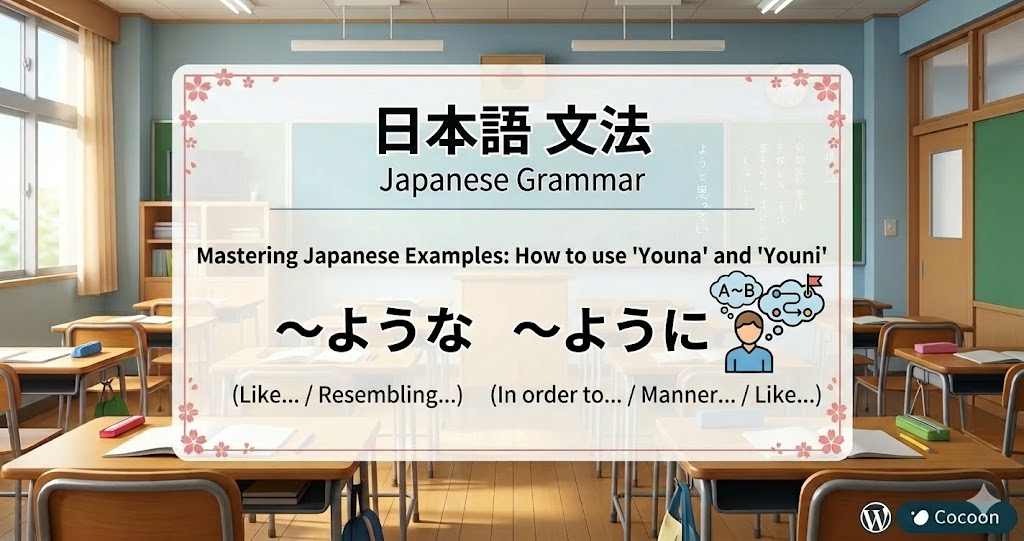
〜ような (youna) or 〜ように (youni)
If you have been studying Japanese for a while, perhaps aiming for the JLPT N3 or N2 levels, you have likely encountered a specific type of frustration. It’s that moment when you want to describe something by comparing it to another thing, or when you want to give a specific example to make your point clearer. In English, we use the word “like” or the phrase “such as” for almost everything. But in Japanese, as you might have guessed, things are a bit more nuanced.
You might find yourself wondering: “Should I use 〜ような (youna) or 〜ように (youni) here? Does it matter? Will people understand me if I mix them up?”
First of all, take a deep breath. You are not alone in this. This specific grammar point is one of the most common stumbling blocks for intermediate learners. It feels simple on the surface, but the grammatical rules governing whether you end with “na” or “ni” can feel like a moving target. In this guide, we are going to break down exactly how to use these expressions for giving examples (例示 – reiji), so you can stop second-guessing yourself and start speaking with more confidence.
Before diving into the grammar detail, here is the JLPT N4 complete guide:
The Ultimate JLPT N4 Complete Guide: Your Gateway to Working and Living in Japan
Understanding the Core Logic of Youna and Youni
Before we dive into the sentence structures, let’s look at the “soul” of this grammar. Both 〜ような and 〜ように are used to point at a specific example that represents a broader category. Think of it as a bridge between a general idea and a concrete instance.
The easiest way to remember which one to use is to look at what comes after the grammar point. In Japanese grammar, the ending “na” usually functions like an adjective (specifically a na-adjective), meaning it wants to describe a noun. The ending “ni” functions like an adverb, meaning it wants to describe an action (verb) or an adjective.
The Basic Rule for 〜ような (Youna)
We use 〜ような when we want to modify a noun. You are saying “A noun like [Example].”
Structure: [Noun A] + の + ような + [Noun B]
In this setup, Noun A is your specific example, and Noun B is the thing you are describing. For example, if you want to say “A person like Tanaka-san,” Tanaka-san is Noun A, and “person” is Noun B. Since “person” (hito) is a noun, we must use “youna.”
The Basic Rule for 〜ように (Youni)
We use 〜ように when the example is being used to describe how an action is performed or to modify the entire following clause. You are saying “To do something like [Example].”
Structure: [Noun A] + の + ように + [Verb / Adjective]
If you want to say “Talk like a Japanese person,” the act of “talking” (verb) is what is being modified. Therefore, you use “youni.”
Real-Life Examples to Bring the Grammar to Life
Rules are fine, but they can feel a bit dry. Let’s look at how these actually sound in daily conversation. I’ve picked three scenarios that you are likely to encounter in your life in Japan or while chatting with Japanese friends.
Talking About Your Preferences
Imagine you are at a cafe or a restaurant with a friend. You are talking about the kinds of food you enjoy. Instead of just saying “I like fruit,” which is a bit broad, you want to give examples to make the conversation more interesting.
Japanese: 私は、リンゴのような甘い果物が好きです。
Romaji: Watashi wa, ringo no you na amai kudamono ga suki desu.
English: I like sweet fruits like (such as) apples.
In this sentence, “apples” (ringo) is the example. The word following our grammar point is “sweet fruits” (amai kudamono). Since “kudamono” is a noun, we use ような. Using this expression makes you sound much more descriptive and fluent than just listing things one by one.
Describing Someone’s Skills or Behavior
One of the best ways to compliment someone or describe a person’s character is by using examples. Let’s say you have a friend who speaks Japanese incredibly well, and you want to describe how they talk.
Japanese: 彼は日本人のように、上手に日本語を話します。
Romaji: Kare wa nihonjin no you ni, jouzu ni nihongo o hanashimasu.
English: He speaks Japanese fluently, like a Japanese person.
Notice here that we are describing how he speaks (the verb “hanashimasu”). Because we are modifying the action of speaking, ように is the correct choice. If you said “nihonjin no you na kare” (a guy like a Japanese person), it would change the meaning to describe his identity rather than his skill.
Expressing Your Future Goals or Dreams
When we talk about our dreams, we often look at role models. You might want to live in a certain type of place or have a certain type of lifestyle. Let’s look at a sentence about a dream home.
Japanese: 京都のような、静かで伝統的な場所に住みたいです。
Romaji: Kyoto no you na, shizuka de dentouteki na basho ni sumitai desu.
English: I want to live in a quiet and traditional place like Kyoto.
Here, Kyoto is the specific example. The thing we are modifying is “place” (basho). Since “basho” is a noun, we use ような. Even though there are adjectives like “quiet” and “traditional” in between, they are all working together to describe the “place.”
Crucial Points and Common Pitfalls to Avoid
Even after understanding the basic “na vs. ni” rule, many students fall into a few common traps. Let’s clear those up so you can avoid the “awkward silence” during your next Japanese conversation.
Don’t Forget the “No” (の)
One of the most frequent mistakes is forgetting the particle の (no) when connecting a noun to youna/youni. In English, we just say “Like Kyoto.” In Japanese, you must say “Kyoto no youna.”
Wrong: 京都ような場所 (Kyoto youna basho)
Right: 京都のような場所 (Kyoto no youna basho)
Think of “youna” as a noun-like entity itself. To connect two nouns in Japanese, you almost always need that “no” bridge. Skipping it is a dead giveaway that you are translating directly from English in your head.
Youna vs. Mitai na: Knowing the Vibe
You might have heard the word みたいな (mitai na) used in almost the exact same way. Grammatically, they serve the same purpose of giving examples or making comparisons. However, the “vibe” is very different.
〜ような/ように is the standard, polite form. It is perfectly safe to use in the JLPT, in business settings, or when writing an essay. It sounds sophisticated and clear.
〜みたいな/みたいに is very casual. It’s what you’ll hear in anime, among friends at a bar, or in casual texts. If you are writing a formal report or speaking to a professor, stick with ような. If you are hanging out with classmates, みたいな is fine. Just remember: for the JLPT exam, you really need to master ような.
The “Middle of the Sentence” Trap
Sometimes, the noun being modified is far away from the “youna.” This happens a lot in complex sentences. For example:
“I want a car like the one my father bought last year.”
In Japanese, you might get confused about where to put the “youna.” Always remember that ような goes directly after your example.
“Chichi ga kyonen katta kuruma no youna…”
Wait, is the car the example? Yes. So: “Chichi no kuruma no youna kuruma ga hoshii.” If you find yourself getting tangled, try to simplify the sentence first. Identify the example (Noun A) and identify what it is representing (Noun B).
Is it an Example or a Simile?
While this article focuses on “examples” (例示), 〜ような is also used for similes (比喩 – hiyu), where you compare two things that aren’t actually the same. For instance, “She runs like a wind.” She isn’t literally a wind, but you are comparing her speed to it.
The good news? The grammar rules are exactly the same! Whether you are giving a real example (like apples for fruit) or a poetic comparison (like the wind for speed), the “na for nouns” and “ni for verbs” rule never changes. This makes the grammar point very versatile once you master the connection rules.
How to Practice and Internalize This Grammar
Knowing the rule is only 20% of the battle. The other 80% is training your brain to choose the right ending automatically. Here are a few “human” ways to practice that don’t involve just staring at a textbook.
The “Inventory” Game
Look around your room right now. Pick a category, like “Electronic devices” (denshi kiki). Now, find a specific one, like your smartphone. Practice saying: “Sumaho no youna denshi kiki” (Electronic devices like smartphones). Then, think of an action. “I want to work fast, like a computer.” (Konpyuuta no youni hayaku hatarakitai). By applying it to the objects around you, the grammar becomes “real.”
Shadowing and Listening
When you are listening to a Japanese podcast or watching a drama, keep an ear out for “youna” and “youni.” When you hear one, hit pause. Ask yourself: “Why did they use ‘ni’ there? Oh, it’s because the next word was a verb!” This active listening helps your brain recognize the patterns of native speakers.
Write a “Dream List”
Write five sentences about your ideal life.
“I want to live in a house like a castle.”
“I want to speak Japanese like a news anchor.”
“I want to travel to countries like Iceland.”
Trying to express your own actual desires makes the grammar stick much better than practicing with generic sentences about “Tanaka-san” or “Apples.”
Summary of the Key Takeaways
As we wrap up, let’s quickly recap the most important points to keep you on track for your studies:
- 〜ような (Youna) is used when you are followed by a Noun. (Example: A dog like a wolf.)
- 〜ように (Youni) is used when you are followed by a Verb or Adjective. (Example: To howl like a wolf.)
- Don’t forget the の (no) between your example noun and “youna/youni.”
- 〜ような is the polite and professional version of 〜みたいな.
- This grammar is essential for JLPT N3/N2 and will significantly boost how “natural” your Japanese sounds.
Learning Japanese is a marathon, not a sprint. It’s perfectly normal to slip up and use “na” when you should have used “ni” a few times. Most Japanese speakers will still understand exactly what you mean! The goal isn’t to be a perfect grammar robot, but to communicate your thoughts more clearly and beautifully.
Keep practicing, stay curious, and don’t be afraid to make mistakes. You’re doing great, and every time you use a phrase like 〜のような, you are one step closer to fluency. Happy studying!
IPPO, JLPT training platform is always here to help you to pass the JLPT!!

We offer the Best Online Japanese Learning (All Free), and our goal is to facilitate the adoption into life in Japan. Our service “IPPO” is made by native Japanese teachers and professionals. The tips we share with you can help you to learn Japanese efficiently and pass JLPT (Japanese Language Proficiency Test).