Tips for JLPT from the Native Japanese Teacher

Tips to efficiently pass the JLPT - Advice from the native Japanese teacher - 1) Know the structure 2)Time managing 3) Daily training

→ Free Learning Platform ←
JLPT Tips

IPPO, Becoming a Global Standard for the JLPT

The Japanese Language Proficiency Test (JLPT) is widely recognized worldwide as an exam that measures the Japanese language abilities of learners. In recent years, the JLPT has begun to play a role beyond just being an exam. This article will provide a detailed introduction to how the JLPT is being utilized in Japanese universities and companies, and the benefits it offers to learners.
2026.01.29
grammar

A Deep Dive into the Essential Grammar of 〜ことがある

〜ことがある (koto ga aru) If you are preparing for the Japanese Language Proficiency Test (JLPT), especially at the N4 or...
grammar

Mastering Modesty: Unlocking the Power of 「〜かもしれない」 (Kamoshirenai)

「〜かもしれない」 expresses the speaker’s educated guess or assumption about a situation. The level of probability implied is generally considered to be 50% or less.
grammar

Mastering the Art of Uncertainty “〜かどうか” (Ka Dou Ka): A Deep Dive into the Essential JLPT GrammarPoint,

「〜かどうか」 is straightforward, but it adheres strictly to the rule of connecting with the Plain Form (普通形, futsūkei) of the preceding word.
grammar

Conquering the Senses 〜がする(Ga Suru): A Comprehensive Guide to the Japanese Grammar Point

[Noun related to Sensation] + が + する is used to describe an involuntary perception—something that registers in your senses without you trying to make it happen.
grammar

The Essential Grammar Guide: Mastering the Japanese Indirect Question Structure(疑問詞 + 〜か) for the JLPT

[疑問詞]〜か is used to embed a specific piece of unknown information into a larger statement or another question. In English, this is known as an indirect question.
grammar

Mastering “~Owaru (~終わる)”: A Key to Expressing Task Completion in Japanese

〜終わる (owaru) is attached to the end of another verb to indicate that the action has been completed. In Japanese, we "glue" the word for "finish" (終わる) directly onto the action.
grammar

Mastering ‘〜間に’ (Aida ni): Your Essential Guide for JLPT Success and NaturalJapanese Conversations

'〜間に' (aida ni) means "while," "during," or "in the midst of." It signifies that an action or state occurs within a certain period of time.
grammar

Mastering “〜間 (aida)”: Your Guide to Expressing Duration in Japanese for JLPT

The grammar "間 (aida)" functions as a noun, you simply need to connect it to other words as if you were describing a noun like "book" or "house."
grammar

Mastering 〜てみる: Unlocking Your Japanese “Trial and Error” Expression for the JLPT

The grammar point 〜てみる is formed by taking the て-form of a verb and attaching みる (miru). While みる typically means "to see" or "to look," when combined in this structure, it takes on a different, more nuanced meaning.
grammar

Mastering “~でしょう”: Your Definitive Guide to Expressing Conjecture and Seeking Confirmation in Japanese

Many Japanese learners, especially those aiming for the JLPT N4 or N3 levels and beyond, struggle with the versatile yet tricky grammar point: ~でしょう (~deshou). It’s one of those expressions that seems simple on the surface but carries a surprising amount of depth and flexibility, reflecting the speaker's confidence, politeness, and intention.
grammar

A Deep Dive into the Essential Grammar of 〜ことがある

〜ことがある (koto ga aru) If you are preparing for the Japanese Language Proficiency Test (JLPT), especially at the N4 or...
grammar

Mastering Modesty: Unlocking the Power of 「〜かもしれない」 (Kamoshirenai)

「〜かもしれない」 expresses the speaker’s educated guess or assumption about a situation. The level of probability implied is generally considered to be 50% or less.
grammar

Mastering the Art of Uncertainty “〜かどうか” (Ka Dou Ka): A Deep Dive into the Essential JLPT GrammarPoint,

「〜かどうか」 is straightforward, but it adheres strictly to the rule of connecting with the Plain Form (普通形, futsūkei) of the preceding word.
grammar

Conquering the Senses 〜がする(Ga Suru): A Comprehensive Guide to the Japanese Grammar Point

[Noun related to Sensation] + が + する is used to describe an involuntary perception—something that registers in your senses without you trying to make it happen.
grammar

The Essential Grammar Guide: Mastering the Japanese Indirect Question Structure(疑問詞 + 〜か) for the JLPT

[疑問詞]〜か is used to embed a specific piece of unknown information into a larger statement or another question. In English, this is known as an indirect question.
grammar

Mastering “~Owaru (~終わる)”: A Key to Expressing Task Completion in Japanese

〜終わる (owaru) is attached to the end of another verb to indicate that the action has been completed. In Japanese, we "glue" the word for "finish" (終わる) directly onto the action.
grammar

Mastering ‘〜間に’ (Aida ni): Your Essential Guide for JLPT Success and NaturalJapanese Conversations

'〜間に' (aida ni) means "while," "during," or "in the midst of." It signifies that an action or state occurs within a certain period of time.
grammar

Mastering “〜間 (aida)”: Your Guide to Expressing Duration in Japanese for JLPT

The grammar "間 (aida)" functions as a noun, you simply need to connect it to other words as if you were describing a noun like "book" or "house."
grammar

Mastering 〜てみる: Unlocking Your Japanese “Trial and Error” Expression for the JLPT

The grammar point 〜てみる is formed by taking the て-form of a verb and attaching みる (miru). While みる typically means "to see" or "to look," when combined in this structure, it takes on a different, more nuanced meaning.
grammar

Mastering “~でしょう”: Your Definitive Guide to Expressing Conjecture and Seeking Confirmation in Japanese

Many Japanese learners, especially those aiming for the JLPT N4 or N3 levels and beyond, struggle with the versatile yet tricky grammar point: ~でしょう (~deshou). It’s one of those expressions that seems simple on the surface but carries a surprising amount of depth and flexibility, reflecting the speaker's confidence, politeness, and intention.
JLPT Tips

Japan’s Dwindling Population: A Looming Crisis and the Rise of Japanese Language Learning

In the face of a shrinking population and an increasingly diverse workforce, Japanese language learning has become more important than ever. Proficiency in Japanese is essential for foreign workers to fully integrate into Japanese society and contribute effectively to the economy.
2026.01.23
JLPT Tips

IPPO, Becoming a Global Standard for the JLPT

The Japanese Language Proficiency Test (JLPT) is widely recognized worldwide as an exam that measures the Japanese language abilities of learners. In recent years, the JLPT has begun to play a role beyond just being an exam. This article will provide a detailed introduction to how the JLPT is being utilized in Japanese universities and companies, and the benefits it offers to learners.
2026.01.29
JLPT Tips

IPPO: Revolutionizing Japanese Language Learning in University Collaborations

Explore the groundbreaking impact of IPPO in revolutionizing Japanese language learning through innovative university collaborations, offering a transformative approach to language education.
2026.01.29
JLPT Tips

JLPT N5 Tips: Achieving Success on Your First Step to Japanese Language Proficiency

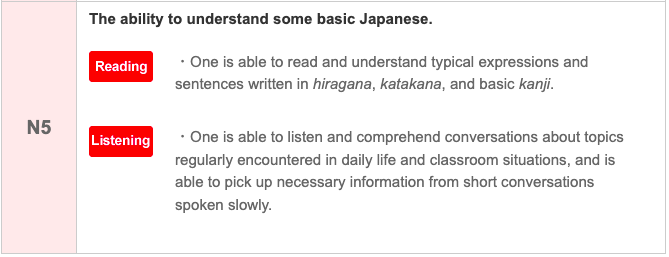
The Japanese Language Proficiency Test (JLPT) N5 is the first step in your journey toward Japanese language mastery. As the easiest of the five JLPT levels, N5 is an excellent starting point for beginners.
JLPT Tips

JLPT N1 Tips: Achieving the Pinnacle of Japanese Language Proficiency

The Japanese Language Proficiency Test (JLPT) N1 is the highest level of the JLPT, representing the pinnacle of Japanese language proficiency. Reach this level and you are a hero!
JLPT Tips

Mastering the JLPT: Top Study Materials and Tips for Each Level

The Japanese Language Proficiency Test (JLPT) is a highly-regarded examination that measures your ability to understand and use the Japanese language. Passing the JLPT can open doors to educational and professional opportunities in Japan and beyond. In this blog post, we will discuss essential study materials, tips for each level, and strategies for mastering the JLPT.
JLPT Tips

Ace the JLPT: Comprehensive Preparation for All Levels

In this blog post, we will provide an all-encompassing guide to help you excel in your JLPT journey, covering the test format, study resources for each level, techniques for mastering grammar, vocabulary, kanji, listening, and reading comprehension, as well as effective test preparation tips.
2026.01.29
JLPT Tips

IPPO, Digitalized Textbook for JLPT Training!

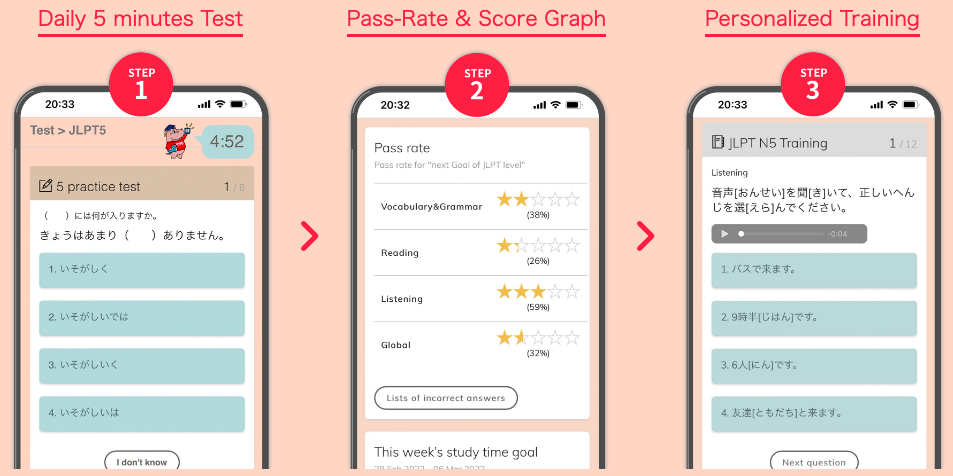
IPPO is an App that helps Japanese Learners to pass JLPT. If you can be a loyal user of IPPO, you will see a drastic difference.
2026.01.29
\Share IPPO with friends/
Back to top
Copied title and URL