Table of Contents
ように (youni)
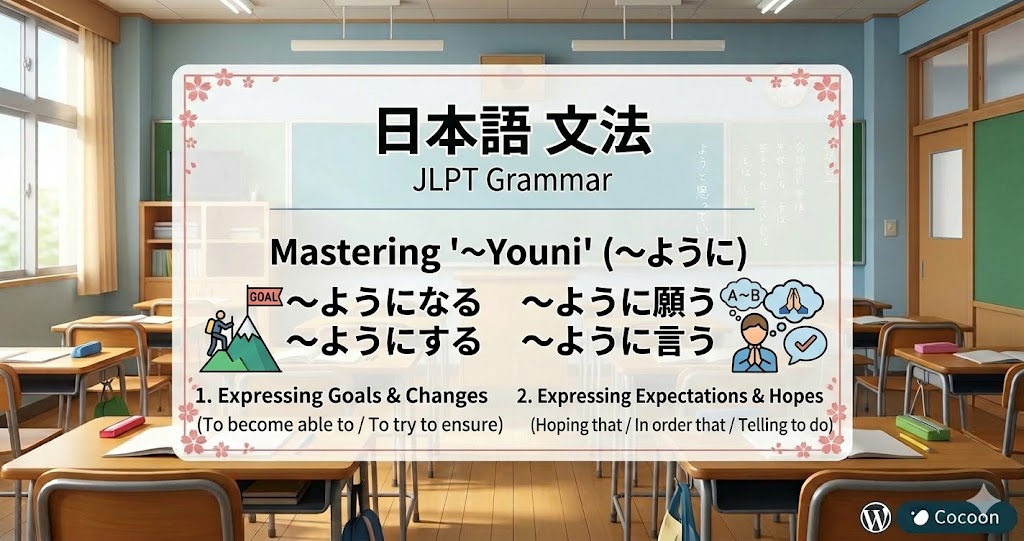
If you have been studying Japanese for a while, you have likely encountered the word ように (youni) in many different contexts. It is one of those versatile Japanese expressions that seems to pop up everywhere—sometimes it means “like” or “similar to,” other times it is used for requests, and sometimes it is used to describe a goal. If you are preparing for the JLPT (especially the N4 and N3 levels), understanding the “goal and expectation” usage of ように is absolutely essential.
We know how it feels. You are staring at your textbook, and you see two sentences that look almost identical. One uses ために (tameni) and the other uses ように (youni). Both are translated as “in order to” or “so that” in English. It is enough to make any learner want to close their book and take a long nap. But don’t worry! Once you understand the underlying logic of how Japanese speakers view “goals,” this grammar point will become one of your strongest tools in your language arsenal. In this guide, we are going to break down ように in a way that actually makes sense, helping you move past the “textbook confusion” and into real-world fluency.
Before diving into the grammar detail, here is the JLPT N4 complete guide:
The Ultimate JLPT N4 Complete Guide: Your Gateway to Working and Living in Japan
The Core Concept of ~Youni
At its heart, ように is used when you are aiming for a certain state or outcome. Think of it as setting a target. You are doing an action now so that a specific situation becomes possible later.
The biggest secret to mastering this grammar point is understanding the type of verbs that come before ように. Unlike other “purpose” grammar points, ように is almost always paired with verbs that are non-volitional. This means verbs that describe things you can’t directly control with a simple “yes/no” decision, such as “to be able to,” “to understand,” or “to not forget.”
The Basic Grammar Rule
The structure is quite simple, but the verb choice is where most students get tripped up. Here is the formula:
[Verb Dictionary Form / Verb Negative Form] + ように + [Main Action]
However, the “Dictionary Form” verb should usually be:
- Potential Verbs: (e.g., 買える – can buy, 話せる – can speak)
- Intransitive Verbs: (e.g., 治る – to heal, 届く – to reach)
- Negative Verbs: (e.g., 忘れない – to not forget, 遅れない – to not be late)
- State Verbs: (e.g., 分かる – to understand, ある – to exist/be)
Essentially, you are saying: “I do [Main Action] so that [Target State] happens.” Because the “Target State” is often a wish, a hope, or a potential ability, we use ように to bridge that gap.
Real-Life Examples of ~Youni in Action
To really get a feel for how this works, let’s look at how a Japanese person would use this in their daily life. Notice how the focus is on a “state” or an “ability” that the speaker wants to achieve.
Example 1: The Goal of Ability
日本語の新聞が読めるように、毎日漢字を練習しています。
(Nihongo no shinbun ga yomeru youni, mainichi kanji wo renshuu shite imasu.)
Translation: I practice kanji every day so that I will be able to read Japanese newspapers.
In this sentence, the goal is 読める (yomeru – to be able to read). This is a potential verb. The speaker cannot simply “decide” to be able to read a newspaper instantly; it is a state they are working toward. Therefore, ように is the perfect choice here. The daily practice is the action taken to reach that future state of “being able to read.”
Example 2: Avoiding a Negative Outcome
忘れないように、メモを取っておきます。
(Wasurenai youni, memo wo totte okimasu.)
Translation: I will take notes so that I don’t forget.
Here, we use the negative form 忘れない (wasurenai). Forgetting is something that happens involuntarily—nobody “decides” to forget their keys! Since “not forgetting” is a state you are aiming for, ように is used. This is a very common way to express precautions in Japanese.
Example 3: A Natural Process or Wish
風邪が早く治るように、温かいスープを飲んで寝ます。
(Kaze ga hayaku naoru youni, atatakai suupu wo nonde nemasu.)
Translation: I will drink warm soup and go to sleep so that my cold heals quickly.
The verb 治る (naoru – to heal) is an intransitive verb. You can’t force your body to heal by sheer willpower; it’s a natural process (a state). You are doing the action of drinking soup with the expectation or hope that your body reaches the state of being healthy again.
Understanding the Difference: ~Youni vs ~Tameni
This is the most frequent question Japanese teachers receive. Both ように (youni) and ために (tameni) can be translated as “in order to,” so how do you choose? The answer lies in control and willpower.
Tameni is for Volition (Direct Control)
When you use ために, the action before it is a deliberate choice. You use the dictionary form of a volitional verb (an action verb).
Example: 車を買うために、貯金しています。 (I am saving money in order to buy a car.)
You can decide to buy a car. It is a concrete action. There is no “ability” or “hope” involved in the verb “to buy” itself; it’s just the transaction.
Youni is for States (Indirect Aim)
When you use ように, you are looking at a target that isn’t a single, simple action. It’s a change in condition or ability.
Example: 車が買えるように、貯金しています。 (I am saving money so that I can buy a car.)
By using the potential form 買える (kaeru – can buy), you are emphasizing the ability to buy it. Perhaps the car is very expensive or rare. You are aiming for the state of “being able to afford it.”
Pro-Tip for the JLPT: If you see a potential verb (like rareru or eru), 99% of the time the answer will be ように, not ために.
Common Mistakes to Avoid
Even advanced learners sometimes slip up with ように. Here are the three most common pitfalls to watch out for so you don’t lose points on your exam or sound unnatural in conversation.
1. Using Volitional Verbs with Youni
One of the most common errors is saying something like 「日本に行くように、貯金します」. Because “go” (iku) is a volitional action you can control, this sounds very strange to a Japanese ear. You should use ために if you are just “going.” If you want to use ように, you must change it to a potential form: 日本に行けるように (so that I can go to Japan).
2. Forgetting the Negative Form (Nai-form)
When you want to say “so that [X] doesn’t happen,” you almost always use ように, never ために. ために is rarely used with negative verbs in this context. If you want to avoid a mistake, avoid a cold, or avoid being late, stick with 〜ないように.
3. Confusing Goals with Requests
Sometimes you will hear ように at the end of a sentence, like 「合格しますように!」 (I hope I pass!). This is a variation of the “expectation/hope” usage, often used in prayers or wishes. Don’t confuse this with the ように that connects two clauses. While they share the same DNA of “aiming for a state,” the grammar structure is slightly different when it stands alone at the end of a sentence.
Social Nuance: Why This Grammar Matters
In Japanese culture, there is a subtle emphasis on harmony and the natural flow of things. Using ように often sounds a bit softer and more focused on the result than ために, which can sound very direct and goal-oriented. By using ように, you are expressing a sense of “nurturing” a situation. You are creating the conditions for success to occur.
For instance, when a teacher says to a student, 「忘れないようにね」 (So you don’t forget, okay?), it sounds caring. It acknowledges that human memory is fickle. If they used a more forceful structure, it might sound like a stern command. Understanding this nuance will help you not just pass the JLPT, but also sound more like a compassionate and natural Japanese speaker.
Summary and Final Tips
Let’s wrap up what we have learned today about 〜ように for goals and expectations:
- The Purpose: Use it to describe an action taken to reach a specific state, ability, or to avoid an unwanted outcome.
- The Verbs: Pair it with potential verbs (can do), intransitive verbs (natural changes), or negative verbs (not doing).
- The Distinction: Remember that ように is for “states/abilities” (out of direct control), while ために is for “actions” (under direct control).
- The Negative: Always use 〜ないように when the goal is to prevent something from happening.
The best way to truly “own” this grammar is to start using it in your own life. Think about your Japanese studies. Why are you studying? Is it 話せるように (so you can speak)? Is it 合格できるように (so you can pass)? Or maybe it’s 忘れないように (so you don’t forget) what you’ve already learned?
Try writing three sentences about your own goals using ように in the comments or in your study journal today. The jump from N4 to N3 and beyond is all about mastering these nuances. You are doing a great job, and with consistent practice, these patterns will become second nature. Keep going, stay curious, and most importantly, enjoy the process of making the Japanese language your own!
Happy studying! がんばってください!
IPPO, JLPT training platform is always here to help you to pass the JLPT!!

We offer the Best Online Japanese Learning (All Free), and our goal is to facilitate the adoption into life in Japan. Our service “IPPO” is made by native Japanese teachers and professionals. The tips we share with you can help you to learn Japanese efficiently and pass JLPT (Japanese Language Proficiency Test).