Tired of Confusing Verb Forms? How 「〜ておく」 Simplifies Preparation
If you are currently studying for the JLPT N3 or N2, you know that mastering Japanese verbs is the key to success. You’ve successfully navigated the waters of the simple te-form, and perhaps you’ve even tackled the nuances of -ta form and passive voice. But then you encounter combinations like 「〜ておく」 (te oku), and suddenly, the simple act of doing something becomes complicated by layers of planning and intention. 「〜ておく」 means doing something in advance, as in 部屋を掃除しておきます (I will clean the room in preparation).
Do you often find yourself pausing mid-sentence, wondering how to express that you need to do something in advance? Have you struggled to explain to your Japanese friend that you already bought the tickets for the movie next week?
You are not alone. Many learners mistake 「〜ておく」 for simple future tense or confuse it with similar structures like 「〜てある」 (te aru) or 「〜てしまう」 (te shimau). However, mastering 「〜ておく」 is essential because it allows you to express one of the most fundamental concepts in human communication: preparation.
Before diving into the grammar detail, here is the JLPT N4 complete guide:
The Ultimate JLPT N4 Complete Guide: Your Gateway to Working and Living in Japan
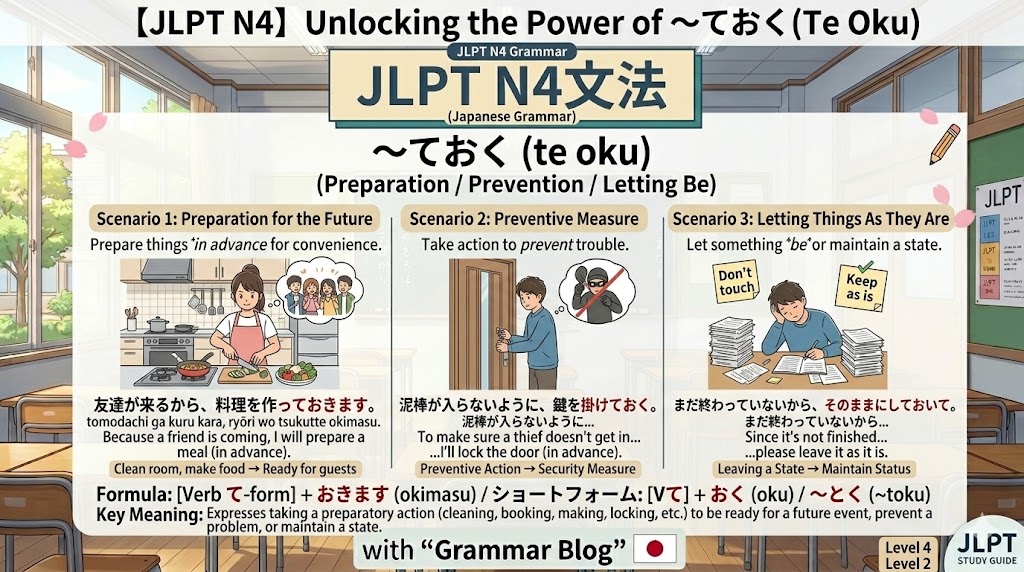
- 「〜ておく」 (te oku) means doing something now in preparation for a future event or purpose. 「〜ておく」 can also mean intentionally leaving a state as it is for the time being.
- To form 「〜ておく」, put the verb in the te-form and add おく: 書く → 書いておく, 予約する → 予約しておく. The request form 「〜ておいてください」 means “Please do this in advance.”
- In casual speech, 「〜ておく」 contracts to 「〜とく」 after て and 「〜どく」 after で: 買っとく, 読んどく.
- 「〜ておく」 focuses on someone acting on purpose for later, while 「〜てある」 describes the current state of readiness. 「〜てしまう」 looks back at completion or regret, while 「〜ておく」 looks forward.
- A common mistake is treating 「〜ておく」 as a simple future tense. 「入れました」 only states a past fact, while 「入れておきました」 tells the listener it was done as preparation.
What does 「〜ておく」 mean?
「〜ておく」 means that an action is done with future purpose or for temporary preservation. 「〜ておく」 combines the te-form of a verb with the verb おく (oku), which literally means “to put” or “to place.” When used as an auxiliary verb (following the te-form), 「おく」 transforms the meaning of the main verb in this way.
How do you form 「〜ておく」?
To form 「〜ておく」, change the verb to the te-form and add おく. The rule is the same regardless of the verb type (U-verbs or Ru-verbs):
- Verb (Dictionary Form) → Te-Form → Te-Form + おく
Examples of Connection:
| Dictionary Form | Te-Form | Te Oku Form | Meaning (Preparation) |
|---|---|---|---|
| 書く (kaku, to write) | 書いて (kaite) | 書いておく (kaite oku) | To write (in advance/for later use) |
| 食べる (taberu, to eat) | 食べて (tabete) | 食べておく (tabete oku) | To eat (now, before it’s too late) |
| 予約する (yoyaku suru, to reserve) | 予約して (yoyaku shite) | 予約しておく (yoyaku shite oku) | To reserve (in advance) |
What are the three meanings of 「〜ておく」?
「〜ておく」 has three main functions: preparation, temporary maintenance (leaving something as is), and completion to get something out of the way. The core essence of 「〜ておく」 is always intentional action.
1. Preparation (Jumbi – 準備) – The Most Common Use
This is the primary function. It indicates that an action is performed now, specifically in preparation for a future event or purpose. The speaker completes the action so that they or others can benefit from it later.
- Focus: Doing A now, so that B (a future event) can proceed smoothly.
- Example: 明日パーティーがあるから、部屋を掃除しておきます。(Ashita paatii ga aru kara, heya o souji shite okimasu.) Since there will be a party tomorrow, I will clean the room (in preparation).
2. Temporary Maintenance or Leaving As Is (Houchi – 放置)
This usage indicates that an action is performed, and the resulting state is intentionally maintained or left as is for the time being, often until a later action is necessary. It’s a deliberate decision to not change the current state.
- Focus: Leaving the result of the action (A) intact for a while.
- Example: この書類は後で使うので、机の上に置いておいてください。(Kono shorui wa ato de tsukau node, tsukue no ue ni oite oite kudasai.) Since I will use this document later, please leave it on the desk.
3. Completion and Return to Original State (Shouri – 処理) – Less Common
In certain contexts, particularly when the verb implies removing or consuming something, 「〜ておく」 can mean performing the action now to get it “out of the way,” often implying the restoration of the original state or making the space clear.
- Focus: Finishing A now, so it doesn’t cause trouble later.
- Example: ビールは全部飲んでおいた。(Biiru wa zenbu nonde oita.) I drank all the beer (so that the empty bottles wouldn’t be left around). This implies consuming everything to resolve the situation or clear the space.
How is 「〜ておく」 used in daily life?
People use 「〜ておく」 to talk about getting ready for a trip, leaving something on hold, and, in casual speech, in its contracted form 「〜とく」. Let’s examine scenarios where 「〜ておく」 is absolutely necessary for natural Japanese communication.
Example 1: The Preparatory Action for a Future Trip
Imagine you are planning a trip with friends. You need to ensure everything is ready before you leave. This is the perfect time for the preparation use of 「〜ておく」.
Scenario: You are leaving for a mountain hike tomorrow, and you need to make sure you have enough water and snacks.
Japanese Sentence:
水と食料をカバンに入れておきました。
Hiragana/Romaji:
みずと しょくりょうを カバンにいれておきました。(Mizu to shokuryou o kaban ni irete okimashita.)
English Translation:
I put the water and food into the bag (in advance/as preparation).
Deep Dive Analysis:
- Why not just 「入れました」 (Iremashita)? If you simply said 「水と食料をカバンに入れました」, it only states the past fact: “I put the water and food into the bag.” It doesn’t convey the reason—that you did it specifically for the upcoming trip. 「入れておきました」 clearly tells the listener that this action was a necessary preliminary step for the future plan.
- Grammatical Structure: 入れる (Ireru, Ru-verb) → 入れて (Irete) + おきました (Okimashita, Past Polite Form)
Example 2: Leaving Something Undone or On Hold
Sometimes 「〜ておく」 is used negatively (e.g., in a request) or to state that a state should remain unchanged until further notice. This highlights the “maintenance” aspect.
Scenario: You are using a laptop and need to leave the screen open because you will be returning to it shortly.
Japanese Sentence:
席を立つけど、パソコンはつけておくね。
Hiragana/Romaji:
せきを たつけど、パソコンはつけておくね。(Seki o tatsu kedo, pasokon wa tsukete oku ne.)
English Translation:
I’m leaving my seat, but I’ll leave the computer turned on (and won’t turn it off).
Deep Dive Analysis:
- Here, the action is 「つける」 (tsukeru, to turn on). By using 「つけておく」, the speaker is communicating the intent to keep the computer in the “turned on” state (maintenance) because they plan to use it again soon. It’s a deliberate decision to postpone the closing/turning-off action.
- Casual Form: Notice the casual form 「ておく」 (te oku) instead of the polite 「ておきます」 (te okimasu). This is extremely common in daily conversation, particularly with friends or family.
Example 3: The Swift, Casual Action (The 「〜とく」 Form)
In highly casual speech, especially among younger speakers or close friends, 「〜ておく」 often contracts into the sound change **「〜とく」 (toku)**. This contraction is mandatory to sound natural in relaxed settings and is crucial for JLPT listening comprehension.
Scenario: A colleague asks you if you’ve sent the urgent email yet.
Japanese Sentence (Formal):
はい、もう送っておきました。
(Hai, mou okutte okimashita.)
Japanese Sentence (Casual/Contracted):
うん、もう送っといたよ。
Hiragana/Romaji:
うん、もうおくっといたよ。(Un, mou okutoita yo.)
English Translation:
Yeah, I already sent it (in advance/as preparation for the meeting).
Deep Dive Analysis on Contraction:
- The Te-form ends in 「て」 or 「で」.
- Rule 1: て + おく → とく (e.g., 買って + おく → 買っとく)
- Rule 2: で + おく → どく (e.g., 読んで + おく → 読んどく)
- This contracted form (とく/どく) is often tested on the JLPT listening section because it represents genuine, natural speech.
What mistakes do learners make with 「〜ておく」?
The most common mistake with 「〜ておく」 is confusing it with two related forms: 「〜てある」 and 「〜てしまう」. When studying for the JLPT, the biggest challenge isn’t learning a new structure, but differentiating it from similar, yet distinct, structures.
What is the difference between 「〜ておく」 and 「〜てある」?
「〜ておく」 focuses on the person who did an action on purpose for later, while 「〜てある」 focuses on the current state of an object. Both structures involve the te-form and indicate a resulting state, but their focus is fundamentally different.
「〜ておく」 (Te Oku): Focus on the Action and Intention
- Meaning: Someone performed an action intentionally for future use or purpose.
- Key Agent: Always focuses on the person who did the action (the agent). The action is proactive.
- Example: 母がケーキを作っておいた。(Haha ga keeki o tsukutte oita.) My mother made the cake (in advance for the party). (Focus on the mother’s intentional preparation.)
「〜てある」 (Te Aru): Focus on the State and Arrangement
- Meaning: A state exists now because someone previously did something, and the result remains.
- Key Agent: Focuses purely on the state of the object. The agent is often omitted or implied, and the result seems passive or arranged. Requires transitive verbs.
- Example: ケーキが作ってある。(Keeki ga tsukutte aru.) The cake has been made/is ready. (Focus on the cake’s current state of readiness.)
In short: If you did it (or someone did it) on purpose for later, use 「ておく」. If you are just describing the current state of readiness, use 「てある」.
What is the difference between 「〜ておく」 and 「〜てしまう」?
「〜ておく」 looks forward to a future need, while 「〜てしまう」 (te shimau) emphasizes complete, often quick completion of an action, or regret. 「ておく」 can imply completion that clears the way for the future, but 「〜てしまう」 has a much stronger, different emphasis.
「〜てしまう」 (Te Shimau): Focus on Completion or Regret
- Meaning: Indicates either the complete, thorough, and often quick completion of an action, OR expresses regret or accidental occurrence.
- Focus: The action is finished, often swiftly, and sometimes causes consequences.
- Example (Completion): 宿題を全部やってしまった。(Shukudai o zenbu yatte shimatta.) I completely finished all my homework.
- Example (Regret): 友達の秘密を言ってしまった。(Tomodachi no himitsu o itte shimatta.) I accidentally let slip my friend’s secret.
Key Difference: 「ておく」 looks forward (preparation for the future); 「てしまう」 looks back (completion of the action or a resulting mishap).
- Compare:
- 本を読んでおいた。(Hon o yonde oita.) – I read the book (in preparation for the test). (Preparation)
- 本を読んでしまった。(Hon o yonde shimatta.) – I finished reading the book (all the way through). (Completion)
What does 「〜ておく」 mean with verbs like 食べる and 片付ける?
With verbs like 食べる (taberu), 飲む (nomu), and 片付ける (katazukeru, to tidy up), 「〜ておく」 often means consuming something or clearing the space so that the task is finished before the next event. This is a specific area where the nuance of 「ておく」 can be tricky.
- Example: 晩ご飯、全部食べておきなさい。(Ban gohan, zenbu tabete okinasai.) Eat all your dinner now (so that you can go out/so that it doesn’t get wasted). The implied purpose is preparation for the next activity or clearing the plate.
How does 「〜ておく」 conjugate?
「〜ておく」 conjugates through all standard Japanese tenses and politeness levels, just like the verb 「おく」 itself. Understanding these forms is vital for the JLPT.
Standard Conjugation of 「〜ておく」 (e.g., 食べる → 食べておく)
| Tense/Style | Polite Form (Masu) | Casual Form (Plain) | Contraction (Casual) |
|---|---|---|---|
| Non-Past/Future | 食べておきます | 食べておく | 食っとく |
| Past | 食べておきました | 食べておいた | 食っといた |
| Negative | 食べておきません | 食べておかない | 食っとがない (Less common) |
| Request/Command | 食べておいてください | 食べておいて/食べておけ | 食っといて |
Focus on the Command Form: The request form 「〜ておいてください」 (Te oite kudasai) is incredibly common, meaning “Please do this in advance.” The contraction 「〜といて」 (toite) is standard in rapid, casual speech.
- Example: 忘れ物がないように、メモを書いといて! (Wasuremono ga nai you ni, memo o kaitoite!) Write a memo (in advance) so you don’t forget anything!
Why is 「〜ておく」 more than just preparation?
「〜ておく」 is an aspectual marker emphasizing intentional purpose related to a future event. Japanese is a language heavily focused on aspect—how an action relates to time (duration, completion, state)—rather than just simple tense (past, present, future).
In English, we often rely on adverbs (“in advance,” “beforehand”) or subordinate clauses (“so that we can…”) to convey this meaning. Japanese streamlines this by combining the verb and the marker of preparation directly:
- English: I’ll prepare the dinner (so that it’s ready when you get home).
- Japanese (Te Oku): 晩御飯を作っておきます。
By using 「ておく」, you efficiently embed the preparatory function directly into the verb, making the sentence flow more naturally and concisely. This efficiency is why the JLPT tests your ability to deploy this structure correctly.
Summary: Your Checklist for Mastering 「〜ておく」
「〜ておく」 is a mandatory grammar point for achieving fluency and passing the intermediate levels of the JLPT. Here is what you need to remember:
- Structure: Always use the Te-Form of the main verb + おく (or its conjugated form).
- Core Meaning: The primary function is to indicate preparation for a future event or purpose.
- Secondary Meaning: It can also indicate maintaining a state or clearing the way by consuming/removing something.
- Casual Speech Alert: In casual settings, 「ておく」 contracts to 「とく」 (for te-forms) or 「どく」 (for de-forms). This is critical for listening comprehension.
- Distinctions: Do not confuse it with 「てある」 (which focuses on the current resulting state without emphasizing the agent’s preparation) or 「てしまう」 (which focuses on thorough completion or regret).
Start applying 「〜ておく」 immediately in your conversations. The next time you plan to buy groceries, clean your apartment, or review your flashcards for the JLPT, verbalize that action using 「〜ておく」. This active practice will solidify the grammar point far better than rote memorization.
Good luck with your studies, and remember to always 勉強しておいてください (Benkyou shite oite kudasai – Please study in advance!) for your next exam!
IPPO, JLPT training platform is always here to help you to pass the JLPT!!

We offer the Best Online Japanese Learning (All Free), and our goal is to facilitate the adoption into life in Japan. Our service “IPPO” is made by native Japanese teachers and professionals. The tips we share with you can help you to learn Japanese efficiently and pass JLPT (Japanese Language Proficiency Test).