〜しか〜ない
Preparing for the Japanese Language Proficiency Test (JLPT) is a demanding journey. You are constantly bombarded with new vocabulary, complex kanji, and—perhaps most frustratingly—grammar patterns that seem to overlap and contradict each other. Among these tricky patterns, few cause as much confusion as the subtle differences between expressions of limitation, such as 〜だけ (dake) and 〜しか〜ない (shika…nai).
If you’ve ever felt that slight pang of uncertainty when deciding whether to use one over the other, or if you struggle to grasp the inherent negativity baked into the “shika” structure, you are absolutely not alone. This grammar point is a crucial stepping stone, particularly for those aiming for the N3 and N2 levels, as it moves beyond simple statements of fact and delves into expressing feeling and nuance.
This comprehensive guide is designed to dissect “〜しか〜ない.” We will clarify its essential function, compare it directly to its closest counterpart, and provide you with detailed examples so you can use it naturally, confidently, and correctly, guaranteeing those crucial points on exam day.
Before diving into the grammar detail, here is the JLPT N4 complete guide:
The Ultimate JLPT N4 Complete Guide: Your Gateway to Working and Living in Japan
The Heart of Limitation: Understanding the Core Function of “〜しか〜ない”
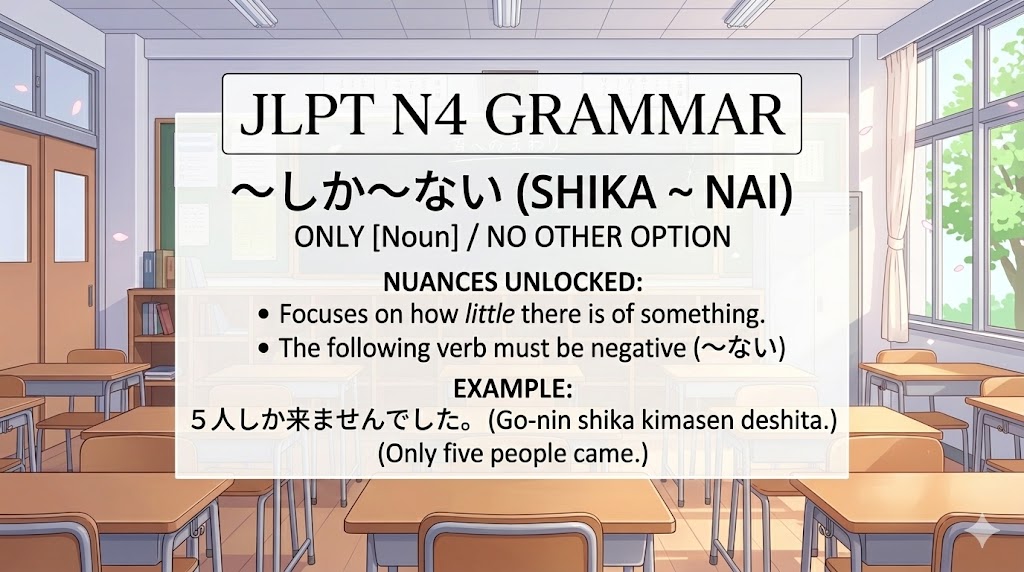
At its core, 〜しか〜ない is a structure used to express limitation, restriction, or exclusivity. However, unlike simply stating a fact (like “I only have one apple”), this pattern carries a significant emotional weight: a tone of dissatisfaction, regret, scarcity, or inadequacy.
Think of it this way: when you use shika, you are not just saying “only X,” you are implying, “It’s only X, and that’s not enough,” or “It’s only X, and I wish it were more or something different.”
The Essential Structural Rule
The grammatical mechanics of 〜しか〜ない are simple yet rigid. It requires two parts to function correctly:
- The particle 〜しか (shika) immediately follows the noun, quantity, verb form, or phrase being restricted.
- A corresponding negative verb or phrase (〜ない, 〜ません, 〜なかった, etc.) must conclude the sentence.
Structure: [Noun/Quantity/Phrase] + しか + [Negative Form (ない/ません/なかった)]
It is absolutely critical to remember this partnership: Shika can never be followed by a positive verb form. If you forget the negative ending, the sentence becomes grammatically incorrect and loses its intended meaning of limitation.
Deep Dive: The Crucial Difference Between “しか” and “だけ”
This is the biggest hurdle for most learners. Both shika and dake (だけ) mean “only” or “just.” So, how do we choose?
The distinction lies entirely in tone and context.
1. 〜だけ (Dake)
- Meaning: Simple exclusivity; “only,” “just.”
- Tone: Neutral or sometimes positive. It simply states a fact without emotional commentary.
- Grammar: Always followed by a positive or neutral ending.
- Example: 水だけ飲みます。(Mizu dake nomimasu.) – I will only drink water. (Neutral statement.)
2. 〜しか〜ない (Shika…nai)
- Meaning: Exclusive limitation; “only,” “nothing but,” implying a lack.
- Tone: Negative, disappointed, insufficient, or emphasizing the severity of the restriction.
- Grammar: Always followed by a negative ending.
- Example: 水しか飲みません。(Mizu shika nomimasen.) – I will only drink water. (Implies: I wish I could drink juice or alcohol, but I can’t/don’t have anything else. This suggests a restriction or regret.)
The Core Takeaway: If you are happy or neutral about the limited amount, use dake. If you are expressing disappointment, scarcity, or regret about the limitation, you must use shika…nai.
The Historical and Logical Explanation
For those who prefer a deeper logical understanding, consider the literal meaning of the negative ending in the shika structure. When you say, “I only have 500 yen,” using shika…nai:
五百円しかありません。 (Gohyakuen shika arimasen.)
The sentence logically translates to: “If it’s anything *other* than 500 yen, I don’t have it.” It focuses on denying everything outside the specified amount, thereby emphasizing the severe restriction of the stated amount.
Real-Life Applications: Essential Examples for Daily Conversation and JLPT Success
To truly master this pattern, you need to see it in action across various contexts, from expressing financial woes to discussing limitations in ability.
Example 1: Expressing Scarcity (Money and Time)
One of the most common uses of shika…nai is to lament a lack of resources, particularly money or time. This perfectly captures the feeling of disappointment.
Japanese:
「すみません、このカフェでは現金しか使えません。」
Romaji: Sumimasen, kono kafe de wa genkin shika tsukaemasen.
English Translation: “Excuse me, at this cafe, you can only use cash (and nothing else).”
Analysis: The speaker (the clerk) is stating a rule, but the structure implicitly suggests that this policy (the limitation to cash) is somewhat inconvenient or restrictive to the customer, hence the use of shika.
Japanese:
「来週のJLPTに向けて、勉強する時間が3時間しかない。」
Romaji: Raishū no JLPT ni mukete, benkyō suru jikan ga san-jikan shika nai.
English Translation: “Regarding next week’s JLPT, I only have three hours of study time (which is not enough/I wish I had more).”
Analysis: Here, the quantity (3時間) is restricted by shika, and the resulting negative feeling (not enough time to prepare adequately) is clearly conveyed. If the speaker were happy with three hours, they would use dake (3時間だけある).
Example 2: Restricting Ability or Action (Verb Form)
When you want to express that you are only capable of performing one specific action, or that only one course of action is possible, shika…nai is the appropriate structure. This often occurs with potential forms (〜できる) or when describing limitations in scope.
Japanese:
「私の日本語能力では、簡単な挨拶しかできません。」
Romaji: Watashi no Nihongo nōryoku de wa, kantan na aisatsu shika dekimasen.
English Translation: “With my Japanese ability, I can only manage simple greetings (and no complex conversations).”
Analysis: The speaker is expressing humility or inadequacy regarding their skill level. They are restricted to simple greetings; their ability does not extend beyond that. This restriction necessitates the use of shika…nai.
Japanese (Action Limitation):
「電車の運行がストップしたから、今日は家に帰って待つしかないよ。」
Romaji: Densha no unkō ga sutoppu shita kara, kyō wa ie ni kaette matsu shika nai yo.
English Translation: “Because the train service stopped, today we only have the option of going home and waiting.”
Analysis: This usage highlights the lack of alternative actions. The speaker is saying: “There is nothing to do except wait.” This phrase, 〜するしかない (suru shika nai, “have no choice but to do X”), is extremely common in daily life and crucial for JLPT N3/N2.
Example 3: Exclusivity (People and Objects)
While dake can also describe exclusivity, using shika…nai in this context often elevates the feeling to devotion or a sense of unique, irreplaceable importance—though still filtered through the lens of restriction (i.e., “My world is restricted to this one thing/person”).
Japanese:
「彼女は、家族の健康しか考えていないようだ。」
Romaji: Kanojo wa, kazoku no kenkō shika kangaeteinai yō da.
English Translation: “It seems she only thinks about her family’s health (and nothing else concerns her).”
Analysis: This suggests a limiting preoccupation. Her thoughts are restricted entirely to one subject, implying that she might be neglecting other important things or activities because of this singular focus.
Japanese (Deeply Emotional Restriction):
「私はあなたしか見えない。」
Romaji: Watashi wa anata shika mienai.
English Translation: “I only see you / My eyes are only for you.”
Analysis: This is a highly emotive phrase, typically used in romance. It restricts the speaker’s vision/attention to just one person, emphasizing the singularity and depth of their feeling. The limitation here is positive for the relationship but still grammatically defined by restriction.
Advanced Usage and Common Pitfalls to Avoid
As you progress toward N2, you will encounter shika…nai combined with different grammatical structures and honorifics. Understanding how to handle these variations is essential.
Pitfall 1: Forgetting the Negation
This is the number one mistake JLPT candidates make. You cannot use shika with an affirmative verb.
❌ INCORRECT: 私はビールしか飲みます。(I only drink beer.)
✅ CORRECT: 私はビールしか飲みません。(I only drink beer.)
✅ CORRECT (Alternative Nuance): 私はビールだけ飲みます。(I only drink beer.)
Remember: If you use shika, the negative ending is non-negotiable. If you want a positive ending, you must switch to dake.
Pitfall 2: Using “Shika” in Positive Contexts
Because shika…nai inherently carries a connotation of insufficiency or limitation, avoid using it when the small amount is actually a positive thing or perfectly adequate.
Imagine you run a race, and you came in second place. This is a great achievement. If you say:
❌ AWKWARD: 私は二位しか取れなかった。(I only got second place.)
This implies dissatisfaction with second place, suggesting you feel it was inadequate. If you want to state the fact neutrally, use dake:
✅ BETTER/NEUTRAL: 私は二位だけ取れた。(I got second place.)
However, if you came in 50th place and were deeply disappointed, then shika…nai is perfect:
✅ APPROPRIATE: 私は50位しか取れなかった。(I only got 50th place [which is terrible]).
Pitfall 3: Combining with Politeness Levels
The grammatical rule requiring a negative ending holds true across all levels of formality and politeness.
- Plain Form: これしかない (Kore shika nai)
- Polite Form (ます-form): これしかありません (Kore shika arimasen)
- Past Plain Form: これしかなかった (Kore shika nakatta)
- Past Polite Form: これしかありませんでした (Kore shika arimasen deshita)
Mastering the conjugation of the negative ending (especially the difference between nai, masen, nakatta, and arimasen deshita) is essential for using shika correctly in varied contexts.
Advanced Nuance: Using the Potential Form with Shika
When shika is used with the potential form (e.g., できる/can do), it strongly emphasizes the speaker’s limitations. This combination is very common in official or business settings where one must clearly state the scope of their capabilities or services.
Example: Customer Service
「お客様、ここではメールでの対応しかできかねます。」
Romaji: Okyakusama, koko de wa mēru de no taiō shika dekikanemasu.
English Translation: “Sir/Ma’am, we can only handle inquiries via email here (we are unable to offer phone support, etc.).”
(Note: Dekikanemasu is a very polite negative potential form, emphasizing the restriction of service.)
Exploring Related Structures: Shika and Other Particles
The particle shika often replaces other common particles like が (ga) and を (o) when used in this structure, much like dake does. However, it usually follows particles that indicate method or scope, such as で (de), に (ni), and から (kara).
1. Replacing が/を:
- お金しかない。 (Okane shika nai. – I only have money.) (Shika replaces ga)
- パンしか食べない。 (Pan shika tabenai. – I only eat bread.) (Shika replaces o)
2. Following other particles (less common, but important):
- 彼にしか話せない秘密だ。 (Kare ni shika hanasenai himitsu da. – It’s a secret I can only tell him.) (Shika follows ni)
This flexibility demonstrates that shika operates as a strong limiting filter that modifies the entire sentence’s scope, pushing the sentence toward a negative conclusion.
Why “〜しか〜ない” is Critical for JLPT Success
In the JLPT grammar sections, particularly N3 and N2, test designers frequently use shika…nai to test two key concepts:
- Grammatical Pairing: Can the student correctly identify that shika must be paired with a negative ending?
- Nuance Recognition: Can the student choose shika…nai over dake in a context where disappointment, insufficiency, or strong restriction is implied?
For example, you might encounter a listening comprehension question where the speaker uses a disappointed tone. If they are talking about money, and they use dake, the tone contradicts the grammar. If they use shika…nai, the tone and grammar align perfectly, revealing the speaker’s true feeling of dissatisfaction.
Conclusion: Integrating “〜しか〜ない” into Your Japanese
The grammar pattern 〜しか〜ない is far more than just a synonym for 〜だけ. It is a powerful tool for injecting emotion, regret, and a sense of limitation into your Japanese sentences. It tells the listener that the limited quantity or restriction being discussed is either insufficient or undesirable.
Key Takeaways to Remember:
- Inseparable Pair: しか must always be followed by a negative verb form (ない, ません, etc.).
- Tone is Negative: Use shika…nai when you want to express that the limitation is disappointing, small, or insufficient.
- Choose Wisely: If the limitation is neutral or positive, use だけ with a positive ending.
- Common Use: Be prepared to see this structure often in phrases expressing inability or having no alternative (e.g., 〜するしかない).
By understanding and correctly applying the intrinsic negativity of shika…nai, you move beyond simple textbook Japanese and begin speaking with genuine nuance—a necessary skill for acing the JLPT and communicating effectively in real-life Japan. Keep practicing these examples, pay close attention to the emotional context of the sentences you read, and that tricky grammar point will soon become second nature!
IPPO, JLPT training platform is always here to help you to pass the JLPT!!

We offer the Best Online Japanese Learning (All Free), and our goal is to facilitate the adoption into life in Japan. Our service “IPPO” is made by native Japanese teachers and professionals. The tips we share with you can help you to learn Japanese efficiently and pass JLPT (Japanese Language Proficiency Test).