~ても (~temo)
If you have been studying for the JLPT (whether it’s N5, N4, or even higher), you’ve probably hit that wall where you want to say something more complex than a simple “A happens, then B happens.” You want to express persistence. You want to talk about doing something even if the circumstances are difficult. You want to say, “Even if it rains, I’m going for a run,” or “Even if I study all night, I can’t remember these Kanji.”
In Japanese, that bridge is built using the grammar point ~ても (~temo). It is one of those foundational structures that, once mastered, suddenly unlocks a much more natural and expressive way of speaking. But I know what you’re thinking: “Wait, is it the same for verbs and adjectives? What about nouns? Why does it sound different sometimes?”
Don’t worry. We’ve all been there, scratching our heads over the nuances of the te-form. In this guide, we’re going to break down everything you need to know about ~ても so you can use it confidently in your next conversation and ace those JLPT questions.
Before diving into the grammar detail, here is the JLPT N4 complete guide:
The Ultimate JLPT N4 Complete Guide: Your Gateway to Working and Living in Japan
The Basic Rules of Formation
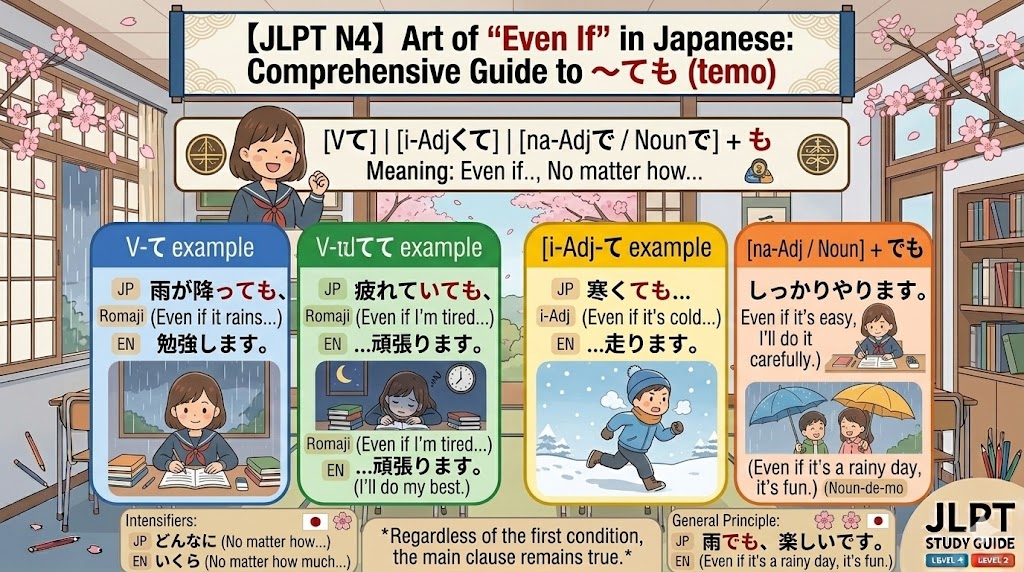
The core of this grammar point is the Te-form. If you are comfortable with the Te-form, you are 90% of the way there. The simple rule is: Te-form + も (mo). However, the conjugation changes slightly depending on whether you are using a verb, an adjective, or a noun. Let’s look at the breakdown.
Verbs
For verbs, you simply take the Te-form and add も. The meaning is “Even if [verb]…” or “Even though [verb]…”
- Group 1 (U-Verbs): 会う (au) → 会って (atte) → 会っても (attemo) – Even if I meet…
- Group 2 (Ru-Verbs): 食べる (taberu) → 食べて (tabete) → 食べても (tabetemo) – Even if I eat…
- Group 3 (Irregular): する (suru) → して (shite) → しても (shitemo) / 来る (kuru) → 来て (kite) → 来ても (kitemo)
I-Adjectives
For I-adjectives, you remove the final 〜い (~i) and add 〜くても (~kutemo).
- 高い (takai) → 高くても (takakutemo) – Even if it’s expensive…
- 忙しい (isogashii) → 忙しくても (isogashikutemo) – Even if I’m busy…
- いい (ii/yoi) → よくても (yokutemo) – Even if it’s good (Remember, ii always changes to yo for conjugations!)
Na-Adjectives and Nouns
For Na-adjectives and Nouns, the rule is the same. You add 〜でも (~demo). Yes, the te becomes a de here!
- Na-Adjective: 暇 (hima) → 暇でも (hima demo) – Even if I’m free…
- Noun: 雨 (ame) → 雨でも (ame demo) – Even if it’s rain/raining…
Pro Tip: When using the negative form (“Even if I don’t…”), you use the nai-form, change it to nakute, and add mo. For example: 行かない (ikanai) → 行かなくても (ikanakutemo) – Even if I don’t go.
Real-Life Examples of ~ても in Action
Rules are great, but seeing how these phrases live in the real world is how you truly learn. Here are three common scenarios where you will encounter and use this grammar.
Scenario 1: Persistence Despite Obstacles
Imagine you are talking to a friend about your dedication to your hobbies or work. You want to show that nothing will stop you.
Japanese: どんなに忙しくても、毎日日本語を勉強します。
Romaji: Donna ni isogashikutemo, mainichi nihongo o benkyou shimasu.
English: No matter how busy I am, I study Japanese every day.
In this sentence, the addition of “donna ni” (no matter how) often pairs with ~temo to add emphasis. It shows a strong will or a guaranteed outcome regardless of the condition.
Scenario 2: Unexpected Outcomes
Sometimes you do everything right, but the result isn’t what you expected. This is a very common way to use this grammar in daily life.
Japanese: 薬を飲んでも、頭痛が治りません。
Romaji: Kusuri o nondemo, zutsuu ga naorimasen.
English: Even though I took medicine, my headache won’t go away.
Here, the ~temo (nondemo) acts as a contrast. Usually, if you take medicine, the pain stops. By using ~temo, you are highlighting the frustration that the expected result didn’t happen.
Scenario 3: Giving Permission or Flexibility
You’ll often hear this in shops or when talking with friends to offer options. It’s a very polite yet casual way to show flexibility.
Japanese: 支払いは、クレジットカードでもいいですか?
Romaji: Shiharai wa, kurejitto kaado demo ii desu ka?
English: Is it okay even if I use a credit card? (Can I pay by credit card?)
The phrase “~てもいいです” (~temo ii desu) is a subset of this grammar used specifically for asking or giving permission. Literally, it translates to “Even if [A], it is good.”
Common Mistakes and Pitfalls to Avoid
Even advanced learners sometimes trip over ~ても. Let’s look at the most frequent “traps” so you can avoid them.
Confusing ~ても with ~たら
This is the big one. ~たら (~tara) is used for “if/when” (conditional), whereas ~ても (~temo) is “even if” (concessive).
Compare these two:
1. 雨が降ったら、行きません。 (Ame ga futtara, ikimasen) – If it rains, I won’t go. (Rain = Stay home)
2. 雨が降っても、行きます。 (Ame ga futtemo, ikimasu) – Even if it rains, I will go. (Rain = Still going)
If you use ~tara when you mean ~temo, you might end up telling your friends the exact opposite of what you intended!
The “Ten-Ten” (Voiced Sound) Confusion
Remember that if a verb’s Te-form ends in ~de (like non-de, yon-de, asoon-de), the mo must follow that sound.
Wrong: 飲んでも (Wait, this one is correct!)
Common Mistake: People sometimes forget to apply the d-sound to adjectives or nouns.
Wrong: 雨ても (Ame-temo)
Right: 雨でも (Ame-demo)
Think of it this way: if the dictionary form or the base ends in a “soft” sound or is a noun, it often pulls that “de” sound in.
Using ~ても with Past Tense
This is a stylistic point that often confuses English speakers. In English, we say “Even if I went…” using the past tense. In Japanese, the ~temo part itself doesn’t change to a “past” form like ~tatta-mo. The tense of the entire sentence is determined at the very end of the sentence.
Right: 練習しても、勝てませんでした。(Renshuu shitemo, katemasen deshita) – Even though I practiced, I couldn’t win.
Notice that shitemo stays as it is, and deshita at the end tells us the whole story happened in the past.
Taking it Further: Advanced Nuances
Since you are aiming for the JLPT, let’s look at one more advanced way ~temo is used: The Question Word + ~temo construction. This is incredibly useful for sounding more fluent.
When you combine words like nani (what), doko (where), or itsu (when) with ~temo, you get meanings like “whatever,” “wherever,” and “whenever.”
- どこへ行っても (Doko e ittemo) – No matter where I go / Wherever I go.
- 何を食べても (Nani o tabetemo) – No matter what I eat / Whatever I eat.
- いつ会っても (Itsu attemo) – No matter when we meet / Whenever we meet.
This adds a poetic or emphatic quality to your Japanese. For example: “Wherever I go in Japan, the food is delicious” becomes “Nihon no doko e ittemo, ryouri ga oishii desu.”
Summary
The ~ても grammar point is your tool for expressing resilience, contrast, and permission. It breaks the “cause and effect” chain and allows you to talk about situations where the result happens regardless of the condition.
To recap:
- Verbs: Te-form + も
- I-Adjectives: ~くても
- Na-Adjectives/Nouns: ~でも
- Meaning: Even if / Even though / No matter how.
Mastering this will make your Japanese sound much more mature and less like a textbook. The next time you’re stuck in the rain or struggling with a difficult task, try using ~ても to describe your situation. Practice makes perfect, and even if it feels difficult now (muzukashikutemo!), keep going—you’re doing great!
Good luck with your JLPT studies, and see you in the next lesson!
IPPO, JLPT training platform is always here to help you to pass the JLPT!!

We offer the Best Online Japanese Learning (All Free), and our goal is to facilitate the adoption into life in Japan. Our service “IPPO” is made by native Japanese teachers and professionals. The tips we share with you can help you to learn Japanese efficiently and pass JLPT (Japanese Language Proficiency Test).