ところだ(Tokoro Da)
If you have been studying Japanese for a while, you’ve probably reached that frustrating plateau where you can say what you are doing, but you can’t quite capture the exact moment things are happening. You know how to say “I eat” (taberu) and “I ate” (tabeta), but what about that split second when you have the chopsticks in your hand and the food is an inch from your mouth? Or that moment you just swallowed the last bite and are still wiping your face?
Japanese is a language that obsesses over “stages” of action. This is where 〜ところだ (~tokoro da) comes in. 〜ところだ shows exactly which stage an action is at, such as 今、家を出るところだ (I’m just about to leave the house). It is one of those versatile grammar points that appears frequently in the JLPT N4 and N3 levels, and it’s a total game-changer for making your Japanese sound more natural, fluid, and precise. Instead of just stating facts, you start painting a picture of time.
Before diving into the grammar detail, here is the JLPT N4 complete guide:
The Ultimate JLPT N4 Complete Guide: Your Gateway to Working and Living in Japan
- 〜ところだ (~tokoro da) shows the exact stage of an action: about to start, in the middle of it, or just finished.
- The verb form before 〜ところだ sets the stage: dictionary form for “about to” (出るところだ), te-iru form for “right now” (書いているところだ), and ta-form for “just finished” (食べたところだ).
- 〜ところだ describes a single moment, not a long period. Adverbs make the stage clear: これから with the dictionary form, 今 with the te-iru form, and ちょうど or たった今 with the ta-form.
- 〜たところだ means the action literally just ended, while 〜たばかりだ means it feels recent even after time has passed: after three months in Japan, say 日本に来たばかり, not 日本に来たところ.
- In the middle of a sentence, ところ needs a particle such as に, を, or へ (寝ようとしたところに、電話が掛かってきた). Leaving bare ところ makes the sentence sound unfinished.
What does 〜ところだ mean?
〜ところだ (~tokoro da) shows the exact point an action has reached: about to start, in the middle, or just finished. The word ところ (tokoro) usually translates to “place” (as in basho), but in 〜ところだ, think of it as a “point in time.” Imagine time is a long horizontal line. Tokoro allows you to put a magnifying glass over one specific point on that line to show exactly where the action stands.
The beauty of this grammar is its simplicity in structure. It always follows a verb, and the tense of that verb determines which “point” you are magnifying. There are three primary patterns you must memorize:
The “About To” Phase: Dictionary Form + ところだ
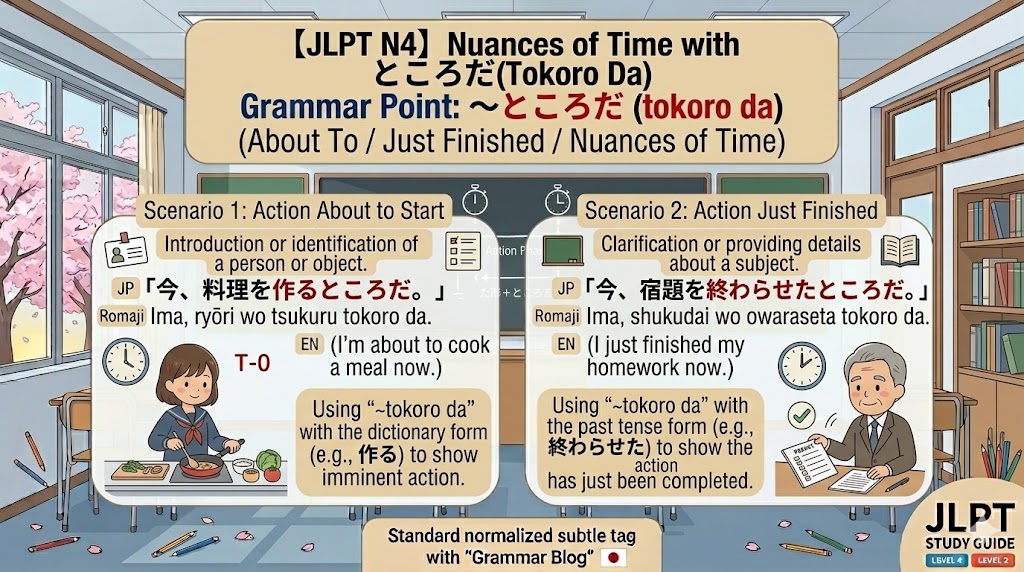
When you use the dictionary form (plain form) of a verb followed by tokoro da, it means you are just about to start something. You haven’t started yet, but the preparation is finished, and the action is imminent. It’s like standing on the edge of a diving board right before you jump.
The “Right Now” Phase: ている Form + ところだ
When you use the te-iru form, it emphasizes that you are in the thick of the action. While the standard ~te iru also means “currently doing,” adding tokoro da adds a sense of “I am busy doing this right this second.” It’s often used when someone interrupts you or asks what you are doing.
The “Just Finished” Phase: た Form + ところだ
Using the past tense (ta-form) plus tokoro da means the action ended just a moment ago. This isn’t just “I did it” (past tense); it’s “I literally just finished it three seconds ago.” The “freshness” of the action is the focus here.
How is 〜ところだ used in everyday conversation?
In everyday conversation, 〜ところだ tells the listener exactly where you are in an action, such as leaving the house, writing a report, or finishing a meal. Notice how the meaning shifts entirely based on the verb form used before tokoro.
Scenario: Getting Ready to Head Out
Imagine your friend calls you and asks, “Are you coming to the party?” You are literally putting on your shoes at the door. You would say:
今、家を出るところだ。
(Ima, ie o deru tokoro da.)
“I’m just about to leave the house.”
In this case, you haven’t stepped outside yet, but your hand is on the doorknob. If you just said “Ie o demasu,” it sounds like a general statement of intent. But “deru tokoro da” tells your friend they should expect you to start moving in the next ten seconds.
Scenario: Caught in the Middle of Work
Your boss walks by your desk and asks for a status update on a report. You are currently typing the sentences. You would say:
今、報告書を書いているところです。
(Ima, houkokusho o kaite iru tokoro desu.)
“I’m in the middle of writing the report right now.”
This conveys that you are actively engaged in the task. It sounds more immediate than just saying “Kaite imasu.” It suggests, “I’m right in the middle of it, so give me a moment.”
Scenario: Finishing a Meal
You just put your chopsticks down and said “Gochisousama.” Your phone rings, and a friend asks if you want to grab lunch. You reply:
ちょうど昼ご飯を食べたところなんです。
(Choudo hirugohan o tabeta tokoro nan desu.)
“I actually just finished eating lunch.”
By using the ta-form, you emphasize that you are still full. If you just said “Tabemashita,” it might mean you ate an hour ago or two hours ago. “Tabeta tokoro” makes it clear that the event is extremely recent.
Which adverbs go with 〜ところだ?
〜ところだ is often paired with adverbs that make the phase clear: これから with the dictionary form, 今 with the te-iru form, and たった今 or ちょうど with the ta-form. Using tokoro da isn’t just a grammatical choice; it’s a social one.
One of the most common ways to enhance this grammar is by adding adverbs that act as “flavor enhancers.” They help clarify which phase of tokoro you are using:
- これから (Kore kara): Often paired with the dictionary form. “From now, I’m about to…”
- 今 (Ima): Usually paired with the te-iru form. “Right now, I’m in the middle of…”
- たった今 (Tatta ima) / ちょうど (Choudo): Frequently used with the ta-form. “Just now / Exactly just finished…”
Think of these adverbs as the “set-up” and tokoro da as the “punchline.” Together, they create a crystal-clear image of the timing for your listener.
What do ところに, ところを, and ところへ mean?
ところに, ところを, and ところへ put tokoro in the middle of a sentence, and the core meaning of “a specific moment” remains the same. The particle simply tells us what happens at that moment: an interruption (ni), being seen or caught (wo), or someone arriving at the scene (e). Don’t panic!
Tokoro ni (When an external event happens)
Use ~tokoro ni when something external happens right at the moment you are doing something else. It often describes an interruption or a coincidence.
Example: 寝ようとしたところに、電話が掛かってきた。
(Neyou to shita tokoro ni, denwa ga kakatte kita.)
“Just as I was about to go to sleep, the phone rang.”
Tokoro wo (When you are seen or caught)
Use ~tokoro wo when someone witnesses or “catches” you in a certain state. It’s very common with verbs like “to see,” “to help,” or “to stop.”
Example: 犯人が逃げるところを、警察が捕まえた。
(Hannin ga nigeru tokoro wo, keisatsu ga tsukamaeta.)
“The police caught the criminal just as he was escaping.”
Tokoro e (Movement toward the scene)
This is similar to ni, but it emphasizes someone arriving at the scene where an action is happening.
Example: 困っているところへ、友達が来てくれた。
(Komatte iru tokoro e, tomodachi ga kite kureta.)
“Right when I was in trouble, my friend came along (to help).”
What mistakes do learners make with 〜ところだ?
Learners make three common mistakes with 〜ところだ: confusing ~ta tokoro with ~ta bakari, using tokoro for long-term states, and forgetting the particle when tokoro sits in the middle of a sentence. Let’s clear those up so you can use this grammar with confidence.
What is the difference between 〜たところだ and 〜たばかりだ?
~ta tokoro means an action literally just ended, while ~ta bakari means it feels like it just happened, even if a lot of time has passed. Both can be translated as “just did something,” so ~ta tokoro da is often confused with ~ta bakari, but they have a key difference in perspective.
~ta tokoro is about objective time. It means the action literally just ended. If you finished your coffee five seconds ago, that is ta tokoro. If you finished it an hour ago, you generally cannot use ta tokoro.
~ta bakari is about subjective time. It means “I feel like it just happened,” even if a lot of time has passed. For example, if you moved to Japan three months ago, you can say “Nihon ni kita bakari” (I just arrived in Japan), because in the context of a whole life, three months is a short time. You cannot say “Nihon ni kita tokoro” after three months—that would sound like you are standing in the airport right this second.
Can you use 〜ところだ for long-term states?
No. Tokoro is a “snapshot,” like a camera flash, so 〜ところだ cannot be used for things that take a long, indefinite amount of time or for habitual actions.
For example, you can’t say “I am studying Japanese (these days) tokoro da.” If you are a student, you are always “studying Japanese” in a general sense. You only use benkyou shite iru tokoro da if your books are open on the table and you are looking at a kanji at this exact second.
Do you need a particle after ところ in the middle of a sentence?
Yes. If you are ending the sentence, it’s always tokoro da or tokoro desu, but if you are connecting ところ to another verb, you must use a particle (ni, wo, e, de). Beginners often forget this and just leave it as tokoro, which makes the sentence sound unfinished and confusing.
Mastering the Feeling of Tokoro
To really master this, I want you to start thinking in “snapshots.” When you are going about your day, try to identify your “tokoro” moments.
Are you about to press the “order” button on Amazon? That’s chuumon suru tokoro.
Are you currently washing the dishes? That’s aratte iru tokoro.
Did you just turn off the shower? That’s abita tokoro.
By narrating your life in your head using these three phases, the grammar will move from your “textbook brain” into your “speaking brain.” This is the secret to passing the JLPT. The exam doesn’t just test your ability to pick the right answer; it tests your ability to recognize the context and timing of a situation.
Conclusion
The 〜ところだ grammar point is one of the most rewarding structures to learn because it immediately elevates your Japanese from “functional” to “expressive.” It allows you to communicate the urgency, the busyness, or the freshness of your actions to others.
Let’s recap the essentials:
- Dictionary Form + tokoro: On the verge of starting.
- Te-iru Form + tokoro: In the heat of the moment.
- Ta-form + tokoro: Just crossed the finish line.
Don’t worry if you mix them up at first—every Japanese learner does! The key is to keep listening for these patterns in anime, dramas, and daily conversations. You’ll be surprised how often Japanese people use it to soften a request or explain why they can’t talk right now.
Now, I have a question for you: What are you “tokoro” right now? Are you Nihongo o benkyou shite iru tokoro (in the middle of studying Japanese)? Or perhaps you are kiji o yomi-owatta tokoro (just finished reading this article)? Whatever it is, keep practicing, and your hard work will pay off when you sit for your JLPT exam. Good luck!
IPPO, JLPT training platform is always here to help you to pass the JLPT!!

We offer the Best Online Japanese Learning (All Free), and our goal is to facilitate the adoption into life in Japan. Our service “IPPO” is made by native Japanese teachers and professionals. The tips we share with you can help you to learn Japanese efficiently and pass JLPT (Japanese Language Proficiency Test).