~nara (〜なら)
If you have been studying Japanese for a while, you have probably hit that frustrating wall known as the “Conditionals.” In English, we mostly get away with using the word “if.” But in Japanese, we are suddenly faced with a four-headed monster: ~to, ~ba, ~tara, and ~nara.
I know exactly how you feel. You’re sitting in the JLPT exam, or perhaps you’re trying to have a conversation with a Japanese friend, and you freeze. You want to say “If you’re going to the convenience store, buy me a coffee,” but you start cycling through the grammar rules in your head. Is it ikuto? Iktara? Ikeba? Or ikunara?
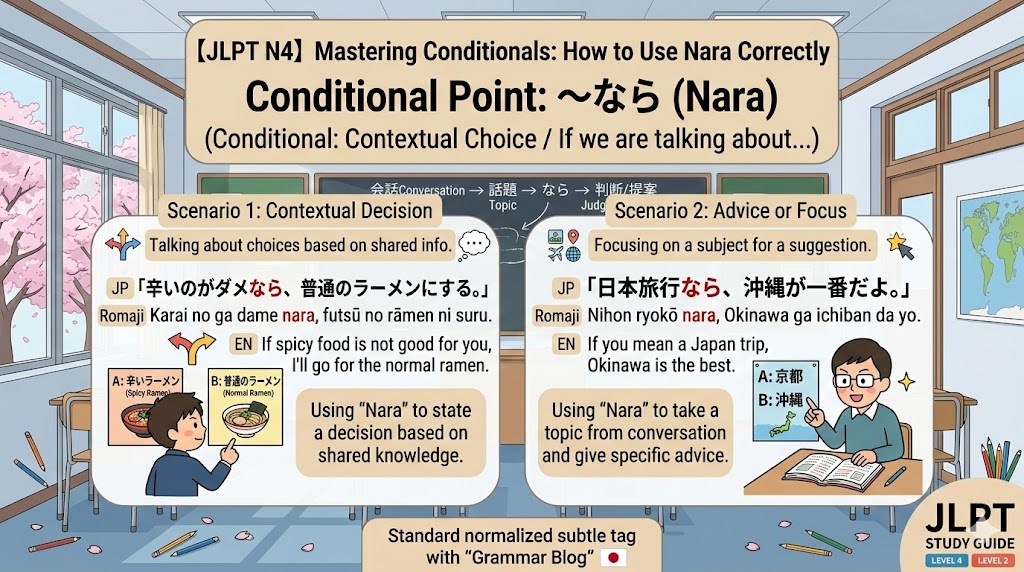
Today, we are going to demystify one of the most useful and unique members of this family: ~nara (〜なら). ~nara means “if that is the case” or “if we are talking about X,” and you use it to respond to a topic someone just raised: 寿司を食べるなら、築地が一番いいですよ (If you are going to eat sushi, Tsukiji is the best place).
Before diving into the grammar detail, here is the JLPT N4 complete guide:
The Ultimate JLPT N4 Complete Guide: Your Gateway to Working and Living in Japan
- ~nara (〜なら) means “if that is the case” or “if we are talking about X.” ~nara responds to a topic someone just mentioned or a situation that has just become apparent.
- ~nara attaches directly to nouns and na-adjectives (日本なら, 好きなら) and to the dictionary form of i-adjectives and verbs (暑いなら, 行くなら).
- ~nara is used for recommendations (寿司を食べるなら、築地が一番いいですよ), for advice based on new information, and for limits such as ひらがななら、書けます.
- Unlike ~tara, ~nara can describe an action that happens before the condition: 日本に行くなら、スーツケースを買ってください means buying the suitcase before the trip.
- Do not use ~nara for natural consequences or machine operations such as “If you press this button, the water comes out”; use ~to instead.
What does ~nara (〜なら) mean?
~nara means “if that is the case” and is used when you pick up on a topic that someone else mentioned, or a situation that has just become apparent. If I had to give ~nara a nickname, I would call it “The Context Conditional.”
Unlike other conditionals that focus on cause-and-effect (like “If I drop this glass, it will break”), ~nara is used when you are picking up on a topic that someone else mentioned, or a situation that has just become apparent. It’s like saying, “If that’s the situation we are talking about, then…” or “Based on that information, here is my suggestion.”
How do you form ~nara?
~nara is incredibly easy to form: add nara directly to nouns and na-adjectives, and to the dictionary form of i-adjectives and verbs. Unlike the ~ba form or the ~tara form, ~nara doesn’t require much “mangling” of the words.
1. Nouns
This is the most common usage. Just add nara directly to the noun.
Example: Nihon (Japan) → Nihon nara
2. Na-Adjectives
Just like nouns, you add nara directly. You do not need to keep the “na.”
Example: Suki (Like) → Suki nara
3. I-Adjectives
Add nara to the dictionary form (the one ending in ~i).
Example: Atsui (Hot) → Atsui nara
4. Verbs
Add nara to the dictionary form. (Sometimes you will see no nara or n nara, which adds a bit of explanatory emphasis, but for the JLPT N4/N3 level, focusing on the dictionary form is your best bet).
Example: Iku (Go) → Iku nara
When should you use ~nara in daily life?
~nara is the natural choice when you give a recommendation, offer a solution based on what someone just told you, or set a limit on what you can do. Let’s look at three situations where ~nara is the perfect choice over any other conditional.
Giving a Recommendation
Imagine your friend says, “I really want to eat some great sushi while I’m in Tokyo.” You have a specific place in mind. Since you are responding to the topic they introduced (sushi), you use nara.
Japanese: 寿司を食べるなら、築地が一番いいですよ。
Reading: Sushi o taberu nara, Tsukiji ga ichiban ii desu yo.
English: If (you are talking about) eating sushi, Tsukiji is the best place.
In this case, the friend hasn’t eaten yet. You are saying, “In the event that you want to eat sushi, here is my advice.”
Providing a Solution Based on a Condition
Imagine your coworker looks pale and says, “I have a terrible headache.” You respond based on that new information.
Japanese: 頭が痛いなら、今日は早く帰ったほうがいいですよ。
Reading: Atama ga itai nara, kyou wa hayaku kaetta hou ga ii desu yo.
English: If your head hurts (if that’s the case), it’s better to go home early today.
Notice how nara connects the situation (headache) to the advice (go home). You aren’t saying the headache caused them to go home yet; you are offering a suggestion based on the context.
The “Limitation” Usage
Sometimes we use nara to say “If it’s only X, then okay/yes.” For example, someone asks if you can speak Japanese. You might be humble and say you can only speak a little.
Japanese: ひらがななら、書けます。
Reading: Hiragana nara, kakemasu.
English: If it’s (just) Hiragana, I can write it.
Here, you are setting a boundary. “Don’t ask me for Kanji, but if we are talking about Hiragana, I can do that.” This is a very common way to use nara in daily Japanese life to clarify what you are capable of or what you are willing to do.
Can ~nara describe something that happens before the condition?
Yes. ~nara can work backward in time: the action in Part B can happen before the condition in Part A, which is why we can’t always replace ~tara with ~nara. This is where most students get tripped up, because in English we usually think of “if” as a sequence: First Part A happens, then Part B happens.
“If it rains (Part A), I will stay home (Part B).”
Consider this sentence: “If you are going to go to Japan, buy a suitcase.”
In this case, you buy the suitcase before you go to Japan. In Japanese, when Part B (buying the suitcase) happens before Part A (the trip), you must use nara.
Correct: 日本に行くなら、スーツケースを買ってください。
Wrong: 日本に行ったら、スーツケースを買ってください。 (This would mean “Buy a suitcase after you arrive in Japan,” which might be too late!)
If you remember this “Time Machine” rule—that nara is for things you do in preparation for or based on the idea of the condition—you will avoid the most common mistake on the JLPT.
What mistakes do learners make with ~nara?
Learners often use ~nara for natural consequences, mix up ~nara and ~tara, and think of ~nara only as “if.” Let’s look at each of these areas.
Can you use ~nara for natural consequences?
No. For natural laws or mechanical operations, such as “If you press this button, the water comes out,” use ~to instead of ~nara. Using ~nara there would sound like you are giving the machine advice, which is quite strange!
What is the difference between ~nara and ~tara?
~tara means “After this happens…” and ~nara means “On the topic of…”
If you say “If it becomes 5:00 PM, let’s leave,” you should use tara (5-ji ni nattara) because the time actually has to pass first. If you use nara, it sounds like you are discussing the abstract concept of 5:00 PM, which doesn’t fit the situation of waiting for a specific time.
Does ~nara always mean “if”?
Not always. ~nara is sometimes translated as “since” or “as long as,” and it is much more about selection and context than a simple gamble on whether something will happen. When a Japanese person says “Ashita nara aiteimasu” (If it’s tomorrow, I’m free), they are effectively saying, “Tomorrow is the specific condition under which I am available.”
Final Thoughts and Study Tip
Mastering ~nara is a huge step toward sounding more natural in Japanese. It moves you away from the “robotic” cause-and-effect sentences and allows you to react to what people are saying in real-time. It shows that you are listening and responding to the specific context of the conversation.
Your homework: The next time you are in a Japanese restaurant or talking to a language partner, try to use the “Limitation” usage. If they ask, “Can you eat spicy food?” instead of just saying “Yes,” try saying: “Sukoshi nara daijoubu desu” (If it’s a little bit, it’s okay). It’s a small change, but it makes you sound incredibly fluent!
Keep practicing, keep making mistakes, and don’t let the conditionals scare you. You’ve got this!
Summary of Nara Rules
- Nouns/Na-Adjectives: Just add nara.
- Verbs/I-Adjectives: Add nara to the dictionary form.
- The “Vibe”: Use it to respond to a topic or give advice based on context.
- The Secret: Use it when the result (Part B) needs to happen before the condition (Part A).
Good luck with your JLPT studies!
IPPO, JLPT training platform is always here to help you to pass the JLPT!!

We offer the Best Online Japanese Learning (All Free), and our goal is to facilitate the adoption into life in Japan. Our service “IPPO” is made by native Japanese teachers and professionals. The tips we share with you can help you to learn Japanese efficiently and pass JLPT (Japanese Language Proficiency Test).