“node” (ので)
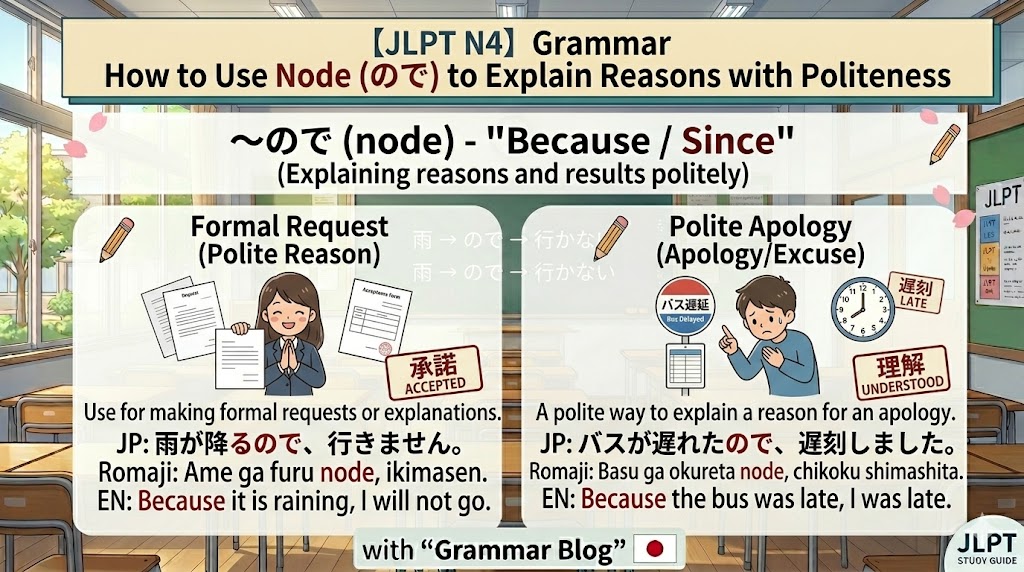
If you have been studying Japanese for even a few months, you’ve likely encountered the word “kara” (から) to express “because.” It’s the first tool we get in our linguistic toolbox to explain why we are late, why we like sushi, or why we can’t come to a party. But as you progress toward the JLPT N4 and N3 levels, you start noticing another word popping up everywhere: “node” (ので). Node also means “because” or “since,” but it gives the reason as an objective fact: 電車が遅れたので、少し遅れます (Because the train was delayed, I will be a little late).
You might find yourself wondering, “If I already know kara, why do I need node?” or “Every time I try to use it, I get confused about whether to add a na or not.” Trust me, you are not alone. Transitioning from the directness of kara to the nuanced, softer world of node is one of the biggest milestones in sounding more like a native speaker and less like a textbook.
Before diving into the grammar detail, here is the JLPT N4 complete guide:
The Ultimate JLPT N4 Complete Guide: Your Gateway to Working and Living in Japan
- Node (ので) means “because” or “since,” and node presents the reason as an objective fact: 電車が遅れたので、少し遅れます (Because the train was delayed, I will be a little late).
- To form node, attach ので to the plain form of verbs and i-adjectives (忙しいので). Nouns and na-adjectives need な in the present tense (風邪なので, 好きなので).
- Node sounds soft, polite, and logical, so node is the safer choice at work, in shops, and with people you are not close to, especially before a request.
- Node and kara both mean “because,” but kara is subjective and focuses on the speaker’s thoughts and feelings, while node is objective and focuses on the situation.
- The most common mistake with node is dropping な: 雨ので is wrong, so say 雨なので. Node also does not pair well with strong commands, where kara sounds natural (危ないから、見ろ!).
What does node (ので) mean?
“node” (ので) connects a reason to a result, and in English we translate node as “because,” “since,” or “so.” However, unlike its cousin kara, node places the emphasis on the objective circumstances. It feels more like you are explaining a cause-and-effect relationship that anyone could see, rather than just stating your personal opinion.
To form node, use the plain form of verbs and i-adjectives, and add na after na-adjectives and nouns in the present tense. Japanese grammar is all about the “connectors,” and node has some specific rules depending on what comes before it.
1. Verbs
For verbs, you simply use the dictionary form (plain form). This applies to present, past, affirmative, and negative forms.
- Taberu (eat) + node = Taberu node
- Itta (went) + node = Itta node
- Shinai (don’t do) + node = Shinai node
2. I-Adjectives
Similar to verbs, just attach node to the dictionary form.
- Samui (cold) + node = Samui node
- Oishikatta (was delicious) + node = Oishikatta node
3. Na-Adjectives and Nouns
This is where most learners make a mistake! If you are using a Na-adjective or a Noun in the present tense, you must add “na” before node. Think of it as the glue that holds the sentence together.
- Suki (like/Na-adj) + node = Suki na node
- Ame (rain/Noun) + node = Ame na node
- Byouki (illness/Noun) + node = Byouki na node
Pro Tip: If you are speaking in a very formal setting, you can also use the polite form (Desu/Masu) before node (e.g., Ame desu node), but in 90% of JLPT contexts and daily conversations, the plain form + node (or na node) is the standard.
When do you use node in real life?
You use node in work environments, shops, and when talking to people you aren’t extremely close with, for example when apologizing for being late or asking for a favor. Node provides a “cushion” to your sentences, making your reasons sound more logical and less like an excuse.
Scenario 1: Apologizing for being late
Imagine the train was delayed—a classic Japanese dilemma. You want to explain that it wasn’t your fault; it was an external factor.
Japanese: 電車が遅れたので、少し遅れます。
Reading: Densha ga okureta node, sukoshi okuremasu.
English: Because the train was delayed, I will be a little late.
By using node here, you are pointing to the reality of the train delay. It sounds much more professional than using kara, which can sometimes sound like you are being defensive.
Scenario 2: Asking for a favor at a restaurant
You’re at a cafe and it’s a bit too bright or noisy, and you’d like to move seats. You want to give a reason before making your request to be polite.
Japanese: ここは少し眩しいので、席を替えてもいいですか?
Reading: Koko wa sukoshi mabushii node, seki o kaete mo ii desu ka?
English: Since it’s a bit bright here, would it be okay to change seats?
Here, the node softens the request. It explains the “why” so the staff understands your situation immediately.
Scenario 3: Explaining a personal situation (The “Na” rule)
Let’s say a friend invites you to go for a run, but you have a bit of a cold. Since “cold” (kaze) is a noun, we need that na.
Japanese: 風邪なので、今日は家で休みます。
Reading: Kaze na node, kyou wa ie de yasumimasu.
English: Since I have a cold, I’m going to rest at home today.
Using na node makes the statement sound like a simple fact of life. It’s a gentle way to decline an invitation without sounding harsh.
What is the difference between node and kara?
Node and kara both mean “because,” but kara is subjective and focuses on the speaker’s thoughts, while node is objective and focuses on the situation. Node also sounds softer, so the psychological impact on the listener is quite different. Understanding this is the key to sounding “natural.”
Objective vs. Subjective
Kara (から) is subjective. It focuses on the speaker’s thoughts, feelings, and will. It says, “I am doing this because I want to/think so.”
Node (ので) is objective. It focuses on the situation. It says, “This is happening because this is the state of the world.”
If you say, “Abunai kara, yamete!” (Stop because it’s dangerous!), you are giving a strong personal command. It’s direct.
If you see a sign that says, “Abunai node, hairanaide kudasai” (Please do not enter because it is dangerous), it uses node because it’s a general rule or a matter-of-fact safety warning.
Is node more polite than kara?
Yes. Node is much “softer” than kara. Because node sounds like you are just stating facts, it avoids the “pushiness” that kara can sometimes have. This is why node is the king of the Japanese workplace. When you talk to your boss or a customer, node is almost always the safer choice. It sounds humble and respectful.
Think of it this way: Kara is a straight line from your head to the listener. Node is like showing the listener a picture of the situation and letting the reason speak for itself.
What mistakes do learners make with node?
Learners make three common mistakes with node: forgetting the “na” after nouns and na-adjectives, following node with a strong command, and using node for a reason that is purely their opinion. JLPT examiners love to put these traps in the test, so let’s make sure you don’t fall into them.
Do you need な before ので with nouns and na-adjectives?
Yes. With a noun or a na-adjective, you need na before node, and forgetting it is the number one mistake. Learners often say “Ame node” (Because it’s rain) or “Kirei node” (Because it’s beautiful).
Correct: Ame na node / Kirei na node.
If you forget it, the sentence feels “broken” to a native ear.
Can you use node with a strong command?
Usually not. Because node is soft and objective, node usually doesn’t pair well with strong, bossy commands or personal opinions like ~nasai (do it!) or ~to omou (I think).
Incorrect: Abunai node, mirosu! (Because it’s dangerous, look!) — This feels like a clash of styles.
Correct: Abunai kara, miro! (Direct reason + direct command) or Abunai node, ki o tsukete kudasai (Soft reason + polite request).
Can you use node when the reason is your opinion?
It is not wrong, but kara usually sounds better than node when the reason is purely your opinion. If you are saying “I like this movie because it’s interesting,” kara is usually better because “interesting” is your personal opinion, not an objective fact.
Omoshiroi kara, mite! (It’s interesting, so watch it!)
Using node here isn’t grammatically “wrong,” but it makes you sound like you’re trying to state your opinion as an absolute universal truth, which can sound a bit formal or strange in a casual chat.
Cultural Nuance: The “Cushion” Language
In Japanese culture, harmony (Wa) is vital. Directness is often avoided because it can be seen as confrontational. This is why “node” is so popular. It acts as a “buffer.”
When you use node, you are giving the other person a “social out.” You aren’t saying “I won’t do it because I don’t want to.” You are saying “The situation is [X], so [Y] is the natural result.” This takes the personal pressure off both you and the listener. Mastering node is about more than just passing the JLPT; it’s about mastering the “feel” of Japanese social interaction.
I always tell my students: If you are in doubt in a professional setting or when speaking to a stranger, choose “node.” It is almost never considered rude, whereas kara can sometimes come across as a bit childish or overly aggressive if used in the wrong context.
Summary and Practice
We’ve covered a lot of ground today! Let’s do a quick recap of the essentials for “node” (ので):
- Function: Explains a reason or cause, focusing on objective facts rather than personal will.
- Conjugation:
- Verbs/I-adjectives: Plain form + node.
- Nouns/Na-adjectives: Plain form + na + node.
- Vibe: Polite, soft, and logical. Perfect for business, formal situations, and requests.
- Golden Rule: Don’t forget the “na” for nouns, and keep it objective!
The best way to get comfortable with node is to start noticing it. Next time you watch an anime, a Japanese drama, or listen to a podcast, listen for that “~na node” or “~ta node.” Notice the situation. Is the person apologizing? Are they explaining a rule? You’ll start to see the pattern of “polite explanation” everywhere.
Don’t be afraid to make mistakes! Even if you forget the “na” once or twice, people will understand you. But as you keep practicing, that “na” will start to feel natural. Keep up the hard work with your JLPT studies, and remember: every grammar point you master is another bridge built between you and the Japanese-speaking world. Ganbatte!
Quick Challenge for You
Can you translate this sentence using node?
“Since I am busy tomorrow, I cannot go to the party.”
(Hint: “Busy” is isogashii, which is an I-adjective. “Tomorrow” is ashita. “Party” is paatii.)
Think about it… did you get it?
Answer: 明日は忙しいので、パーティーに行けません。(Ashita wa isogashii node, paatii ni ikemasen.)
Perfect! You’re already on your way to mastering “node.” See you in the next lesson!
IPPO, JLPT training platform is always here to help you to pass the JLPT!!

We offer the Best Online Japanese Learning (All Free), and our goal is to facilitate the adoption into life in Japan. Our service “IPPO” is made by native Japanese teachers and professionals. The tips we share with you can help you to learn Japanese efficiently and pass JLPT (Japanese Language Proficiency Test).