〜のは〜です (~ no wa ~ desu)
If you have been studying Japanese for a while, perhaps aiming for the JLPT N4 or N3 levels, you have likely reached a point where your sentences feel a bit… repetitive. You know the basic “Subject-Object-Verb” pattern, and you can communicate your basic needs. But then, you listen to a native speaker or watch a Japanese drama, and you notice they flip the script. They don’t just say “I like tea.” They say something that sounds more like, “The thing that I like is tea.”
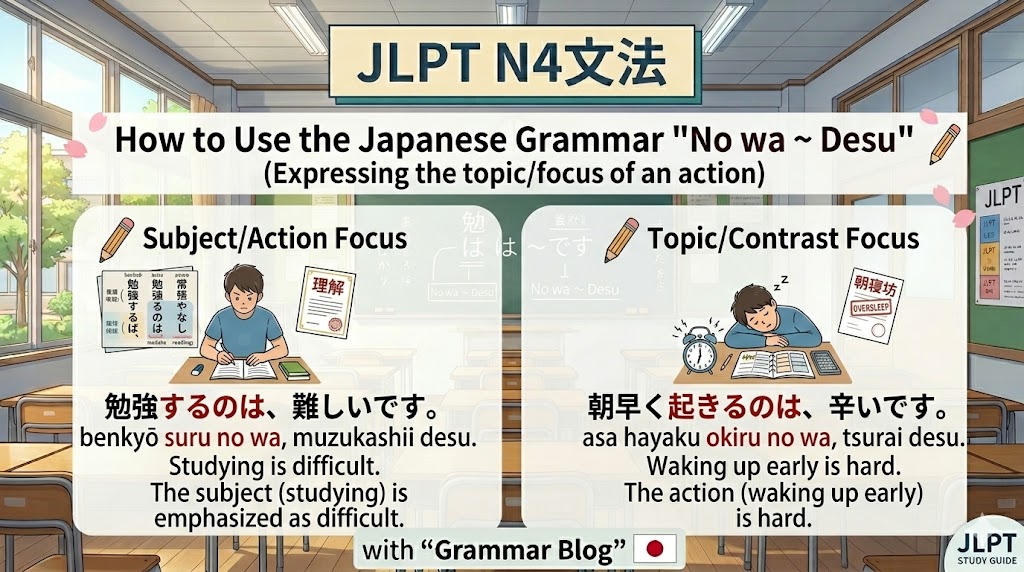
This is where the grammar structure 〜のは〜です (~ no wa ~ desu) comes into play. It means “The thing that … is ~,” as in 日本に来たのは、日本の文化が好きだからです (The reason I came to Japan is because I like Japanese culture). It is a powerful tool that allows you to emphasize exactly what you want to talk about. It moves the most important part of your sentence to the end for maximum impact. If you have ever felt frustrated because you couldn’t highlight the “point” of your sentence, this guide is for you.
Before diving into the grammar detail, here is the JLPT N4 complete guide:
The Ultimate JLPT N4 Complete Guide: Your Gateway to Working and Living in Japan
- 〜のは〜です (~ no wa ~ desu) means “The thing that … is ~.” 〜のは〜です turns a phrase into a noun and moves the most important information to the end for emphasis.
- To form 〜のは〜です, use the plain form of a verb or i-adjective, or a na-adjective + な, then add のは and the focus + です: 日本に来たのは、日本の文化が好きだからです.
- 〜のは〜です is used to give a reason, identify a specific thing or person, or highlight a feeling. Inside the のは clause, the subject usually takes が: 私が探しているのは、その鍵です.
- When 〜のは〜です emphasizes a specific person, place, or thing, use の, not こと. 好きなのはメアリーさんです is correct, but 好きなことは sounds like Mary is a thing or an event.
- Common mistakes with 〜のは〜です are dropping な after a na-adjective (好きのは is wrong; 好きなのは is correct) and using the masu-form before のは.
What does 〜のは〜です mean?
〜のは〜です means “The thing that … is ~.” 〜のは〜です turns a whole phrase or a verb into a noun so that you can talk about it as the subject. In English, we call this a “cleft sentence.” In Japanese, we call the particle の (no) a “nominalizer” because it turns whatever comes before it into a “noun clause.”
The structure usually looks like this:
[Verb (Plain Form) / i-Adjective / na-Adjective + na] + のは + [Noun/Phrase] + です
Think of the のは as “The thing that…” or “The reason why…” or “The place where…” It sets the stage, and then the part after it provides the specific answer or focus.
Step-by-Step Breakdown
1. The Verb/Adjective Part: Before the “no wa,” you must use the Plain Form (Dictionary form, -nai form, -ta form). You cannot use the polite -masu form here. For example, instead of tabemasu, you use taberu.
2. The Nominalizer (no): This “no” acts like a container. It takes the action (like “eating”) and turns it into a topic (“The act of eating”).
3. The Topic Marker (wa): This tells the listener, “Okay, everything I just said is what we are talking about.”
4. The Focus: This is the most important information. It’s what you want the listener to remember.
How is 〜のは〜です used in everyday Japanese?
People use 〜のは〜です to give a reason, to identify a specific object or person, and to describe feelings or preferences. Let’s look at three common scenarios where this grammar makes your Japanese sound much more fluent.
Example 1: Expressing a Reason or Motivation
Imagine someone asks you why you moved to Japan. You could say “I like Japanese culture, so I came to Japan.” That’s fine, but it’s a bit basic. To sound more natural and emphasize the reason, you can use 〜のは.
Japanese: 日本に来たのは、日本の文化が好きだからです。
Reading: Nihon ni kita no wa, Nihon no bunka ga suki dakara desu.
English: The reason I came to Japan is because I like Japanese culture.
In this sentence, “Coming to Japan” is the context we already know. The “new” and “important” information is the “liking the culture” part. By putting the reason at the very end, you give it more weight.
Example 2: Identifying a Specific Object or Person
Suppose you are looking for your car keys in a messy room. Your friend picks up a set of keys and asks if they are yours. You want to confirm that those specific keys are exactly what you were looking for.
Japanese: 私が探しているのは、その鍵です。
Reading: Watashi ga sagashite iru no wa, sono kagi desu.
English: What I am looking for are those keys.
Notice how we use が (ga) instead of は (wa) inside the first clause (Watashi ga sagashite iru). This is a common rule: inside a clause that describes a noun (or a nominalized clause), the subject usually takes “ga.”
Example 3: Describing Feelings or Preferences
When talking about hobbies, we often want to highlight the best part of an activity. If you love traveling, you might want to specify what exactly makes it fun for you.
Japanese: 旅行で一番楽しいのは、新しい人と出会うことです。
Reading: Ryokou de ichiban tanoshii no wa, atarashii hito to deau koto desu.
English: The most enjoyable thing about traveling is meeting new people.
Here, the “most enjoyable thing” is the topic, and “meeting new people” is the focus. It creates a very clear, logical flow to your thoughts that is highly valued in Japanese communication.
What mistakes do learners make with 〜のは〜です?
Learners often forget な with na-adjectives, mix up のは and ことは, and use the polite form before のは. Let’s look at how to avoid these common errors so you can pass your JLPT with flying colors.
Do you need な before のは with na-adjectives?
Yes. If you are using a na-adjective or a noun right before the “no wa,” you must include な (na). You cannot just jump from the word to “no.” This is perhaps the most frequent mistake.
Incorrect: 好きのはテニスです。(Suki no wa tenisu desu.)
Correct: 好きなのはテニスです。(Suki na no wa tenisu desu.)
Think of it this way: the “no” is acting like a noun, and na-adjectives need that “na” to connect to any noun-like structure.
What is the difference between のは and ことは?
Both の (no) and こと (koto) turn verbs into nouns, but they are not always interchangeable. In the 〜のは〜です structure, you almost always use の, while こと is generally used for more abstract concepts or fixed patterns. This is a classic headache for JLPT learners.
When you are using the 〜のは〜です structure to emphasize a specific piece of information (like a time, a place, or a person), you almost always use の. こと is generally used for more abstract concepts or specific grammar patterns like “koto ga dekiru” (can do) or “koto ga aru” (have done).
For example, if you say “The person I like is Mary,” you must use の:
Suki na no wa Mearii-san desu. (Correct)
Suki na koto wa Mearii-san desu. (Incorrect – this sounds like Mary is a ‘thing’ or an ‘event’).
Can you use the polite form before のは?
No. The part before のは is a descriptive clause, and in Japanese, descriptive clauses must be in the Plain Form. Even if you are speaking very politely to your boss, you cannot say “Tabemasu no wa…” You must say “Taberu no wa…”
The politeness of the entire sentence is determined by the very last word—usually です (desu). As long as you end with です, the whole sentence remains polite.
Can のは refer to a person or a place?
Yes. When the focus at the end of the sentence is a person or a place, のは works on its own, so you do not need to switch to 人は or 場所は. Learners sometimes get confused about this.
Actually, のは is very flexible! It can represent a person, a place, or a thing.
Example: Kinou atta no wa Tanaka-san desu. (The one I met yesterday was Mr. Tanaka).
You don’t need to say “Kinou atta hito wa…” (though you can, it changes the nuance slightly). の is like a pronoun that replaces the noun “person.”
Why does 〜のは〜です matter for the JLPT?
〜のは〜です often appears in JLPT grammar questions, where the test-makers check whether you know how to connect adjectives and verbs to “no.” You will see the structure in the “Sentences in Context” or “Grammar Form” sections.
More importantly, this structure appears constantly in the Listening Section. In many listening tasks, the speakers won’t give you a straight answer. Instead of saying “I want to go to Kyoto,” a character might say, “Well, the place I’ve been wanting to visit for a long time is actually Kyoto.” If you aren’t familiar with 〜のは, you might miss the key information because you are waiting for a standard “Verb-tai” ending.
By mastering this, you aren’t just memorizing a rule; you are training your ears to catch the “point” of what Japanese people are saying.
How to Practice Using “No wa” in Your Daily Life
Learning grammar is one thing, but using it is another. To make 〜のは〜です a natural part of your vocabulary, try these simple exercises:
The “Truth About Me” Exercise
Write down five sentences about yourself using this structure. Focus on your preferences and history. For example:
- 私が一番好きな食べ物は、寿司です。(The food I like best is sushi.)
- 私が日本語を勉強しているのは、日本で働きたいからです。(The reason I study Japanese is because I want to work in Japan.)
- 今、一番行きたいのは、北海道です。(Where I want to go most right now is Hokkaido.)
The “Spot the Focus” Exercise
Next time you watch an anime or a Japanese YouTuber, listen for the syllable “no wa.” When you hear it, pause and ask yourself: What are they emphasizing? Are they talking about a reason? A person? A specific time?
Convert Your Basic Sentences
Take a simple sentence like “I bought this bread at the bakery.”
Panya de kono pan o kaimashita.
Now, try to flip it using のは to emphasize different parts:
Emphasize the bread: Panya de katta no wa, kono pan desu. (What I bought at the bakery was this bread.)
Emphasize the bakery: Kono pan o katta no wa, panya desu. (The place where I bought this bread was the bakery.)
Summary
The 〜のは〜です structure is a game-changer for Japanese learners. It moves you away from the robotic “A is B” sentence style and allows you to guide your listener’s attention to what truly matters. It adds flavor, clarity, and a touch of “native-like” flow to your speech.
Remember the golden rules:
- Use Plain Form before の.
- Don’t forget the な (na) for na-adjectives and nouns.
- Use の instead of こと when emphasizing specific people, places, or things in this cleft structure.
- Keep the focus (the most important info) at the end of the sentence, right before です.
Mastering this grammar point will not only help you score higher on the JLPT but will also make your conversations in Japan much more engaging. You’ll be able to explain your reasons more clearly, identify things more precisely, and express your feelings with more nuance. Keep practicing, and soon, using のは will feel as natural as saying konnichiwa!
Happy studying, and good luck with your JLPT preparation! You’ve got this!
IPPO, JLPT training platform is always here to help you to pass the JLPT!!

We offer the Best Online Japanese Learning (All Free), and our goal is to facilitate the adoption into life in Japan. Our service “IPPO” is made by native Japanese teachers and professionals. The tips we share with you can help you to learn Japanese efficiently and pass JLPT (Japanese Language Proficiency Test).