は(Wa)
If you have been studying Japanese for any length of time, you have likely encountered the particle “wa” (は) within your first few hours of learning. Usually, it is introduced as the “topic marker.” You learn to say “Watashi wa Gakusei desu” (I am a student), and everything seems simple enough. But then, as you progress toward the JLPT N5 and N4 levels, things start to get a bit more nuanced. You notice that “wa” starts popping up in places you didn’t expect, or it appears twice in the same sentence.
One of the most common points of confusion for learners is the Contrastive Wa. You might feel frustrated when you try to explain that you like apples but dislike bananas, or that you can speak English but not Japanese. You know the words, but the structure feels slippery. If you’ve ever felt like you’re just guessing which particle to use, don’t worry—you are not alone. This is one of the “boss levels” of Japanese grammar, and once you conquer it, your Japanese will sound significantly more natural and sophisticated.
In this guide, we are going to break down the ~は~が、~は structure. We will look at why it exists, how to use it without sounding like a textbook, and the subtle ways it changes the meaning of your sentences. By the end of this post, you’ll be able to use contrast to express your thoughts with precision.
Before diving into the grammar detail, here is the JLPT N4 complete guide:
The Ultimate JLPT N4 Complete Guide: Your Gateway to Working and Living in Japan
The Basic Rule of Contrastive Wa
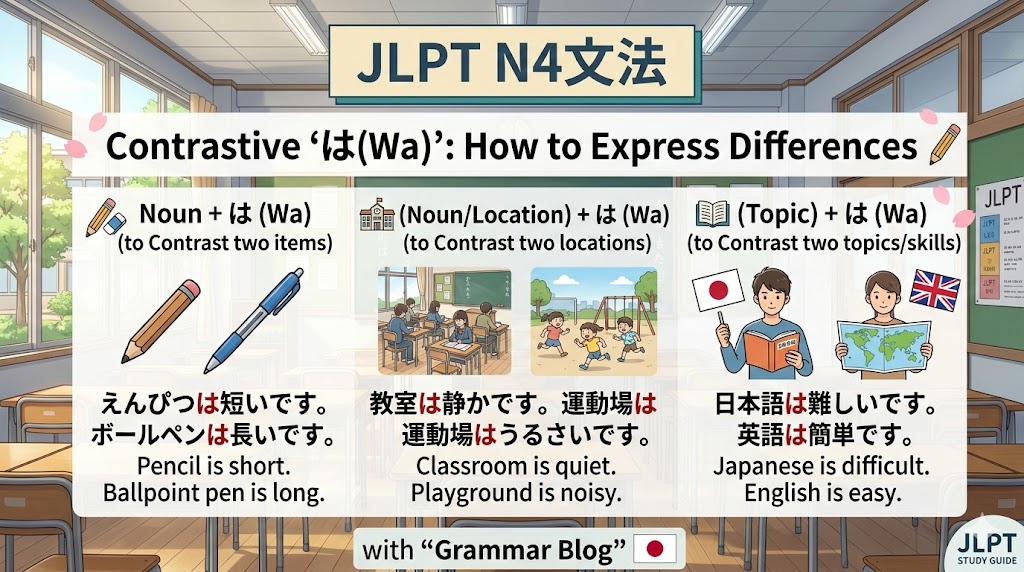
In Japanese, the particle “wa” (は) has two primary jobs. The first is to mark the topic (what the sentence is about). The second is to show contrast (対比 – taihi). When we want to compare two different things or highlight a difference between two situations, we use “wa” for both items being compared.
The standard pattern looks like this:
[Item A] は [State/Action] が、[Item B] は [State/Action].
Think of it as a balance scale. On one side, you have Item A, and on the other, you have Item B. By using “wa” for both, you are telling the listener, “Focus on these two specific things because I am comparing them.”
Why not use “Ga” or “Wo”?
This is where many students get stuck. Usually, the subject of a sentence takes “ga” (が) and the object takes “wo” (を). However, when you want to show contrast, the contrastive “wa” is so strong that it often replaces these particles.
For example, if you say “Ringo wo tabemasu” (I eat apples), it’s a simple statement. But if you say “Ringo wa tabemasu ga, banana wa tabemasen” (I eat apples, but I don’t eat bananas), the “wa” replaces the “wo” to signal that you are making a specific distinction between the two fruits.
The “Implicit” Contrast
Sometimes, you might only see one “wa” in a sentence, but it is still contrastive. If someone asks, “Do you drink alcohol?” and you reply, “Biiru wa nomimasu” (I drink beer), you are implying that while you drink beer, you might not drink wine, sake, or other spirits. The “wa” creates a “wall” around the word beer, separating it from other possibilities. This nuance is vital for understanding the famous Japanese trait of “reading the air” (kuuki wo yomu).
Practical Examples for Daily Life
Let’s look at how this works in real-world scenarios. These examples are designed to show you how the structure functions in common conversations you might have while living or traveling in Japan.
Comparing Likes and Dislikes
This is perhaps the most common way to use the contrastive structure. It allows you to be specific about your preferences instead of making broad generalizations.
Japanese: 肉は食べますが、魚は食べません。
Romaji: Niku wa tabemasu ga, sakana wa tabemasen.
English: I eat meat, but I don’t eat fish.
In this sentence, the speaker is clearly defining their dietary boundaries. If they used “Niku wo tabete, sakana wo tabemasen,” it would sound like a robotic list of facts. By using “wa,” the speaker highlights the choice they’ve made. Note how “ga” (が) in the middle acts as the bridge meaning “but.”
Comparing Abilities and Skills
When you are talking about what you can and cannot do (using the potential form), the contrastive “wa” is your best friend. It helps you be humble while still being clear about your skills.
Japanese: 英語は話せますが、日本語は話せません。
Romaji: Eigo wa hanasemasu ga, Nihongo wa hanasemasen.
English: I can speak English, but I can’t speak Japanese.
Here, the contrast is between two languages. In a normal sentence, you might say “Nihongo ga hanasemasen” (I can’t speak Japanese). But when you want to show the gap between your English ability and your Japanese ability, you switch both particles to “wa.” This emphasizes the “difference” in your proficiency levels.
Comparing Settings or Conditions
You can also use this to compare times, places, or conditions. This is very useful when discussing schedules or the weather.
Japanese: 今日は忙しいですが、明日は暇です。
Romaji: Kyou wa isogashii desu ga, ashita wa hima desu.
English: I’m busy today, but I’m free tomorrow.
In this case, the speaker is contrasting “today” and “tomorrow.” Using “wa” here is essential because you are setting a “topic” for two different time frames to show how they differ. It provides a clear contrast that helps the listener understand exactly when you are available.
Important Nuances and Common Mistakes
While the rule seems straightforward, there are a few traps that learners often fall into. Understanding these will help you move from “classroom Japanese” to “natural Japanese.”
The “Only” Mistake
One common mistake is using the contrastive “wa” when you actually mean “dake” (only).
If you say “Biiru wa nomimasu,” you are saying “As for beer, I drink it (implying other things are different).”
If you say “Biiru dake nomimasu,” you are saying “I drink only beer and nothing else.”
The contrastive “wa” is softer and leaves room for ambiguity, whereas “dake” is an absolute limit. In Japanese culture, the softer contrastive “wa” is often preferred because it sounds less aggressive.
Overusing “Wa” in One Sentence
While the “Item A wa…, Item B wa…” structure is correct, you should avoid using too many “wa” particles in a single sentence if they aren’t meant for contrast. If you have a topic, a subject, and a contrast all in one sentence using “wa,” it becomes a “Wa-salad” that is very hard for a Japanese person to parse.
Rule of thumb: If you are contrasting two things, use two “wa” particles. If you aren’t contrasting anything, stick to one “wa” for the main topic and use other particles like “ga,” “wo,” or “ni” for the rest.
The Negative “Wa”
In Japanese, negative sentences almost always prefer “wa” over “wo” or “ga.”
For example:
“TV wo mimasu” (I watch TV) -> Positive.
“TV wa mimasen” (I don’t watch TV) -> Negative.
Why does this happen? Because when you say you don’t do something, you are inherently contrasting it against the things you do do. Even if you don’t say the second half of the sentence, the “wa” implies a contrast. Many students forget to switch to “wa” in negative sentences, which makes their Japanese sound a bit “stiff.”
The “But” (Ga) is Essential
Don’t forget the “ga” (が) in the middle of your contrastive sentences! In the pattern “A wa…, B wa…”, the “ga” acts as the “but” or “however.” Without it, you are just saying two separate sentences. For a smooth, JLPT-level flow, joining them with “ga” is the way to go.
Note: In very casual speech, people sometimes drop the “ga” and just pause, but for the JLPT and professional writing, keep the “ga” there.
Summary and Final Tips
Learning the contrastive “wa” is a major milestone in your Japanese language journey. It’s the moment you stop just identifying objects and start expressing the complex relationships between them.
To recap what we’ve covered:
- “Wa” (は) isn’t just a topic marker; it’s a tool for contrast.
- The standard pattern is [A] は ~ が、 [B] は ~.
- The contrastive “wa” often replaces “ga” and “wo” to highlight a difference.
- Using “wa” can imply a contrast even if the second half of the sentence is missing.
- Always use “wa” in negative sentences to sound more natural.
My advice for mastering this? Start small. Tomorrow, try to think of one thing you like and one thing you don’t like, and form a sentence using “wa… ga, wa…”. For example, “Coffee wa suki desu ga, tea wa kirai desu.” (I like coffee, but I hate tea.) Practice saying it out loud. The more you use it, the more your brain will stop seeing it as a “rule” and start seeing it as a “feeling.”
Japanese grammar can feel like a puzzle sometimes, but every piece you fit into place makes the whole picture clearer. The contrastive “wa” is a piece that adds color and depth to your conversations. Keep practicing, stay curious, and don’t be afraid to make mistakes—that’s how you learn! Ganbatte kudasai!
IPPO, JLPT training platform is always here to help you to pass the JLPT!!

We offer the Best Online Japanese Learning (All Free), and our goal is to facilitate the adoption into life in Japan. Our service “IPPO” is made by native Japanese teachers and professionals. The tips we share with you can help you to learn Japanese efficiently and pass JLPT (Japanese Language Proficiency Test).