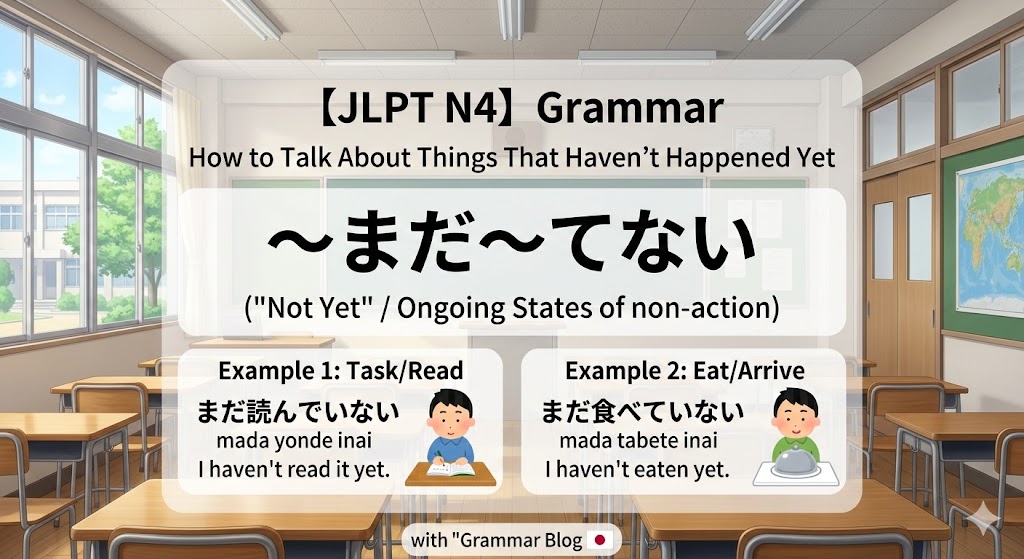
- まだ~てない
- The Basic Rule of Mada ~te Inai
- Why Not Just Use the Simple Negative?
- Everyday Examples to Bring the Grammar to Life
- The Nuances of “Te-iru” in Negative Form
- Common Mistakes and How to Avoid Them
- Politeness Levels and Variations
- Practical Practice: How to Internalize Mada ~te Inai
- Summary of Key Points
まだ~てない
If you have been studying for the JLPT (Japanese Language Proficiency Test) for a while, you have likely run into those moments where you know exactly what you want to say in English, but the Japanese equivalent feels just slightly out of reach. You know how to say “I don’t eat” and you know how to say “I didn’t eat,” but how do you express that specific feeling of “I haven’t eaten yet, but I’m planning to”?
One of the most common hurdles for English speakers learning Japanese is the distinction between a simple negative action and a state of “not yet.” In English, we rely heavily on the present perfect tense (“I haven’t done it”). In Japanese, we use a specific structure: まだ〜ていない (Mada ~te inai).
In this guide, we are going to break down this grammar point so thoroughly that you’ll be able to use it naturally in conversation and spot it instantly on your next JLPT exam. We will look at the rules, the nuances that textbooks often skip, and the common mistakes that trip up even intermediate learners.
Before diving into the grammar detail, here is the JLPT N4 complete guide:
The Ultimate JLPT N4 Complete Guide: Your Gateway to Working and Living in Japan
The Basic Rule of Mada ~te Inai
At its core, まだ〜ていない (Mada ~te inai) translates to “have not yet done [verb].” It is the negative form of the present progressive/continuous state (〜ている).
To understand this, let’s look at the components:
- まだ (Mada): This means “yet” or “still.” When used with a negative verb, it translates to “not yet.”
- 〜て (Te-form): The connective form of the verb.
- いない (Inai): The negative form of いる (iru), which indicates a state of being or an ongoing action.
When you combine these, you aren’t just saying a “no” to an action. You are describing a current state where an action has not occurred up to this point, but there is an underlying expectation that it will happen in the future.
How to Conjugate
The conjugation is straightforward if you already know your Te-forms:
[Verb in Te-form] + いない (Informal)
[Verb in Te-form] + いません (Formal/Polite)
For example, with the verb 食べる (Taberu – to eat):
1. Change to Te-form: 食べて (Tabete)
2. Add negative state: 食べていない (Tabete inai)
Result: まだ食べていない (Mada tabete inai) — “I haven’t eaten yet.”
Why Not Just Use the Simple Negative?
This is where many students get confused. Why can’t we just say “Mada tabenai” (まだ食べない)?
In Japanese, まだ食べない (Mada tabenai) implies a will or a future plan not to eat yet. It sounds like: “I am choosing not to eat for a while longer.”
On the other hand, まだ食べていない (Mada tabete inai) describes the current reality. It focuses on the fact that the action of eating has not been completed up to this moment. If someone asks, “Did you finish the report?” and you say “Mada shinai,” it sounds like you are refusing to do it yet. If you say “Mada shite inai,” it simply means you haven’t finished it yet.
Everyday Examples to Bring the Grammar to Life
To truly master a grammar point, you need to see how it lives in the real world. Here are three common scenarios where you will use まだ〜ていない constantly.
The Work/Study Scenario
Imagine your boss or your teacher asks if you have finished a specific task. This is the most common “test” for this grammar point.
Japanese: 宿題はもう終わりましたか? いいえ、まだ終わっていません。
Romaji: Shukudai wa mou owarimashita ka? Iie, mada owatte imasen.
English: Have you finished your homework already? No, I haven’t finished it yet.
Contextual Breakdown:
Here, 終わる (owaru – to finish) is changed into 終わって (owatte). Because this is a professional or school setting, we use the polite いません (imasen). This tells the listener that while the work isn’t done now, it is currently “in progress” or on your to-do list.
The Social/Daily Life Scenario
You’re meeting a friend for a movie, and they ask if you’ve seen the latest blockbuster that everyone is talking about.
Japanese: その映画、もう見た? ううん、まだ見ていないんだ。
Romaji: Sono eiga, mou mita? Uun, mada mite inai n da.
English: Did you already see that movie? No, I haven’t seen it yet.
Contextual Breakdown:
In this casual conversation, we use いない (inai). The addition of “n da” at the end adds a slight explanatory tone, making the sentence sound more natural and conversational. It implies, “I haven’t seen it yet (but I might want to).”
The Travel/Experience Scenario
This is perfect for when you are talking about your life experiences in Japan or places you want to visit.
Japanese: 京都に行ったことがありますか? いいえ、まだ行っていません。
Romaji: Kyoto ni itta koto ga arimasu ka? Iie, mada itte imasen.
English: Have you ever been to Kyoto? No, I haven’t gone yet.
Contextual Breakdown:
When talking about travel, “mada itte imasen” is the standard way to say you haven’t visited a place. It’s more common than the simple negative “ikimasen” because it leaves the door open for a future trip. It describes your current “state of experience.”
The Nuances of “Te-iru” in Negative Form
To really “feel” this grammar like a native speaker, we have to look at the concept of aspect. In Japanese, 〜ている can mean two things depending on the verb:
- An ongoing action (e.g., I am running).
- A state resulting from a past action (e.g., The door is open).
When we use the negative 〜ていない with まだ, we are almost always referring to the second one—the state.
Think of it like this: There is a “Done” bucket and a “Not Done” bucket. Using まだ〜ていない means the action is still sitting in the “Not Done” bucket, even though you expect it to move to the “Done” bucket eventually. This is why this grammar is so essential for the JLPT N5 and N4 levels; it moves you away from just translating word-for-word and into thinking about states of being.
Common Mistakes and How to Avoid Them
Even though the rule seems simple, there are a few pitfalls that foreign learners often fall into. Let’s clear those up right now.
Mixing up “Mada” and “Mou”
In English, “yet” and “already” are distinct. In Japanese, まだ (Mada) and もう (Mou) are the two sides of the same coin.
– もう (Mou) + Positive = Already done.
– まだ (Mada) + Negative = Not yet done.
A common mistake is saying “Mou ~te inai.” This is grammatically incorrect if you are trying to say “not yet.” If you want to say you have already done something, you would simply use the past tense: “Mou shimashita” (Already did it).
The “Mada -nai” vs. “Mada -teinai” Trap
As mentioned briefly before, this is the biggest hurdle. Let’s look at a clear comparison:
- まだ来ない (Mada konai): He isn’t coming yet (He is late, or he hasn’t started moving, and it’s frustrating). This often focuses on the verb itself not happening.
- まだ来ていない (Mada kite inai): He hasn’t arrived yet (He is not here right now). This focuses on the current state of his absence.
If you are taking the JLPT, the exam will often give you a situation where someone is waiting for a result or a person. In 90% of those cases, the answer will be 〜ていない because the question is about the current state of affairs.
Forgetting the Te-form Conjugation
It sounds basic, but in the heat of a conversation or a timed test, it’s easy to mess up the Te-form.
– For Group 1 (U-verbs): Remember the small ‘tsu’ (itte, matte) or the ‘nde’ (yonde, nande).
– For Group 2 (Ru-verbs): Just drop the ‘ru’ and add ‘te’ (tabete, mite).
– For Irregular verbs: Suru becomes Shite, and Kuru becomes Kite.
If you stumble on the Te-form, the whole まだ〜ていない structure falls apart. Practice your Te-form drills until they are muscle memory!
Politeness Levels and Variations
Japanese is all about who you are talking to. まだ〜ていない can change its “outfit” depending on the occasion.
1. Casual (Friends, Family, Peers)
In casual speech, we often drop the “i” in “inai.”
– まだ食べてない (Mada tabetenai)
– まだやってない (Mada yattenai)
This is extremely common in anime, manga, and daily life. If you want to sound like a local, try dropping that “i.”
2. Polite (Bosses, Strangers, Teachers)
Use the “imasen” form.
– まだ食べていません (Mada tabete imasen)
– まだやっていません (Mada yatte imasen)
3. Very Formal (Speeches, Business Documents)
You might see いまだに (Imadani) instead of まだ (Mada), or the verb ending in おりません (orimasen) instead of いません (imasen).
– いまだに完了しておりません (Imadani kanryou shite orimasen) — “It has not yet been completed.”
This is high-level JLPT N2/N1 territory, but it’s good to recognize the pattern.
Practical Practice: How to Internalize Mada ~te Inai
You can’t learn Japanese just by reading; you have to produce it. Here is a simple exercise you can do right now. Look around your room or think about your day and answer these three questions using まだ〜ていない.
- Is there a book you started but haven’t finished? (本を読み終わっていない)
- Is there a message you haven’t replied to yet? (返信をしていない)
- Is there a place in Japan (or your current country) you haven’t visited yet? (まだ行っていない)
By connecting the grammar to your actual life, you create neural pathways that make it easier to recall during a stressful exam.
Summary of Key Points
Let’s recap what we have covered to make sure it sticks:
- The Meaning: Use まだ〜ていない to say you “haven’t done something yet.”
- The Focus: It describes a state that exists right now because an action hasn’t happened.
- The Conjugation: Verb [Te-form] + いない (casual) or いません (polite).
- The Expectation: Unlike the simple negative, this grammar implies that the action might or should happen soon.
- The Contrast: Don’t confuse it with “Mada -nai,” which is more about will or a future schedule.
Mastering this grammar point is a major step toward fluency. It allows you to give more nuanced answers than a simple “yes” or “no.” It shows the listener that you understand the flow of time and the status of your actions.
Next time you’re studying for the JLPT and you feel like you haven’t mastered everything yet, just remember: 「まだ全部覚えていないだけです」(Mada zenbu oboete inai dake desu) — “It’s just that I haven’t memorized everything yet.” Keep going, keep practicing, and that “not yet” will eventually turn into “already done!”
Happy Studying!
Learning a language is a marathon, not a sprint. The fact that you are looking up specific grammar points like this shows you have the dedication to succeed. Keep using まだ〜ていない in your daily conversations, and soon it will become second nature.
IPPO, JLPT training platform is always here to help you to pass the JLPT!!

We offer the Best Online Japanese Learning (All Free), and our goal is to facilitate the adoption into life in Japan. Our service “IPPO” is made by native Japanese teachers and professionals. The tips we share with you can help you to learn Japanese efficiently and pass JLPT (Japanese Language Proficiency Test).