Quantity + も
Have you ever felt like your Japanese sentences are a bit too… flat? You might know how to say “I waited for one hour” or “I bought five apples,” but there is a certain “flavor” missing from your speech. In English, we use our tone of voice or words like “as many as,” “as much as,” or “a whopping” to show that a number surprised us. In Japanese, there is a much more elegant and concise way to do this using a single particle: も (mo).
If you are studying for the JLPT (especially around the N4 and N3 levels), you have likely realized that Japanese is a language built on nuance and the speaker’s subjective feelings. Learning how to attach も to a quantity is one of the first steps toward sounding less like a textbook and more like a real person. In this guide, we are going to dive deep into this grammar point so you can use it naturally in your daily life and ace your upcoming exam.
Before diving into the grammar detail, here is the JLPT N4 complete guide:
The Ultimate JLPT N4 Complete Guide: Your Gateway to Working and Living in Japan
The Emotion Behind the Number: Why We Use Quantity + も
Before we look at the grammar rules, let’s talk about the “why.” Why do we bother adding も after a number? Usually, we learn that も means “also” or “too” (e.g., Watashi mo ikimasu – I will go too). However, when placed directly after a quantity or a counter, its meaning shifts significantly.
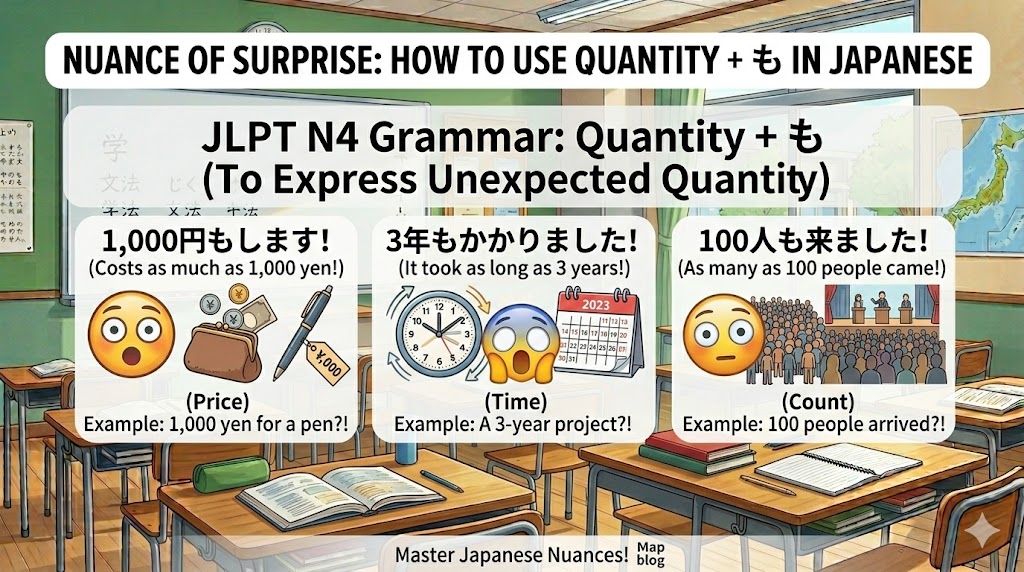
When you use Quantity + も, you are telling the listener: “I think this number is surprisingly large.” It transforms a dry, objective fact into a subjective expression of surprise, emphasis, or even a bit of complaining.
Think about the difference between these two English sentences:
- “I waited for an hour.” (A simple statement of fact.)
- “I waited for as long as an hour!” (Showing that you think an hour is a long time.)
In Japanese, that second sentence is exactly what Quantity + も achieves. Without it, you’re just a calculator. With it, you’re a human being sharing your perspective.
The Basic Rule: How to Form the Sentence
The beauty of this grammar point lies in its simplicity. Unlike some Japanese grammar that requires complex conjugations or specific particles like ni or de, this one is very straightforward.
The Structure: [Quantity / Counter] + も + Verb
You simply take your quantity (like go-mai for five flat objects, san-jikan for three hours, or juu-nin for ten people) and place も right after it. Note that when you use this structure, you usually do not need particles like o or ga between the quantity and the verb.
Example:
Objective: Ringo o go-ko tabemashita. (I ate five apples.)
With Emphasis: Ringo o go-ko mo tabemashita. (I ate as many as five apples! / I can’t believe I ate five!)
Notice how the focus shifts from the action of eating to the amount eaten. This subtle change tells your friend that you might be feeling a bit full or that you’re proud (or ashamed) of your appetite.
Real-Life Scenarios: Bringing the Grammar to Life
To truly understand how this works, we need to see it in action. Here are three common daily scenarios where Quantity + も makes a huge difference in how your message is received.
Example 1: Complaining About a Long Wait
Imagine you are meeting a friend at a cafe in Shibuya. They are late, and you are getting frustrated. When they finally arrive, you want to emphasize how long you’ve been standing there.
Japanese: 昨日は、友達を1時間も待っていました。
Romaji: Kinou wa, tomodachi o ichi-jikan mo matte imashita.
English: Yesterday, I waited for my friend for as long as an hour.
If you said ichi-jikan matte imashita, it sounds like you are just reporting your schedule. By adding も, your friend will immediately understand that you found the wait excessive and that you’re probably a little annoyed. It conveys the “weight” of the time spent.
Example 2: Surprised by a High Price
Let’s say you went to a fancy department store in Ginza and saw a simple T-shirt. You look at the price tag and your eyes nearly pop out of your head.
Japanese: このTシャツは1万円もしました!
Romaji: Kono tii-shatsu wa ichiman-en mo shimashita!
English: This T-shirt cost a whopping 10,000 yen!
In this case, も highlights your shock at the price. 10,000 yen might be normal for a coat, but for a T-shirt? It’s a lot! Using も here validates your reaction. It invites the listener to agree with you, essentially saying, “Can you believe it?”
Example 3: Bragging (or Complaining) About Workload
You’re talking to a classmate about your weekend. While they were out partying, you were stuck at home studying for the JLPT. You want to show how hard you worked.
Japanese: 昨日は漢字を50個も覚えました。
Romaji: Kinou wa Kanji o go-juu-ko mo oboemashita.
English: I memorized as many as 50 Kanji yesterday.
Here, the も serves as an intensifier. It turns “50 Kanji” into a significant achievement. It tells the listener that 50 is a large number in your opinion. Whether you are seeking praise or just venting about the difficulty of Japanese, も is your best friend here.
Common Pitfalls and How to Avoid Them
While the grammar structure is simple, the usage can be tricky because it is entirely subjective. This is where many learners get confused. Let’s look at some common mistakes and nuances you should keep in mind.
Is the Number Actually “Large”?
The most important thing to remember is that も is based on your perspective, not objective truth. However, if you use it for a number that everyone considers small, you might sound sarcastic or just plain confusing.
For example, if you say: Ringo o ikko mo tabemashita (I ate as many as one apple), people will look at you funny. One apple is generally not considered a “large” amount. However, if you are talking about a tiny baby who usually eats nothing, then ikko mo might make sense. Always consider the context: is this number surprisingly high for the situation?
Don’t Confuse it with the Negative “Mo”
This is a major point of confusion for JLPT students. You might have learned that Quantity + も + Negative Verb means “not even one.”
- Quantity + も + Positive: “As many as…” (Surprising plenty)
- Quantity + も + Negative: “Not even…” (Surprising lack)
Example:
Saifu ni ichien mo arimasen. (There isn’t even one yen in my wallet.)
In this article, we are focusing on the positive usage (as many as), but be careful during the JLPT listening section. If the verb at the end of the sentence is negative, the meaning flips from “a lot” to “absolutely zero/none.”
Overusing Particles
Newer learners often try to keep the original particles (like o or ga) and then add も on top of them. While sometimes you see o mo in very formal or literary contexts, in standard daily Japanese and on the JLPT, the も usually replaces the particle or is added directly to the counter.
Avoid saying: Gohan o go-hai o mo tabemashita (Incorrect).
Instead, say: Gohan o go-hai mo tabemashita. (Correct).
Comparison with Other Particles: Mo vs. Shika
To truly master も, you have to understand its “rival” particle: しか (shika). While も emphasizes that a number is unexpectedly large, しか emphasizes that a number is unexpectedly small or insufficient.
Think of them as two sides of the same coin. Let’s look at a bank account scenario:
Scenario A: You have 1,000,000 yen. You feel rich!
Ginkou ni hyakuman-en mo arimasu. (I have as much as a million yen.)
Scenario B: You have 100 yen. You feel poor.
Ginkou ni hyaku-en shika arimasen. (I only have 100 yen / I have nothing but 100 yen.)
Note that しか must always be paired with a negative verb (arimasen, nai, tabenai, etc.), whereas the も we are discussing today is paired with a positive verb to show “plenty.” Mastering the contrast between these two will significantly improve your JLPT reading comprehension scores.
Summary and Final Tips for Your JLPT Journey
The Quantity + も grammar point is more than just a rule to memorize; it’s a tool for expression. It allows you to inject your personality and your feelings into your Japanese. Whether you are shocked by the price of a coffee, impressed by how many pages you read, or frustrated by a long commute, も is the perfect way to convey that emotion.
Key Takeaways:
- Use [Quantity] + も to express “as many as” or “as much as.”
- It shows the speaker’s subjective surprise that the amount is large.
- It usually replaces other particles like ga or o after the counter.
- If used with a negative verb, it means “not even [small amount].”
- Contrast it with しか (…nai), which means “only [a small amount].”
As you continue your studies, try to “feel” the quantity. When you see a number in a Japanese news article or a manga, ask yourself: Is the writer just stating a fact, or are they using も to tell me they are surprised? The more you notice it, the more natural it will become to use it yourself.
Good luck with your JLPT prep! Keep practicing, and soon you’ll be using these nuances like a pro. If you found this helpful, be sure to check out our other grammar guides to help you navigate the beautiful complexities of the Japanese language!
IPPO, JLPT training platform is always here to help you to pass the JLPT!!

We offer the Best Online Japanese Learning (All Free), and our goal is to facilitate the adoption into life in Japan. Our service “IPPO” is made by native Japanese teachers and professionals. The tips we share with you can help you to learn Japanese efficiently and pass JLPT (Japanese Language Proficiency Test).