
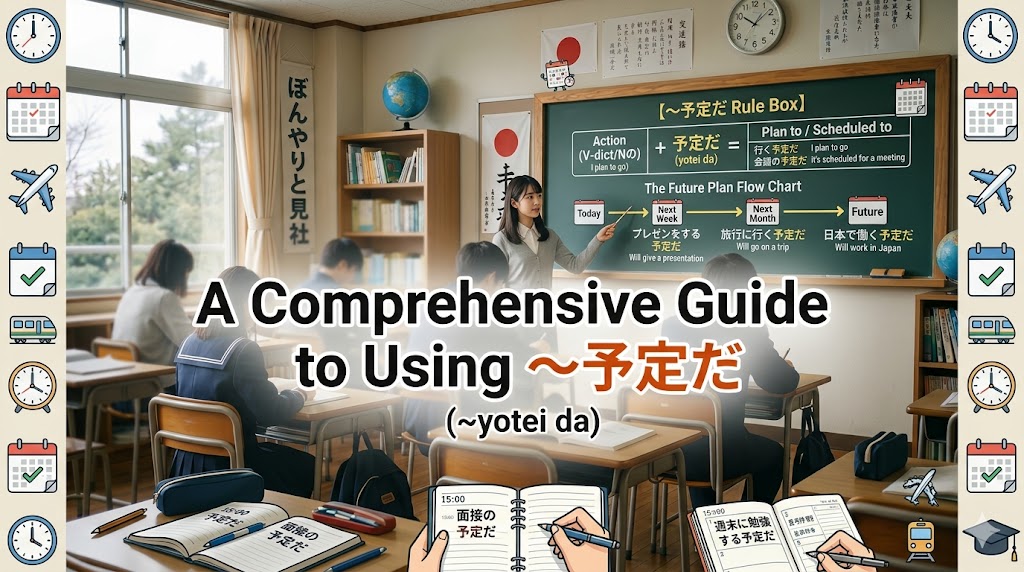
~予定だ (~yotei da)
If you have been studying Japanese for a while, you know that the language has a unique way of expressing time, intention, and certainty. One of the most common hurdles for students preparing for the JLPT (Japanese Language Proficiency Test) is figuring out how to talk about the future. You might already know “shimasu” for the future tense, or perhaps you’ve dabbled with “~tsumori da” to express your intentions. But what happens when you have a concrete plan? What if there’s a schedule involved, or an event that has already been decided upon?
That is where ~予定だ (~yotei da) comes in. This grammar point is an absolute staple for N4 and N3 learners, and it is something you will hear daily in offices, schools, and even among friends in Japan. It helps you sound organized, professional, and clear about your schedule. In this guide, we are going to break down everything you need to know about this grammar structure so you can stop guessing and start speaking with confidence.
Before diving into the grammar detail, here is the JLPT N4 complete guide:
The Ultimate JLPT N4 Complete Guide: Your Gateway to Working and Living in Japan
Understanding the Basics of Yotei Da
Before we dive into the sentence structures, let’s look at the word itself. The word 予定 (yotei) is made up of two kanji: 予 (yo), which means “in advance” or “beforehand,” and 定 (tei), which means “determine” or “fix.” Put them together, and you get “a plan determined in advance.”
In English, we usually translate ~予定だ as “I plan to…” or “It is scheduled to…” However, it carries a nuance of objectivity. Unlike “tsumori,” which is all about what you want to do in your heart, “yotei” is about what is on the calendar. It suggests that the decision has been made, often involving other people or official arrangements.
The Grammatical Rules
Using this grammar is relatively straightforward, but there are two main patterns you need to memorize. It depends on whether you are using a verb or a noun.
1. Using Verbs:
To use a verb with this structure, you simply take the Dictionary Form (Plain Form) of the verb and add 予定だ (yotei da) or 予定です (yotei desu).
Structure: [Verb Dictionary Form] + 予定だ / 予定です
2. Using Nouns:
When you want to use a noun (like “meeting,” “business trip,” or “vacation”), you must use the particle の (no) to connect the noun to 予定.
Structure: [Noun] + の + 予定だ / 予定です
It is important to remember that because “yotei” acts like a noun in this sentence structure, you follow the standard rules of Japanese noun modification. You won’t use the past tense or the “te-form” directly before 予定 in this context; stick to the dictionary form for future plans.
Real Life Examples of Yotei Da in Action
To really get a feel for how this works, let’s look at three common scenarios. These range from professional settings to personal travel plans, showing just how versatile this grammar point is.
The Business Setting: Scheduling a Meeting
In a Japanese office, clarity is king. You will often hear employees confirming the day’s schedule using this grammar. It sounds much more professional than saying you “want” to do something; it shows you are following the company protocol.
Japanese: 来週の月曜日に、新しいプロジェクトの会議を行う予定です。
Romaji: Raishuu no getsuyoubi ni, atarashii purojekuto no kaigi o okonau yotei desu.
English: We plan to (are scheduled to) hold a meeting for the new project next Monday.
In this example, “okonau” (to hold/conduct) is in the dictionary form. Using “yotei desu” makes it clear that this isn’t just a random idea—it is an official part of the work week.
The Traveler’s Itinerary: Using Nouns
When you are traveling in Japan, you might need to explain your itinerary to a hotel clerk or a friend. Since “travel” (ryokou) is a noun, we use the “no” connection here.
Japanese: 夏休みは、北海道へ旅行の予定です。
Romaji: Natsuyasumi wa, Hokkaido e ryokou no yotei desu.
English: For summer vacation, I have plans to travel to Hokkaido.
Notice how “ryokou” (travel/trip) is a noun. By adding “no yotei desu,” you’re telling the listener that your tickets might already be booked or your route is already decided. It’s a solid plan.
Casual Daily Life: Meeting Friends
While “yotei desu” is polite, in daily life with friends, you’ll likely use the plain form “yotei da” or simply “yotei” to be more casual. Imagine someone asking what you’re doing tonight.
Japanese: 今日の夜は、友達と晩ご飯を食べる予定だよ。
Romaji: Kyou no yoru wa, tomodachi to bangohan o taberu yotei da yo.
English: I’m planning to have dinner with a friend tonight.
Adding the “yo” at the end gives it a friendly, informative tone. It indicates that you’ve already made the promise to your friend and the time is set.
The Subtle Nuance: Yotei vs. Tsumori
One of the biggest headaches for JLPT students is choosing between ~予定だ (yotei da) and ~つもりだ (tsumori da). They both translate to “plan to” in English, but in Japanese, they represent different levels of commitment and objectivity.
Subjectivity vs. Objectivity
Think of ~つもりだ (tsumori da) as something living inside your head. It is your intention, your desire, or your personal resolve. If you say “I plan to study Japanese for 3 hours tonight” using tsumori, you are talking about your personal goal. If you don’t do it, no one else is affected. It’s a “mental plan.”
On the other hand, ~予定だ (yotei da) is like something written on a whiteboard or a digital calendar. It often implies that the plan is “official” or involves external factors. If you say you plan to study using yotei, it sounds more like you have a scheduled class or a tutor session. It’s an “objective schedule.”
The “Out of My Control” Rule
Because yotei is objective, it is often used for things that are scheduled by others, like train departures, store openings, or public events. You would almost never use tsumori for a train departure because the train doesn’t have a “personal intention”—it follows a schedule. Therefore, “The train is scheduled to arrive at 10:00” must be ~予定だ.
Common Mistakes and Pitfalls to Avoid
Even though the grammar is simple, there are a few traps that learners often fall into. Let’s make sure you don’t make these common errors on your next practice test.
Using Yotei for Natural Phenomena
This is a big one. You cannot use yotei for things that happen naturally without human planning, like the weather. Even though we might say “It’s scheduled to rain” in English when looking at a forecast, in Japanese, yotei implies a human-made plan.
Incorrect: 明日は雨が降る予定です。(Ashita wa ame ga furu yotei desu.)
Correct: 明日は雨が降るでしょう。(Ashita wa ame ga furu deshou.) / 明日は雨の予報です。(Ashita wa ame no yohou desu.)
Rain doesn’t check its calendar and “plan” to fall; therefore, we use deshou (probably) or yohou (forecast).
Confusing the Particle with Nouns
Remember the rule: Verb + 予定 but Noun + の + 予定. Many students forget the “no” when using a noun. If you say “Kaigi yotei desu,” it sounds like a compound word that doesn’t quite work grammatically in a full sentence. Always keep that “no” as a bridge between your noun and your plan.
Overusing it for Sudden Intentions
If you just decided this very second to go to the convenience store, you shouldn’t use yotei. Yotei is for things “determined in advance.” For sudden decisions, the plain future form (ikimasu) or “~ou to omoimasu” (I think I will…) is much more natural.
Advanced Usage: Business Formalities
If you are aiming for N2 or N1, or if you are working in Japan, you might need to elevate this grammar even further. In very formal situations, such as writing an email to a client or speaking to a superior, you can swap “yotei desu” for 予定でございます (yotei de gozaimasu) or 予定となっております (yotei to natte orimasu).
The phrase “to natte orimasu” is particularly common in business. It suggests that the schedule has been set by the company or by circumstances, and it sounds very polite and objective. For example:
Formal: 次回の出張は、来月の十日からの予定となっております。
English: Regarding the next business trip, it is scheduled to begin on the 10th of next month.
By using this higher level of Keigo (honorific Japanese), you show respect to your interlocutor while sounding like a seasoned professional.
Summary and Final Tips for Mastery
Mastering ~予定だ is a huge step forward in your Japanese journey. It moves you away from just talking about what you “want” to do and allows you to talk about the reality of your life and schedule. Here is a quick checklist to keep in your study notes:
- Objectivity: Use it for schedules, appointments, and external plans.
- Connection: Verb (Dictionary Form) + 予定 / Noun + の + 予定.
- Difference: Unlike tsumori (intent), yotei is about the “set” schedule.
- No Weather: Never use it for natural events like rain or snow.
To really make this grammar stick, I recommend keeping a “Japanese Schedule” for one week. Every morning, write down three things you are scheduled to do using ~予定です. For example, “Today, I plan to meet a friend at 6 PM” (Kyou wa gogo rokuji ni tomodachi ni au yotei desu). By applying the grammar to your actual life, you’ll find that you no longer have to “translate” in your head—it will just flow naturally.
Learning a language is not just about memorizing rules; it’s about finding the right tools to express your life. ~予定だ is one of those essential tools. Keep practicing, don’t be afraid to make mistakes, and you’ll be navigating Japanese schedules like a pro in no time! Gambatte!
IPPO, JLPT training platform is always here to help you to pass the JLPT!!

We offer the Best Online Japanese Learning (All Free), and our goal is to facilitate the adoption into life in Japan. Our service “IPPO” is made by native Japanese teachers and professionals. The tips we share with you can help you to learn Japanese efficiently and pass JLPT (Japanese Language Proficiency Test).