Tips for JLPT from the Native Japanese Teacher

Tips to efficiently pass the JLPT - Advice from the native Japanese teacher - 1) Know the structure 2)Time managing 3) Daily training

→ Free Learning Platform ←

N4

article-jlpt-grammar

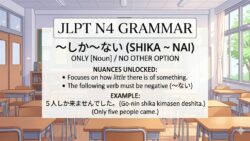
【JLPT N4】Unlocking the Nuances of “〜しか〜ない”

〜しか〜ない is a structure used to express limitation, restriction, or exclusivity. This pattern carries an emotional weight: a tone of dissatisfaction, regret etc.

2026.03.26
article-jlpt-grammar

【JLPT N4】Understanding JLPT Grammar Point 〜たらどうですか

〜たらどうですか functions as a polite and thoughtful suggestion implying the speaker believes the suggestion is a good, practical solution to a problem.
2026.03.26
article-jlpt-grammar

【JLPT N4】Mastering the Art of Continuity 〜続ける(Tsuzukeru)

「〜続ける」(〜tsuzukeru) doesn't just mean "continue"; it conveys a specific, focused sense of uninterrupted action, persistence, and often, effort.
2026.03.26
article-jlpt-grammar

【JLPT N4】〜つもりだ (tsumori da) to Express Intent and Plans

〜つもりだ (tsumori da) is foundational for clearly communicating your intentions, setting goals, and even describing complex personal assumptions.
2026.03.26
article-jlpt-grammar

【JLPT N4】〜て for Cause and Reason

The fundamental principle when 〜て expresses cause is this: The first clause (the reason) led naturally and often unavoidably to the second clause (the result).
2026.03.26
article-jlpt-grammar

【JLPT N4】〜ていく (Te Iku)

When いく (iku) attaches to the te-form, it stops functioning as the verb "to go" and starts acting as a tool that modifies the flow or manner of the action.
2026.03.26
article-jlpt-grammar

【JLPT N4】Unlocking the Power of 〜ておく(Te Oku)

The structure 「〜ておく」 is formed by combining the te-form of a verb with the verb おく (oku), which literally means "to put" or "to place."
2026.03.26
article-jlpt-grammar

【JLPT N4】Polite Requests: How to Use ~ていただけませんか

~te itadakemasenka is the most "useful" polite request form since it strikes the perfect balance between being incredibly respectful and perfectly natural.
2026.03.26
article-jlpt-grammar

【JLPT N4】”Go and Come Back”: 〜てくる for Natural Japanese

In this guide, we are going to break down the "go and come back" nuance of 〜てくる so you can start sounding less like a translation machine and more like a local.
2026.03.26
article-jlpt-grammar

【JLPT N4】Art of “Even If” in Japanese: A Comprehensive Guide to ~ても

The core of this grammar point is the Te-form. If you are comfortable with the Te-form, you are 90% of the way there. The simple rule is: Te-form + も (mo).
2026.03.26
Back to top
Copied title and URL