Tips for JLPT from the Native Japanese Teacher

Tips to efficiently pass the JLPT - Advice from the native Japanese teacher - 1) Know the structure 2)Time managing 3) Daily training

→ Free Learning Platform ←

N4

article-jlpt-grammar

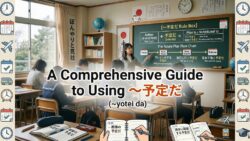
A Comprehensive Guide to Using ~予定だ (~yotei da) 

~予定だ is "I plan to..." or "It is scheduled to...". Unlike "tsumori," which is about what you want to do in your heart, "yotei" is about what is on the calendar.

2026.03.26
article-jlpt-grammar

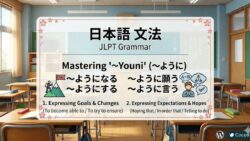
Change in state: How to Use 〜ようになる (Youni Naru)

〜ようになる expresses a change in state or ability. It describes a transition from State A to State B, going from "not being able to do A" to "being able to do it".
2026.03.26
article-jlpt-grammar

Mastering the Making an Effort: A Guide to ~Youni Suru

〜ようにする is used when you are making a conscious effort to do something. It implies you are aiming for a certain result, often by being mindful of your actions.
2026.03.26
article-jlpt-grammar

Mastering the Art of Conscious Effort with Youni Shite Iru

〜ようにしている is used to describe an ongoing effort to do (or not do) something. It implies the action isn’t easy, but you are working hard to make it happen.
2026.03.26
article-jlpt-grammar

~Youni for the JLPT: Expressing Your Goals and Expectations

ように is used when you are aiming for a certain state or outcome. You are doing an action now so that a specific situation becomes possible later.
2026.03.26
article-jlpt-grammar

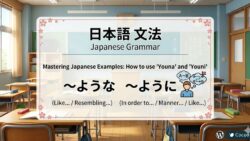
Mastering Japanese Examples: How to use “Youna” and “Youni”

〜ような & 〜ように are used to point at a specific example that represents a broader category. Think of it as a bridge between a general idea and a concrete instance.
2026.03.26
article-jlpt-grammar

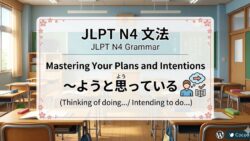
Mastering Your Plans and Intentions with 〜ようと思っている

〜ようと思っている is used to describe an intention that the speaker has had for some time. It suggests that you have been thinking about a certain action for a while.
2026.03.26
article-jlpt-grammar

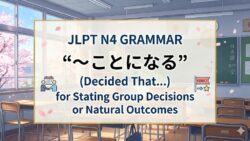
【JLPT N4】〜ことになる for Natural Conversation

「〜ことになる」 translates roughly to: "It has been decided that...", "It turns out that...", or "It is scheduled to be...".
2026.03.26
article-jlpt-grammar

【JLPT N4】“〜させてください” for Seeking Permission and Making Requests

〜てもいいですか (〜te mo ii desu ka) is useful for casual inquiries, but 〜させてください carries a weight of formality and implies a deeper desire to perform the action.
2026.03.26
article-jlpt-grammar

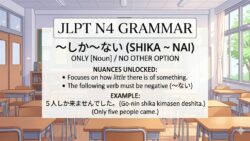
【JLPT N4】Unlocking the Nuances of “〜しか〜ない”

〜しか〜ない is a structure used to express limitation, restriction, or exclusivity. This pattern carries an emotional weight: a tone of dissatisfaction, regret etc.
2026.03.26
\Share IPPO with friends/
Back to top
Copied title and URL