Are You Struggling to Describe States and Results in Japanese?
If you’re preparing for the JLPT, especially at the N3 or N2 level, you’ve likely noticed a common frustration: Japanese loves to describe states—not just actions. Unlike many Western languages that focus heavily on who did what, Japanese often prioritizes the resulting arrangement, condition, or status of an object or situation.
You might feel confident using the basic 〜ている (te iru) form to describe ongoing actions (e.g., 食べる taberu / 食べている tabete iru – is eating). But what happens when you need to describe something that has been prepared, or a state that occurred naturally, such as a window being open, or documents being arranged?
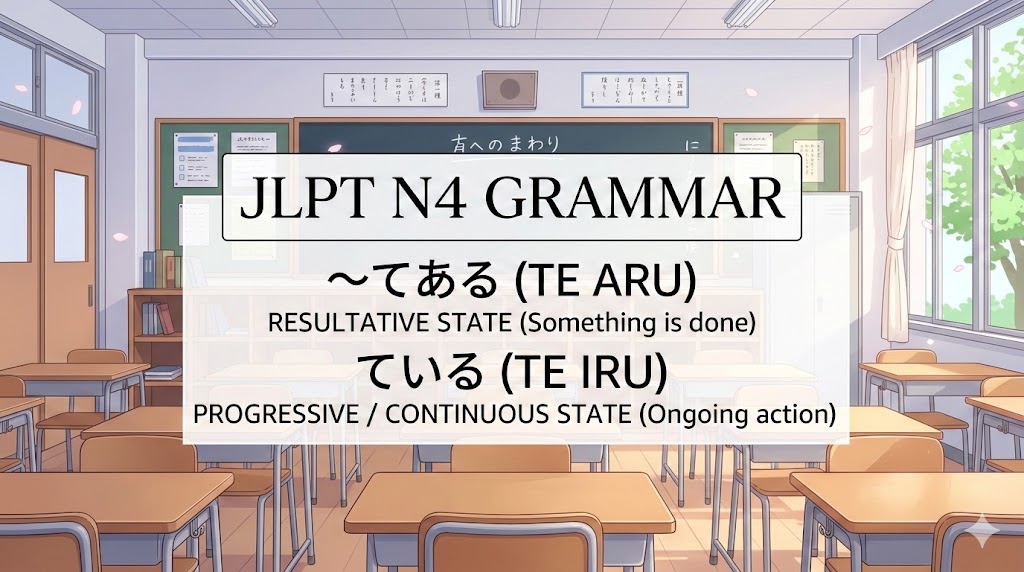
This is where the confusion often begins. Japanese uses two seemingly similar but fundamentally different grammar structures to handle these scenarios: 〜てある (te aru) and the sometimes tricky (自動詞)ている (jidoushi te iru). 〜てある describes a state someone prepared on purpose (窓が開けてある, the window has been opened), while (自動詞)ている describes a state that just exists (窓が開いている, the window is open). Mastering these two forms is absolutely crucial for sounding natural and passing those higher-level JLPT comprehension sections.
Before diving into the grammar detail, here is the JLPT N4 complete guide:
The Ultimate JLPT N4 Complete Guide: Your Gateway to Working and Living in Japan
- 〜てある (te aru) describes a state that someone created on purpose, usually as preparation: 会議の資料は、テーブルの上に並べてあります (The documents for the meeting have been arranged on the table).
- To form 〜てある, use a transitive verb in the te-form + ある (開ける → 開けてある). To form (自動詞)ている, use an intransitive verb in the te-form + いる (開く → 開いている).
- (自動詞)ている describes a state that simply exists or happened naturally, without focusing on who caused it: 古い窓ガラスが割れている (The old window pane is broken).
- The difference between 〜てある and (自動詞)ている is intent: 窓が開けてある means someone opened the window for a reason, while 窓が開いている only says the window is open.
- A common mistake is using 〜ている with a transitive verb to describe a state: ドアを閉めている means someone is closing the door right now. For the state, say ドアが閉めてある or ドアが閉まっている.
What does 〜てある (te aru) mean?
The Core Concept of 〜てある
The grammar pattern 〜てある (te aru) is primarily used to describe a resulting state where an action was performed intentionally by someone in the past, and that resulting arrangement or state persists now.
Think of 〜てある as the structure you use when describing preparation or arrangement.
- It always uses a Transitive Verb (他動詞 / tadoushi). Transitive verbs require an object (marked by を) because the action is directed at something.
- Focus on the Resulting State: While someone performed the action (the agent), the focus of the sentence is the resulting state of the object, which is usually ready or prepared for a future purpose.
- Implied Intent: The speaker knows (or assumes) that the action was done with a specific purpose or goal in mind.
A simple way to translate it mentally is: “The [object] has been put into a state of [verb] in preparation for [purpose].”
How do you form 〜てある?
To form 〜てある, put a transitive verb in the te-form and add ある. The structure is straightforward:
Transitive Verb (V-te form) + ある
When forming sentences with 〜てある, the object of the preparation is usually marked by the particle が (ga), shifting the focus away from the active agent and onto the object’s current state. Although you start with a transitive verb (which usually takes を), when describing the resulting state using 〜てある, the particle often changes to が.
Example Verbs often used with 〜てある:
- 貼る (haru – to stick/paste) → 貼ってある (hatte aru – has been posted/stuck)
- 用意する (youi suru – to prepare) → 用意してある (youi shite aru – has been prepared)
- 開ける (akeru – to open something) → 開けてある (akete aru – has been opened [intentionally])
Real-Life Example Sentences for 〜てある (Te Aru)
Example 1: Preparing Documents
会議の資料は、テーブルの上に並べてあります。
Kaigi no shiryō wa, tēburu no ue ni narabete arimasu.
The documents for the meeting have been arranged (lined up) on the table.
Analysis: The transitive verb here is 並べる (naraberu – to arrange/line up). Someone intentionally arranged them on the table in preparation for the meeting. The focus is on the current, orderly state of the documents.
Example 2: Making Reservations
レストランの予約はもうしてありますから、ご心配なく。
Resutoran no yoyaku wa mō shite arimasu kara, goshinpai naku.
The restaurant reservation has already been made, so don’t worry.
Analysis: The transitive verb is 予約する (yoyaku suru – to make a reservation). This action was performed with the intent of securing a place to eat later. The current state is “reserved.”
Example 3: Setting the Scene
お客様が来るので、玄関に花瓶が飾ってある。
Okyaku-sama ga kuru node, genkan ni kabin ga kazatte aru.
Because a guest is coming, a vase has been displayed (decorated) at the entrance.
Analysis: 飾る (kazaru – to decorate/display) is transitive. The state of the vase being displayed is the result of a deliberate, purposeful action aimed at making the entrance welcoming for the guest.
What does (自動詞)ている (jidoushi te iru) mean?
The Essence of (自動詞)ている
(自動詞)ている, which is 〜ている used with an Intransitive Verb (自動詞 / jidoushi), generally describes a resulting state that occurred spontaneously or naturally, without direct external human interference being the main focus.
While you might be used to 〜ている describing ongoing actions (e.g., 走っている hashitte iru – is running), when paired with specific intransitive verbs, it describes a state of being resulting from a change.
- It always uses an Intransitive Verb (自動詞 / jidoushi). Intransitive verbs describe an action or state that happens to the subject itself (marked by が).
- Focus on the Resulting State: The action is complete, and the focus is on the permanent or temporary state that is a consequence of that action.
- Natural Occurrence: This form implies that the state exists without emphasizing the intentional action of a specific person. It just is that way.
A helpful mental translation is: “The [subject] is currently in the state of having [verb-ed].”
How do you form (自動詞)ている?
To form (自動詞)ている, put an intransitive verb in the te-form and add いる. The structure is also straightforward:
Intransitive Verb (V-te form) + いる
Crucially, the subject of the sentence is always marked by the particle が (ga).
Example Verbs often used with (自動詞)ている to describe a state:
- 開く (aku – to open [itself]) → 開いている (aite iru – is open)
- 壊れる (kowareru – to break [itself]) → 壊れている (kowarete iru – is broken)
- 落ちる (ochiru – to fall [itself]) → 落ちている (ochite iru – is dropped/lying there)
Real-Life Example Sentences for (自動詞)ている (Jidoushi Te Iru)
Example 1: Describing Damage
古い窓ガラスが割れている。
Furui mado garasu ga warete iru.
The old window pane is broken (in a broken state).
Analysis: The intransitive verb is 割れる (wareru – to break/crack). This describes a resulting state—the glass is currently in a broken condition. We are not focusing on who broke it, just the current condition.
Example 2: Describing Position
彼はいま、ソファに座っている。
Kare wa ima, sofa ni suwatte iru.
He is currently sitting on the sofa.
Analysis: The verb 座る (suwaru – to sit down) is an intransitive verb of movement that, when used with 〜ている, describes the resulting state of being seated, not the continuous action of lowering oneself.
Example 3: Describing Natural Change
山に雪がたくさん積もっている。
Yama ni yuki ga takusan tsumotte iru.
A lot of snow has accumulated on the mountain.
Analysis: 積もる (tsumoru – to accumulate) is intransitive. The sentence describes the resulting state of heavy snow accumulation, which happened naturally over time.
What is the difference between 〜てある and (自動詞)ている?
〜てある describes intentional preparation, while 自動詞〜ている describes natural/unintended resulting states. For JLPT success, distinguishing 〜てある from 自動詞〜ている is the most important skill.
How do you tell 〜てある and (自動詞)ている apart?
To tell 〜てある and (自動詞)ている apart, look at the verb pair (transitive vs. intransitive) and the concept of human intent.
| Grammar Pattern | Verb Type | Implied Meaning | Particle Focus |
|---|---|---|---|
| 〜てある (Te Aru) | Transitive (他動詞) | The state results from an intentional act of arrangement or preparation (done for a purpose). | Object (marked by が/を) |
| (自動詞)ている (Te Iru) | Intransitive (自動詞) | The state results from a natural or spontaneous change (the state just exists). | Subject (marked by が) |
The Classic Example: The Open Window
This is the most frequent point of confusion. Japanese distinguishes clearly between a window that was opened by someone on purpose, and a window that is simply open due to natural circumstances (or accidentally).
Scenario A: Intentional Opening (Te Aru)
窓が開けてある。 (Mado ga akete aru.)
The window has been opened (e.g., to let in fresh air, or in preparation for cleaning).
Verb: 開ける (akeru – Transitive). This implies someone decided to open it for a reason.
Scenario B: Natural/Resulting State (Jidoushi Te Iru)
窓が開いている。 (Mado ga aite iru.)
The window is open (it’s just in that state).
Verb: 開く (aku – Intransitive). This just describes the state; we don’t know or care why it’s open—it just is.
What mistakes do learners make with 〜てある and 〜ている?
Learners most often confuse the transitive form of 〜ている (ongoing action) with the state-describing forms 〜てある and (自動詞)ている, and they also mix up the particles を and が. Remember that the verb type is everything!
Mistake 1: Using Transitive Te Iru for a State
If you say: ドアを閉めている (Doa o shimete iru), this means “Someone is currently in the middle of closing the door.” (Ongoing action)
Correct State (Intended): ドアが閉めてある (Doa ga shimete aru). The door is closed because someone closed it for a reason.
Correct State (Natural): ドアが閉まっている (Doa ga shimatte iru). The door is closed (it is in that state).
Mistake 2: Mixing Particles
While the transitive verb 開ける takes を when describing the action (窓を開ける), when you use 〜てある to describe the resulting state, the focus often shifts to the object, prompting the use of が.
Always ensure that when describing a state (either 〜てある or 自動詞〜ている), the object/subject is marked by が.
- 〜てある: テーブルに水が置いてある (Mizu ga oite aru – Water is placed on the table.)
- 〜てある: ポスターが貼ってある (Posutā ga hatte aru – A poster has been put up.) (貼る is transitive, so it takes 〜てある, showing arrangement)
- 自動詞〜ている: 花が咲いている (Hana ga saite iru). (Intransitive, natural state)
Quick Check: Transitive vs. Intransitive
If the verb can take an object (を), it’s transitive. Use 〜てある to describe intentional results.
If the verb cannot take an object (を) and the action happens to the subject (が), it’s intransitive. Use 〜ている to describe natural/unintended results.
Advanced Insight: The Philosophy Behind the Grammar
Focusing on the Environment, Not the Actor
Understanding these grammar points helps you grasp a core concept of the Japanese language: its tendency towards depersonalization.
In English, we often use the passive voice to avoid naming the actor (“The documents were prepared”). However, 〜てある goes a step further. It doesn’t just make the sentence passive; it completely removes the necessity of mentioning the actor while heavily focusing on the existing condition of the environment or the object itself.
When you use 〜てある, you are essentially saying, “The state of the world is this way due to prior, purposeful action.” This focus on the arranged environment is incredibly common in workplaces and public descriptions in Japan, where efficiency and readiness are highly valued.
When you use 自動詞〜ている, you are simply reporting a fact about the world—a state that exists, independent of immediate human control or purpose. This reflects a linguistic inclination to observe and report on phenomena as they are.
By internalizing this philosophical distinction—Purposeful Arrangement vs. Natural State—you move beyond simply memorizing rules and begin to think more like a native speaker.
Your Next Step Towards JLPT Success
The journey to mastering JLPT grammar, especially intricate pairs like 〜てある and (自動詞)ている, requires dedicated practice. These structures are not just academic exercises; they are vital tools for expressing nuance and clarity in everyday Japanese conversation.
To solidify your understanding:
- Flashcard Practice: Create flashcards for common transitive/intransitive pairs (開ける/開く, 閉める/閉まる, 始める/始まる, 汚す/汚れる).
- Contextualize: Whenever you see an object in your environment (e.g., a dish in the sink, a light switch turned on), try to describe its state in Japanese. Was it done intentionally (〜てある)? Or is it just in a natural state (自動詞〜ている)?
- Listen Actively: Pay close attention to how native speakers describe prepared environments (e.g., “The lunch is already 作ってある (tsukutte aru),” or “The lights are 消えている (kiete iru)“).
Don’t be discouraged if you mix them up initially. The distinction between intentional placement and natural result is subtle but powerful. Keep practicing these crucial grammar points, and you will undoubtedly see significant improvement in your Japanese comprehension and fluency, bringing you one step closer to crushing that JLPT goal.
頑張ってください! (Ganbatte kudasai! – Good luck!)
IPPO, JLPT training platform is always here to help you to pass the JLPT!!

We offer the Best Online Japanese Learning (All Free), and our goal is to facilitate the adoption into life in Japan. Our service “IPPO” is made by native Japanese teachers and professionals. The tips we share with you can help you to learn Japanese efficiently and pass JLPT (Japanese Language Proficiency Test).