Table of Contents
~nara (〜なら)
If you have been studying Japanese for a while, you have probably hit that frustrating wall known as the “Conditionals.” In English, we mostly get away with using the word “if.” But in Japanese, we are suddenly faced with a four-headed monster: ~to, ~ba, ~tara, and ~nara.
I know exactly how you feel. You’re sitting in the JLPT exam, or perhaps you’re trying to have a conversation with a Japanese friend, and you freeze. You want to say “If you’re going to the convenience store, buy me a coffee,” but you start cycling through the grammar rules in your head. Is it ikuto? Iktara? Ikeba? Or ikunara?
Today, we are going to demystify one of the most useful and unique members of this family: ~nara (〜なら). By the end of this guide, you won’t just know the “textbook definition”; you’ll understand the “soul” of this grammar point and how to use it like a native speaker.
Before diving into the grammar detail, here is the JLPT N4 complete guide:
The Ultimate JLPT N4 Complete Guide: Your Gateway to Working and Living in Japan
The Core Concept of Nara
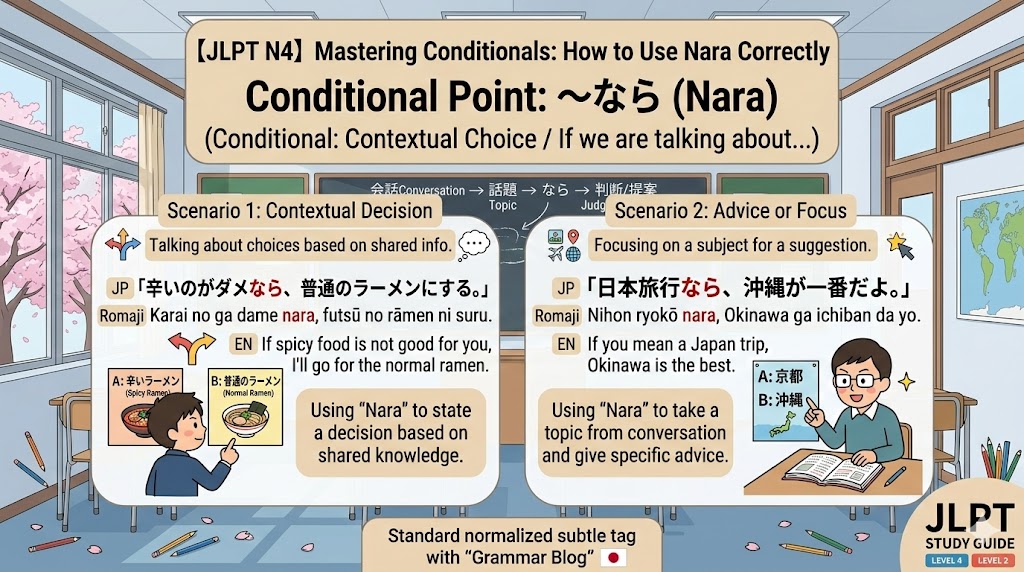
Before we dive into the technical rules, let’s talk about what ~nara actually does. If I had to give it a nickname, I would call it “The Context Conditional.”
Unlike other conditionals that focus on cause-and-effect (like “If I drop this glass, it will break”), ~nara is used when you are picking up on a topic that someone else mentioned, or a situation that has just become apparent. It’s like saying, “If that’s the situation we are talking about, then…” or “Based on that information, here is my suggestion.”
How to Form Nara
One of the best things about ~nara is that it is incredibly easy to conjugate. Unlike the ~ba form or the ~tara form, you don’t have to do much “mangling” of the words. You mostly just stick it onto the end of the dictionary form.
1. Nouns
This is the most common usage. Just add nara directly to the noun.
Example: Nihon (Japan) → Nihon nara
2. Na-Adjectives
Just like nouns, you add nara directly. You do not need to keep the “na.”
Example: Suki (Like) → Suki nara
3. I-Adjectives
Add nara to the dictionary form (the one ending in ~i).
Example: Atsui (Hot) → Atsui nara
4. Verbs
Add nara to the dictionary form. (Sometimes you will see no nara or n nara, which adds a bit of explanatory emphasis, but for the JLPT N4/N3 level, focusing on the dictionary form is your best bet).
Example: Iku (Go) → Iku nara
Three Real-Life Scenarios for Nara
To really “get” this grammar, you need to see it in action. Let’s look at three situations where ~nara is the perfect choice over any other conditional.
Giving a Recommendation
Imagine your friend says, “I really want to eat some great sushi while I’m in Tokyo.” You have a specific place in mind. Since you are responding to the topic they introduced (sushi), you use nara.
Japanese: 寿司を食べるなら、築地が一番いいですよ。
Reading: Sushi o taberu nara, Tsukiji ga ichiban ii desu yo.
English: If (you are talking about) eating sushi, Tsukiji is the best place.
In this case, the friend hasn’t eaten yet. You are saying, “In the event that you want to eat sushi, here is my advice.”
Providing a Solution Based on a Condition
Imagine your coworker looks pale and says, “I have a terrible headache.” You respond based on that new information.
Japanese: 頭が痛いなら、今日は早く帰ったほうがいいですよ。
Reading: Atama ga itai nara, kyou wa hayaku kaetta hou ga ii desu yo.
English: If your head hurts (if that’s the case), it’s better to go home early today.
Notice how nara connects the situation (headache) to the advice (go home). You aren’t saying the headache caused them to go home yet; you are offering a suggestion based on the context.
The “Limitation” Usage
Sometimes we use nara to say “If it’s only X, then okay/yes.” For example, someone asks if you can speak Japanese. You might be humble and say you can only speak a little.
Japanese: ひらがななら、書けます。
Reading: Hiragana nara, kakemasu.
English: If it’s (just) Hiragana, I can write it.
Here, you are setting a boundary. “Don’t ask me for Kanji, but if we are talking about Hiragana, I can do that.” This is a very common way to use nara in daily Japanese life to clarify what you are capable of or what you are willing to do.
The “Nara” Time Machine: A Warning for Learners
This is where most students get tripped up. In English, we usually think of “if” as a sequence: First Part A happens, then Part B happens.
“If it rains (Part A), I will stay home (Part B).”
However, ~nara is special because it can work backward in time. This is why we can’t always replace ~tara with ~nara.
Consider this sentence: “If you are going to go to Japan, buy a suitcase.”
In this case, you buy the suitcase before you go to Japan. In Japanese, when Part B (buying the suitcase) happens before Part A (the trip), you must use nara.
Correct: 日本に行くなら、スーツケースを買ってください。
Wrong: 日本に行ったら、スーツケースを買ってください。 (This would mean “Buy a suitcase after you arrive in Japan,” which might be too late!)
If you remember this “Time Machine” rule—that nara is for things you do in preparation for or based on the idea of the condition—you will avoid the most common mistake on the JLPT.
Common Pitfalls and How to Avoid Them
Let’s look at a few other areas where learners often struggle when using ~nara.
Do not use it for Natural Consequences
If you want to say “If you press this button, the water comes out,” do not use nara. For natural laws or mechanical operations, use ~to. Using nara there would sound like you are giving the machine advice, which is quite strange!
Nara vs. Tara
Think of ~tara as “After this happens…” and ~nara as “On the topic of…”
If you say “If it becomes 5:00 PM, let’s leave,” you should use tara (5-ji ni nattara) because the time actually has to pass first. If you use nara, it sounds like you are discussing the abstract concept of 5:00 PM, which doesn’t fit the situation of waiting for a specific time.
Don’t over-rely on “If”
Sometimes nara is translated as “since” or “as long as.” If you only think of it as “if,” you might miss out on its versatility. When a Japanese person says “Ashita nara aiteimasu” (If it’s tomorrow, I’m free), they are effectively saying, “Tomorrow is the specific condition under which I am available.” It’s much more about selection and context than a simple gamble on whether something will happen.
Final Thoughts and Study Tip
Mastering ~nara is a huge step toward sounding more natural in Japanese. It moves you away from the “robotic” cause-and-effect sentences and allows you to react to what people are saying in real-time. It shows that you are listening and responding to the specific context of the conversation.
Your homework: The next time you are in a Japanese restaurant or talking to a language partner, try to use the “Limitation” usage. If they ask, “Can you eat spicy food?” instead of just saying “Yes,” try saying: “Sukoshi nara daijoubu desu” (If it’s a little bit, it’s okay). It’s a small change, but it makes you sound incredibly fluent!
Keep practicing, keep making mistakes, and don’t let the conditionals scare you. You’ve got this!
Summary of Nara Rules
- Nouns/Na-Adjectives: Just add nara.
- Verbs/I-Adjectives: Add nara to the dictionary form.
- The “Vibe”: Use it to respond to a topic or give advice based on context.
- The Secret: Use it when the result (Part B) needs to happen before the condition (Part A).
Good luck with your JLPT studies!
IPPO, JLPT training platform is always here to help you to pass the JLPT!!

We offer the Best Online Japanese Learning (All Free), and our goal is to facilitate the adoption into life in Japan. Our service “IPPO” is made by native Japanese teachers and professionals. The tips we share with you can help you to learn Japanese efficiently and pass JLPT (Japanese Language Proficiency Test).