- What is 〜ていく (Te Iku)?
- Feeling Stuck? Why Auxiliary Verbs Like 〜ていく Are Crucial for JLPT Success
- The Core Mechanics: Deconstructing the 〜ていく Structure
- Diving Deep into the Two Key Meanings of 〜ていく
- Real-Life Application: Essential Phrases for Daily Conversation and JLPT Contexts
- Navigating the Pitfalls: Common Mistakes and Crucial Distinctions
- Advanced Insight: The Intention and Commitment of 〜ていく
- Final Thoughts on Your JLPT Journey
What is 〜ていく (Te Iku)?
Welcome, dedicated JLPT aspirants! If you’ve been studying Japanese for a while, you know the language isn’t just about memorizing vocabulary and Kanji. The true challenge—and often the source of major confusion—lies in understanding the subtle yet crucial nuances of auxiliary verbs.
These little additions that attach to the te-form of main verbs—such as 〜てしまう (te shimau), 〜てみる (te miru), and especially 〜ていく (te iku)—can completely change the meaning of a sentence, transforming simple actions into expressions of regret, experimentation, or, in the case of 〜ていく, movement away or progress over time.
Do you sometimes struggle to distinguish between simply doing something in the future and continuing to do it into the future? Do you confuse going somewhere with the process of getting there? You are absolutely not alone! The dual nature of 〜ていく, encompassing both physical movement and temporal progression, often trips up even advanced learners.
This comprehensive guide is designed to demystify 〜ていく, providing you with clear rules, contextual examples, and critical comparisons necessary not only to pass the JLPT but also to sound natural and expressive in everyday Japanese conversation. By the time you finish this article, you will master the art of looking forward—both spatially and temporally—in Japanese.
Before diving into the grammar detail, here is the JLPT N4 complete guide:
The Ultimate JLPT N4 Complete Guide: Your Gateway to Working and Living in Japan
Feeling Stuck? Why Auxiliary Verbs Like 〜ていく Are Crucial for JLPT Success
In Japanese grammar, the te-form acts like a linguistic bridge, connecting main verbs to various auxiliary elements (often called secondary verbs or aspect markers). When いく (iku), which primarily means “to go,” attaches to the te-form, it stops functioning purely as the verb “to go” and starts acting as an aspectual marker—a tool that modifies the flow or manner of the action.
Understanding these aspects is vital for the JLPT because tests frequently rely on distinguishing subtle differences in meaning (especially in reading comprehension and grammar sections). Mastering 〜ていく means you are grasping the concept of linguistic directionality—a core feature of how Japanese speakers perceive and describe time and space.
Let’s dive into the core structure and the two main dimensions of 〜ていく.
The Core Mechanics: Deconstructing the 〜ていく Structure
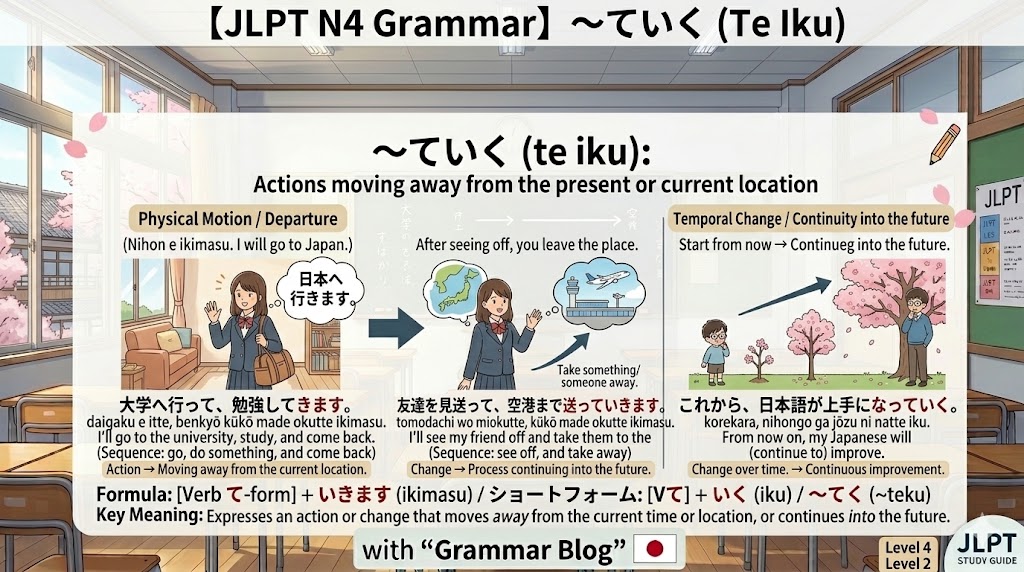
The structure for using this grammar point is straightforward:
Verb (in Te-form) + いく (iku)
Example: 食べる (taberu, to eat) → 食べていく (tabete iku)
Example: 勉強する (benkyō suru, to study) → 勉強していく (benkyō shite iku)
While the construction is simple, the meaning depends heavily on the context. In general, 〜ていく signals an action or change that is directed away from the speaker/reference point. This fundamental directional sense manifests in two powerful ways:
Meaning 1: Action Accompanied by Movement Away (Spatial Direction)
This is the most literal interpretation. When used this way, the action described by the main verb is performed, and then the subject proceeds to move away from the current location (the location of the speaker or the established reference point).
It emphasizes that the subject is performing an action (V-te) and then physically departing, often continuing the action as they leave or having performed the action in preparation for departure.
Key Concept: Departing from the Reference Point.
Imagine you are standing at the front door. If you say, “I’ll go buy groceries,” you are performing the action (buying) and then moving away from the door.
Meaning 2: Temporal Progression and Future Development (Direction in Time)
This is the meaning most critical for expressing long-term plans, goals, and inevitable changes, making it highly frequent in advanced Japanese and JLPT materials. Here, “いく” symbolizes the future—a timeline extending away from the present moment.
The action or state of the main verb (V-te) is something that will continue or progress steadily from the present moment into the future. It signifies a gradual process, a continuous effort, or an anticipated change.
Key Concept: Progression towards the Future.
In this context, we are not talking about physical space, but the space of time. The present moment is the reference point, and the action or state is advancing along the temporal axis toward the future.
Diving Deep into the Two Key Meanings of 〜ていく
To truly master this auxiliary verb, you must internalize the “awayness” it implies, whether that “awayness” is physical distance or temporal distance.
The Dynamic of Spatial Movement: V-te + いく
When 〜ていく is used spatially, it often relates to simple, everyday actions involving motion:
Example Scenario: A teacher speaking to a student who has finished asking a question.
先生は「もう質問はない?じゃあ、帰っていく時間ですよ」と言った。
Sensei wa “Mō shitsumon wa nai? Jā, kaette iku jikan desu yo” to itta.
The teacher said, “Do you have any more questions? Well, it’s time for you to go home (and move away from here).”
Notice how the teacher, who is the reference point (staying in the classroom), perceives the student’s action of going home as moving away from the teacher’s location. The movement is central.
Another common usage involves performing an action and then proceeding:
友達に挨拶をして、パーティー会場から出ていった。
Tomodachi ni aisatsu o shite, pātī kaijō kara dete itta.
I greeted my friend and left (walking away from the venue/speaker).
The verb “出る (deru)” (to leave) is already a movement verb, but adding 〜ていく enhances the sense of movement and final departure from the speaker’s vantage point.
The Power of Temporal Progression: V-te + いく
This usage is particularly powerful for expressing goals, predictions, and long-term trends—elements frequently tested in the JLPT N2 and N1 levels. The action described by the V-te form is not a one-time event but a continuous process unfolding into the future.
1. Continuous Action/Effort: Used when talking about ongoing actions necessary to achieve a future goal.
来年の試験に向けて、今の調子で努力していく必要がある。
Rainen no shiken ni mukete, ima no chōshi de doryoku shite iku hitsuyō ga aru.
In preparation for next year’s exam, it is necessary to continue making efforts at the current pace.
Here, the action “努力する (doryoku suru – to make an effort)” is not just done tomorrow, but progressively carried out over the span of many months.
2. Gradual Change or Development: Used to describe processes of transformation that naturally evolve over time.
デジタル技術の発展によって、私たちの生活は今後大きく変わっていくだろう。
Dejitaru gijutsu no hatten ni yotte, watashitachi no seikatsu wa kongo ōkiku kawatte iku darō.
Due to the development of digital technology, our lives will likely continue to change significantly from now on.
The change (変わる, kawaru) is viewed as an irreversible, ongoing progression directed towards the future.
Real-Life Application: Essential Phrases for Daily Conversation and JLPT Contexts
To solidify your understanding, let’s look at three practical examples, focusing on how the context dictates whether the meaning is spatial or temporal.
Example 1: The Sense of Starting a Journey (Physical Movement)
This example combines a preparatory action with physical departure. It’s common in formal settings like leaving an office or when giving instructions.
日本語: 「山田さん、もう時間なので、先に失礼していきます。」
Romaji: “Yamada-san, mō jikan nanode, saki ni shitsurei shite ikimasu.”
English Translation: “Mr. Yamada, since it’s late, I will excuse myself and leave first (moving away from here).”
Analysis:
The main verb is 失礼する (shitsurei suru), meaning “to excuse oneself/to be rude,” often used as a polite way to announce departure. By adding 〜ていく, the speaker emphasizes the act of departing. The speaker is establishing the current location (office/meeting room) as the reference point and signaling their movement away from it and away from the person they are speaking to (Yamada-san). This is a vital phrase for Japanese workplace etiquette.
Example 2: Expressing Future Goals and Continuous Improvement (Temporal Progression)
This is the most common temporal usage, expressing an intention or commitment to continued action.
日本語: 「N1合格に向けて、これからも諦めずに挑戦していきます。」
Romaji: “N1 gōkaku ni mukete, korekara mo akiramezu ni chōsen shite ikimasu.”
English Translation: “Towards passing the N1, I will continue to challenge myself without giving up from now on.”
Analysis:
The verb is 挑戦する (chōsen suru), meaning “to challenge.” The goal (passing N1) is in the future. The use of 〜ていく here assures the listener (or oneself) that the act of challenging will not stop today or tomorrow, but will persistently progress into the future until the goal is met. It’s the linguistic equivalent of drawing a straight line from the present moment to the future goal.
Example 3: Describing Gradual Change Over Time (Observation/Prediction)
Used frequently in news reports, academic discussions, or when describing environmental or social phenomena, this example highlights irreversible, ongoing change.
日本語: 「日本の人口は、今後も減っていく一方だと予測されている。」
Romaji: “Nihon no jinkō wa, kongo mo hette iku ippō da to yosoku sarete iru.”
English Translation: “It is predicted that Japan’s population will continue to decrease from now on.”
Analysis:
The verb 減る (heru) means “to decrease.” This is not a sudden, one-off decrease, but a continuous demographic trend. Adding 〜ていく captures the dynamic nature of this change—it began in the past (or present) and is proceeding inevitably towards the future. This form is often paired with temporal adverbs like 今後 (kongo, from now on) or これから (korekara, henceforth).
Navigating the Pitfalls: Common Mistakes and Crucial Distinctions
While 〜ていく is essential, its cousin, 〜てくる (te kuru), is equally important. Misunderstanding the difference between these two is the single most common grammatical mistake JLPT candidates make regarding directional auxiliary verbs.
The Everlasting Challenge: 〜ていく vs. 〜てくる
The key to distinguishing between them lies in the concept of the Reference Point, which is usually the speaker’s location or the present time.
| Grammar Form | Directionality (Spatial) | Directionality (Temporal) |
|---|---|---|
| 〜ていく (Te iku) | Moving Away from the reference point. | Progressing Toward the Future from the present. |
| 〜てくる (Te kuru) | Moving Toward the reference point. | Continuing From the Past up to the present. |
Example Comparison (Spatial):
- 買って行く (Katte iku): I will buy it somewhere else and take it away (from here). (Example: Buying a gift to take to a party.)
- 買って来る (Katte kuru): I will buy it somewhere else and bring it back (to here). (Example: Buying milk and bringing it home.)
Example Comparison (Temporal):
- 暖かくなっていく (Attakaku natte iku): It will gradually become warmer (from now into the future).
- 暖かくなってきた (Attakaku natte kita): It has become warmer (the change started in the past and has arrived at the present).
If you internalize that いく means movement away/future and くる means movement toward/past-to-present, you can avoid most errors in JLPT grammar questions.
Not Just for Movement: Differentiating 〜ていく from Simple Future Tense
A common trap for learners is assuming that V-te + いく is simply another way of saying “I will V in the future.” This misses the vital aspectual meaning.
Consider the difference between:
1. 明日、図書館で勉強する。 (Ashita, toshokan de benkyō suru.)
I will study at the library tomorrow. (A simple, definite future action.)
2. 明日からも、図書館で勉強していく。 (Ashita kara mo, toshokan de benkyō shite iku.)
Starting tomorrow, I will continue studying at the library (as a sustained process).
Sentence 1 is a plan for a single event. Sentence 2 implies continuity and process. By using 〜ていく, the speaker commits to the action spanning a period of time, emphasizing the process of persistence rather than just the single act.
The Nuance of Permanent Change
When 〜ていく is used to describe changes, it often implies a change that is moving toward a state of being maintained or is part of a larger, ongoing trend. It’s useful for talking about things like technology, language skills, climate, or societal shifts.
この国では、高齢化がさらに進んでいくだろう。
Kono kuni de wa, kōreika ga sarani susunde iku darō.
In this country, the aging population will continue to advance further.
The verb “進む (susumu, to advance)” combined with 〜ていく strongly conveys the unstoppable nature of the demographic change, moving irreversibly into the future.
Advanced Insight: The Intention and Commitment of 〜ていく
For JLPT N2 and N1, you should recognize that V-te + いく often carries a strong connotation of intention and deliberate effort when referring to personal future actions.
When you say, “I’m going to use my Japanese skills at work (仕事で日本語を使っていきます),” you are not just making a prediction; you are expressing a commitment to continually implement and improve that skill over time in that professional environment. This commitment to continuity gives the phrase more weight and seriousness than a simple future tense statement.
This subtle difference is why politicians, business leaders, and students setting goals frequently use 〜ていく—it communicates dedication to a process that moves forward.
Final Thoughts on Your JLPT Journey
Congratulations on dedicating the time to dive deep into 〜ていく. This grammar point is more than just a conjugation rule; it is a mechanism that allows you to express the dynamic flow of life, whether that means physically leaving a room or watching a long-term plan unfold.
As you continue your JLPT studies, pay close attention to the directionality implied by auxiliary verbs. Whenever you see いく, think “away” and “future progression.” Whenever you see くる, think “toward” and “past accumulation.”
Practice using these structures in context, especially focusing on how they are used to describe long-term goals and societal trends in news articles and study materials. By doing so, you will not only ace the grammar section but also gain a more profound, nuanced understanding of Japanese aspect and time perception.
Keep studying hard, and remember: 頑張っていきましょう (Ganbatte ikimashō) — Let’s continue to work hard from this moment forward!
IPPO, JLPT training platform is always here to help you to pass the JLPT!!

We offer the Best Online Japanese Learning (All Free), and our goal is to facilitate the adoption into life in Japan. Our service “IPPO” is made by native Japanese teachers and professionals. The tips we share with you can help you to learn Japanese efficiently and pass JLPT (Japanese Language Proficiency Test).