と(To)
If you’ve been studying Japanese for any length of time, you’ve likely encountered the tiny but mighty particle と (to). On your first day of class, you probably learned it means “and.” Easy, right? But as you progress toward the JLPT N4 and N3 levels, you start seeing と popping up in places that have nothing to do with lists of groceries. Suddenly, it’s used for “if,” “when,” quoting people, or even describing the sound of a falling object.
It’s completely normal to feel a bit overwhelmed. Many learners reach a plateau where they understand the words in a sentence but can’t quite grasp the logic behind why と is being used instead of other particles like ば (ba) or たら (tara). If you’ve ever stared at a reading comprehension passage and thought, “Is this person listing things or describing a scientific law?”, this guide is for you. We’re going to break down the many faces of と in a way that feels natural, logical, and—most importantly—useful for your daily life in Japan.
Before diving into the grammar detail, here is the JLPT N4 complete guide:
The Ultimate JLPT N4 Complete Guide: Your Gateway to Working and Living in Japan
The Core Functions of the Particle To
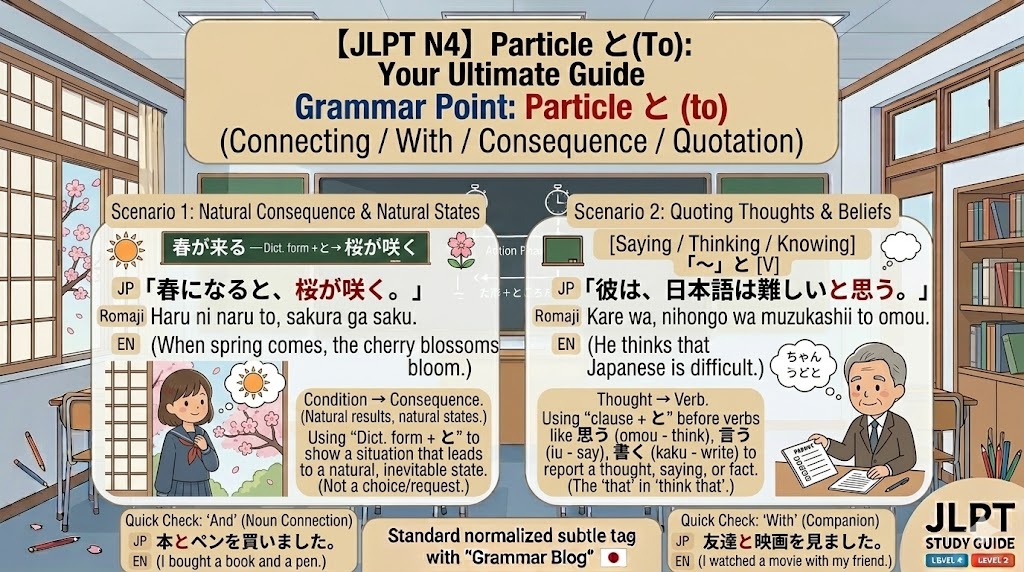
In Japanese grammar, と serves as a bridge. Depending on what it’s bridging, its meaning shifts. To keep things simple for your JLPT prep, we can categorize its uses into four main buckets: Connecting Nouns, Identifying a Partner, Indicating Natural Consequences (Conditionals), and Quoting Thoughts or Speech.
Connecting Nouns: The Exhaustive List
This is the “and” you learned in Chapter 1. However, there’s a nuance that many students overlook. When you use と to link nouns, it implies an exhaustive list. This means you are mentioning everything in that group. If you say “Apple と Orange,” you are implying there is nothing else on the table but the apple and the orange. If you wanted to imply “and others,” you would use や (ya) instead. Mastering this distinction is a small step that makes your Japanese sound much more precise.
The Partner in Action: Doing Things Together
Another common use is indicating the person (or animal) with whom you are performing an action. In English, this is usually translated as “with.” For example, “I went to the park with a friend.” In Japanese, the structure is [Person] + と + [Verb]. This is straightforward, but it’s the foundation for more complex social expressions you’ll need for the JLPT listening section.
The Conditional: Natural and Inevitable Consequences
This is where things get interesting for intermediate learners. と can function as a conditional (if/when). Unlike other conditionals, と carries a sense of inevitability. It describes a “Natural Law” or a “Fixed Result.” If you do Action A, Action B automatically happens. Think of it like a machine: “If you push this button, the light comes on.” There is no room for choice or doubt here. It’s also used for giving directions (“Turn right and you’ll see the bank”) because the bank isn’t going to move—the result of turning right is fixed.
Quoting Speech and Thoughts
Finally, と acts as a “quotation mark” for the mind and mouth. Whether you are saying something (言います – iimasu) or thinking something (思います – omoimasu), the content of that speech or thought is marked by と. This is essential for storytelling and expressing your opinion, which is a major component of the JLPT N3 level and above.
Daily Life Examples: To in Action
To really get a feel for how these rules play out, let’s look at three scenarios you’ll likely encounter while living or traveling in Japan. Pay attention to how と changes the “vibe” of the sentence.
Example 1: Giving and Following Directions
Imagine you’re lost in Shibuya and ask a local for the nearest convenience store. They might say:
「この道をまっすぐ行くと、右側にコンビニがあります。」
(Kono michi o massugu iku to, migigawa ni konbini ga arimasu.)
Translation: If you go straight down this street, there is a convenience store on the right.
In this case, と is used because the store’s location is a physical fact. It isn’t a “maybe” situation. The speaker is saying that the act of walking straight inevitably leads you to the store. This use of と is incredibly common when talking about maps, instructions, or recipes.
Example 2: Expressing Opinions and Intentions
Suppose you are discussing your weekend plans with a colleague. You want to say you think it will rain. You would say:
「明日は雨が降ると思います。」
(Ashita wa ame ga furu to omoimasu.)
Translation: I think it will rain tomorrow.
Here, と marks the entire clause “It will rain tomorrow” as the object of your thought. Without と, the sentence would fall apart. This is the most common way to soften your statements in Japanese culture; rather than stating a fact bluntly, you wrap it in “I think that…” using the 〜と思います structure.
Example 3: Describing Inevitable Habits or Nature
Think about a simple truth, like what happens when you don’t sleep. You might say to a friend:
「寝ないと、疲れが取れません。」
(Nainai to, tsukare ga toremasen.)
Translation: If I don’t sleep, I can’t get rid of my fatigue.
This is a “Natural Consequence.” It’s not a choice; it’s just how the human body works. By using と, you are emphasizing that the lack of sleep always results in being tired. It sounds much more factual and grounded than using other “if” forms.
Common Pitfalls and How to Avoid Them
Even advanced students trip up on と because it feels so similar to other grammar points. Here are the most frequent mistakes to watch out for, especially if you’re aiming to pass the JLPT.
The “Will/Command” Trap
This is the golden rule of the conditional と: You cannot follow it with a command, a request, or a statement of personal will.
Because と represents an inevitable, natural result, it feels weird to use it for something you “decide” to do. For example, you cannot say:
❌ 「時間が有ると、映画を見ましょう。」 (Jikan ga aru to, eiga o mimashou.)
Instead, you must use たら (tara) for personal intentions:
✅ 「時間が有ったら、映画を見ましょう。」 (Jikan ga attara, eiga o mimashou – If I have time, let’s watch a movie.)
Remember: If the second half of your sentence involves a “Let’s,” “Please,” or “I want to,” と is almost always the wrong choice.
Confusing To with Ni for Partners
While と is used for doing things “with” someone, some verbs prefer に (ni). This usually depends on whether the action is “mutual” or “one-way.”
If you meet a friend by chance or for a pre-arranged hang-out, you can use 友達と会う (Tomodachi to au). It implies a mutual meeting. However, if the action is directed at someone (like “consulting” or “reporting”), the line between と and に gets thin. For the JLPT, focus on the fact that と implies a symmetric relationship—you are doing the action with them, together.
Over-listing with To
As mentioned earlier, と is for a complete list. If you are at a cafe and you say, “I bought coffee と cake,” the listener assumes that is all you bought. If you also bought a sandwich but didn’t mention it, using と makes the sentence feel slightly inaccurate. In casual conversation, it’s not a huge deal, but in the JLPT grammar section, choosing between と and や often comes down to whether the list is finished or not.
Summary
The particle と is a versatile tool that evolves as you move from basic Japanese to more nuanced communication. To recap:
- Use it to list all items in a group (Exhaustive “And”).
- Use it to identify your partner in an activity (“With”).
- Use it for quotations and expressing what you think or say.
- Use it for conditionals that are natural, automatic, or inevitable.
The biggest hurdle for most students is the conditional usage. Just remember the “Machine Rule”: If Action A leads to Result B every single time without human interference or choice, と is your best friend.
Keep practicing these nuances in your writing and speaking. The more you use と in context, the more you’ll start to “feel” when a consequence is natural or when a list is complete. Good luck with your JLPT studies—you’ve got this!
IPPO, JLPT training platform is always here to help you to pass the JLPT!!

We offer the Best Online Japanese Learning (All Free), and our goal is to facilitate the adoption into life in Japan. Our service “IPPO” is made by native Japanese teachers and professionals. The tips we share with you can help you to learn Japanese efficiently and pass JLPT (Japanese Language Proficiency Test).