~なさい (~nasai)
If you have been studying Japanese for a while, you have likely encountered a variety of ways to ask someone to do something. You start with the polite ~てください (~te kudasai), then you might learn the casual ~て (~te) form used among friends. But as you progress toward the JLPT N4 level and beyond, you start hearing a new ending: ~なさい (~nasai). ~なさい is a firm instruction meaning “Do [verb],” like a parent telling a child 早く寝なさい (Go to sleep now).
I remember the first time I heard this in real life. I was visiting a friend’s house in Osaka, and her mother turned to her and said, “Chotto, chanto tabenasai!” (Hey, eat properly!). To my ears, it sounded firm, almost like a command, but there was a distinct lack of aggression. It wasn’t the harsh, barking command you hear in action movies (the e-dan imperative like “Tabero!”), but it certainly wasn’t a “please” either.
For many learners, ~なさい occupies a confusing “middle ground.” Is it polite because it comes from nasaru (an honorific verb)? Or is it rude because it’s an order? If you’ve ever hesitated to use this grammar point because you weren’t sure if you’d sound bossy or just plain weird, you are not alone.
Before diving into the grammar detail, here is the JLPT N4 complete guide:
The Ultimate JLPT N4 Complete Guide: Your Gateway to Working and Living in Japan
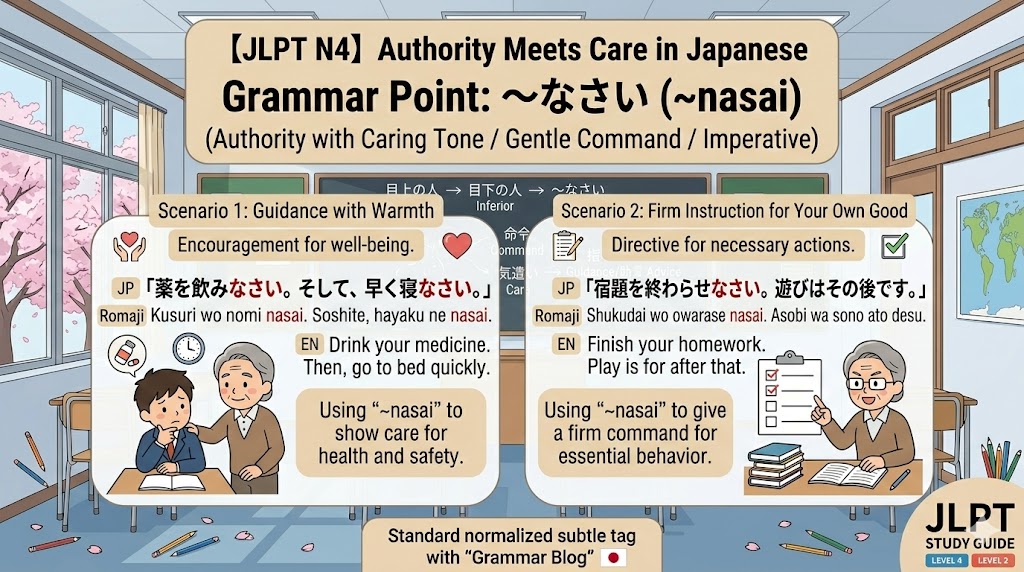
- ~なさい (~nasai) is a firm instruction meaning “Do [verb],” used by someone with authority, like a parent or teacher: 早く寝なさい (Go to sleep now).
- To form ~なさい, take the masu-stem and add なさい: 書きます → 書きなさい, 食べます → 食べなさい, します → しなさい.
- ~なさい is common from parents to children, from seniors giving stern advice, and in exam instructions such as 答えなさい (Answer the questions).
- ~なさい sits between the polite ~てください and the rough ~ろ/~え imperative such as 食べろ. ~なさい is firm and decisive, but not angry by default.
- Never use ~なさい toward your boss, your teacher, or anyone older than you. Set phrases such as おやすみなさい and ごめんなさい are the exception.
How do you form ~なさい?
To form ~なさい, take the verb stem (the part of the verb that remains after you remove ~masu) and attach ~なさい: 書きます → 書きなさい. The construction of ~なさい is incredibly straightforward: if you know how to conjugate the ~ます (~masu) form, you are already 90% of the way there.
The Step-by-Step Rule
Step 1: Start with the Masu-form of the verb.
Step 2: Remove “masu.”
Step 3: Add “nasai.”
Let’s look at a few examples across different verb groups:
Group 1 (U-verbs):
– 書きます (Kakimasu – to write) → 書き + なさい = 書きなさい (Kakinasai)
– 飲みます (Nomimasu – to drink) → 飲み + なさい = 飲みなさい (Nominasai)
– 行きます (Ikimasu – to go) → 行き + なさい = 行きなさい (Ikinasai)
Group 2 (Ru-verbs):
– 食べます (Tabemasu – to eat) → 食べ + なさい = 食べなさい (Tabenasai)
– 寝ます (Nemasu – to sleep) → 寝 + なさい = 寝なさい (Nenasai)
– 見ます (Mimasu – to watch) → 見 + なさい = 見なさい (Minasai)
Group 3 (Irregular verbs):
– します (Shimasu – to do) → し + なさい = しなさい (Shinasai)
– 来ます (Kimasu – to come) → 来 + なさい = 来なさい (Kinasai)
As you can see, there are no tricky stem changes or irregular exceptions once you are at the Masu-stem level. This makes it one of the more “friendly” grammar points to memorize for the JLPT.
What does ~なさい mean?
~なさい is a firm instruction, often translated as “Do [verb],” given by someone with authority, such as a parent or a teacher. That English translation doesn’t capture the cultural weight of ~なさい, so let’s look at its “vibe.”
Technically, ~なさい is the imperative form of the honorific verb なさる (nasaru), which is the polite version of する (suru). However, over centuries of use, it has evolved into a “soft imperative.” It carries the weight of authority, but it is an authority that is expected to be respected within a specific relationship.
Think of it as the “Teacher or Parent Voice.” It implies that the speaker has the right to tell the listener what to do, and the listener is expected to comply without much debate. It is firm, decisive, and leaves little room for a “no,” yet it isn’t “mean” or “angry” by default.
Where do you hear ~なさい in daily life?
You will most often hear ~なさい from parents speaking to children, see it in classroom and exam instructions, and hear it from seniors giving stern advice. Let’s look at these three common scenarios.
Scenario 1: From a Parent to a Child
This is perhaps the most common place to hear ~なさい. Parents use it to guide their children’s behavior, emphasizing that the action is something the child needs to do for their own good or for the sake of discipline.
Japanese: 「もう夜の十時よ。早く寝なさい。」
Romaji: “Mou yoru no juuji yo. Hayaku nenasai.”
English Translation: “It’s already 10 PM. Go to sleep now.”
In this context, using “Nete kudasai” would sound too formal (like the parent is a waiter serving the child), and “Nero!” would sound too aggressive. “Nenasai” hits that perfect “I am your mother/father, and I’m telling you it’s bedtime” note.
Scenario 2: In a Classroom or on an Exam
If you are taking the JLPT, look at the instruction manual or the test booklet. You will often see ~なさい used for instructions. Similarly, a teacher might use it when addressing the whole class.
Japanese: 「次の文を読んで、後の問いに答えなさい。」
Romaji: “Tsugi no bun o yonde, ato no toi ni kotaenasai.”
English Translation: “Read the following passage and answer the questions that follow.”
Here, the authority is institutional. The test-maker is directing the student. It is formal yet direct. When you see this on a test, don’t feel like the test is being “bossy”—it’s simply the standard way to issue instructions in a formal setting.
Scenario 3: Giving Stern Advice
Sometimes, ~なさい is used between people where there is a clear seniority gap, even if they aren’t family. An older mentor or a “Senpai” might use it when giving advice that they feel the “Kohai” (junior) should definitely follow.
Japanese: 「そんなに悩んでいないで、もっと自分に自信を持ちなさい。」
Romaji: “Sonna ni nayande inaide, motto jibun ni jishin o mochinasai.”
English Translation: “Don’t worry so much; have more confidence in yourself.”
In this case, the ~nasai ending adds a layer of “Listen to me, I know what I’m talking about.” It turns the advice into a strong recommendation from someone with more life experience.
What mistakes do learners make with ~なさい?
The biggest mistake with ~なさい is treating it as a “polite” way to ask for things just because it comes from a polite verb (nasaru). This is a dangerous trap! Here is what you need to watch out for to avoid social awkwardness.
Can you use ~なさい with your boss or teacher?
No. You should never use ~なさい toward your boss, your teacher, or anyone older than you (unless they are your own child); this is the golden rule of ~なさい. Even though it’s “softer” than a raw command, it still asserts authority. If you tell your Japanese boss “Tabenasai,” you are essentially treating them like a child or a subordinate. It will be seen as incredibly rude and condescending.
Correction: For superiors, always stick to ~てください (~te kudasai) or even more humble forms like ~ていただけますか (~te itadakemasu ka).
Is O-yasumi nasai a command?
No. O-yasumi nasai (Goodnight) is a set phrase. While it technically uses the same grammar as ~なさい (the “nasai” of nasaru), it has lost its “command” feeling and is simply a standard polite greeting. You can say O-yasumi nasai to your boss without any problem. The same applies to Gomen nasai (I’m sorry). These are exceptions to the “don’t use it upward” rule because they are fixed social formulas.
Does your tone change how ~なさい sounds?
Yes. ~なさい is inherently firm, but your tone of voice can change ~なさい from “kindly guidance” to “scolding.” If you shorten it to just ~な (na)—which is common in very casual speech (e.g., “Tabena!”)—it becomes much softer and more like an invitation. However, if you emphasize the “SAI” at the end with a sharp drop in pitch, it sounds like you are losing your patience.
Do only women use ~なさい?
No. Anyone can use ~なさい, but ~なさい is historically associated more with female speech (mothers and female teachers). Men certainly use it, but in casual settings, men might lean more toward the ~な (~na) shortened version or even the slightly harsher ~ろ (~ro) form depending on the situation. For a female speaker, ~なさい provides a way to be firm without sounding “masculine” or overly aggressive.
What does お + verb stem + なさい mean?
お (o) + verb stem + なさい is a slightly more “refined” or “old-fashioned” way of using ~なさい, seen especially in books or period dramas.
Example: お帰りなさい (O-kaeri nasai).
This is the standard “Welcome home.” Again, it’s a set phrase. But you might also hear someone say 「お黙りなさい!」 (O-damari nasai!) which means “Be quiet!” in a very haughty, high-class way. As a learner, you likely won’t need to produce these forms yourself, but recognizing them as a more “elegant” version of a command is helpful for your reading comprehension.
Summary: When Should You Use It?
To wrap things up, let’s simplify the decision-making process for using ~なさい.
Ask yourself these three questions before using it:
- Is the person I’m talking to younger or lower in status than me? (Child, student, younger sibling).
- Is the situation one where I need to provide clear, firm direction? (Giving instructions, teaching a lesson).
- Am I trying to show “stern care” rather than just being polite?
If the answer to all three is “Yes,” then ~なさい is your best friend.
For the JLPT, remember that ~なさい is an imperative. If you see a question asking for the “order” or “instruction” form, look for that Masu-stem + なさい. It is the bridge between the very polite ~te kudasai and the very rough ~ro/~e forms.
Japanese grammar is often less about “right or wrong” and more about “who and when.” By understanding the hierarchy and the hidden “care” within ~なさい, you are one step closer to speaking Japanese like a natural. Keep practicing, keep listening for it in your favorite anime or dramas, and don’t be afraid to use it (sparingly and correctly)!
Ganbarinasai! (Do your best!)
IPPO, JLPT training platform is always here to help you to pass the JLPT!!

We offer the Best Online Japanese Learning (All Free), and our goal is to facilitate the adoption into life in Japan. Our service “IPPO” is made by native Japanese teachers and professionals. The tips we share with you can help you to learn Japanese efficiently and pass JLPT (Japanese Language Proficiency Test).