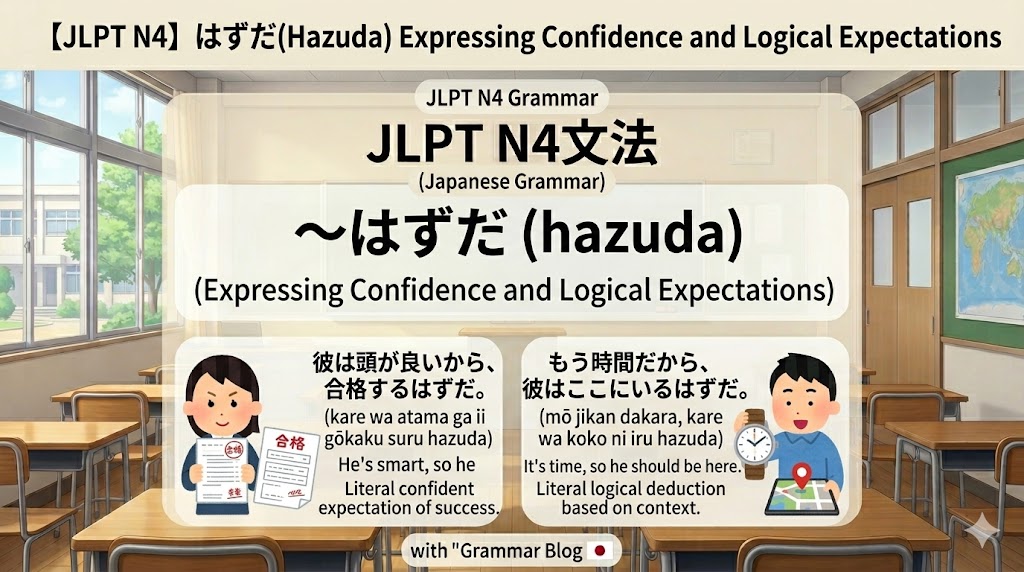
はずだ(Hazuda)
Have you ever been in a situation where you were absolutely sure about something based on the evidence at hand, but you didn’t know how to say it in Japanese? Maybe you checked the train schedule, and it’s 3:00 PM, so the train should be here. Or perhaps your friend is a math genius, so the exam should have been easy for them.
When you transition from the beginner levels of Japanese (N5/N4) into the intermediate stages (N3/N2), you start to realize that “desu” and “darou” aren’t always enough. You need a way to express logical expectation. This is where the grammar point 〜はずだ (hazu da) becomes your best friend.
In this guide, we’re going to break down exactly how to use “hazuda,” why it’s different from just guessing, and how you can avoid the common traps that many learners fall into. If you’re aiming to pass the JLPT or just want to sound more natural in your daily conversations, let’s dive in.
Before diving into the grammar detail, here is the JLPT N4 complete guide:
The Ultimate JLPT N4 Complete Guide: Your Gateway to Working and Living in Japan
The Basic Logic of Hazuda
At its core, 〜はずだ translates to “it is expected that…” or “it ought to be…” or “I am sure that…” However, it isn’t just a random guess. The most important thing to remember about this grammar point is that it is based on objective evidence, logic, or a known schedule.
Think of it as a logical conclusion. If A is true, then B must be true.
The Structure:
- Verbs: Dictionary Form / Past Form + はずだ (e.g., 来るはずだ, 来たはずだ)
- I-Adjectives: ~い + はずだ (e.g., 寒いはずだ)
- Na-Adjectives: ~な + はずだ (e.g., 元気なはずだ)
- Nouns: Noun + の + はずだ (e.g., 休みのはずだ)
When you use “hazuda,” you are telling the listener: “Based on what I know, there is no reason for this not to be the case.” It carries a strong sense of conviction.
Daily Life Examples: Putting Hazuda into Practice
To really get a feel for how “hazuda” works, let’s look at three common scenarios you’ll likely encounter while living or traveling in Japan. Notice how each sentence relies on a reason or a piece of evidence.
Scenario 1: Relying on a Schedule
Imagine you are waiting at a bus stop with a friend. You checked the timetable earlier, and it said the bus arrives at 10:15. It is now 10:14.
Japanese: バスはもうすぐ来るはずですよ。時刻表にそう書いてありましたから。
Reading: Basu wa mousugu kuru hazu desu yo. Jikokuhyou ni sou kaite arimashita kara.
English: The bus should be coming soon. That’s what it said on the timetable.
In this case, your expectation isn’t just a “feeling.” You have the evidence of the timetable (jikokuhyou). This makes “hazuda” the perfect choice.
Scenario 2: Making a Logical Deduction about Someone
Suppose your friend Tanaka-san lived in New York for ten years. Naturally, you assume his English must be quite good.
Japanese: 田中さんはアメリカに10年も住んでいたから、英語が上手なはずです。
Reading: Tanaka-san wa Amerika ni juunen mo sunde ita kara, eigo ga jouzu na hazu desu.
English: Since Tanaka-san lived in America for ten years, his English should be good (he must be good at English).
Here, the “evidence” is the ten years spent abroad. It would be logically strange if his English wasn’t good after that long, right?
Scenario 3: Checking Your Own Memory
You’re at the door of your apartment, digging through your bag. You clearly remember putting your keys in the side pocket this morning.
Japanese: おかしいな。鍵はカバンの中に入れたはずなんだけど…。
Reading: Okashii na. Kagi wa kaban no naka ni ireta hazu nan dakedo…
English: That’s strange. I’m sure I put the keys in my bag (I should have put them in the bag)…
This is a very common way to use “hazuda” in the past tense. You are expressing that based on your memory, the keys ought to be there, which makes the current reality (them being missing) confusing.
Common Mistakes and Nuances to Watch Out For
While “hazuda” seems straightforward, there are a few nuances that can trip up even advanced learners. Understanding these will help you sound much more like a native speaker and avoid awkward misunderstandings.
Hazuda vs. Beki da
One of the biggest mistakes learners make is confusing 〜はずだ (hazu da) with 〜べきだ (beki da). Both can be translated as “should” in English, but they mean completely different things in Japanese.
- Hazuda: Expectation/Logic. “It is expected to happen.” (e.g., The train should arrive at 5:00.)
- Bekida: Moral Obligation/Duty. “You ought to do this because it’s the right thing.” (e.g., You should respect your elders.)
If you say “Tanaka-san wa kuru hazu da,” you mean you expect him to arrive. If you say “Tanaka-san wa kuru beki da,” you are saying it is Tanaka-san’s moral duty to show up, perhaps because he made a promise or has a responsibility.
Hazuda vs. Darou / Kamoshirenai
In the JLPT, you might see “hazuda,” “darou,” and “kamoshirenai” in the same multiple-choice question. Here is how to distinguish them based on certainty levels:
Kamoshirenai (50% or less): “Maybe.” A pure guess with little evidence.
Darou (70-80%): “Probably.” An opinion or prediction based on your own thoughts.
Hazuda (90-100%): “I’m sure/I expect.” Based on objective facts, rules, or logic.
If there is a clear reason or evidence provided in the sentence (like “because it’s a holiday” or “according to the weather report”), “hazuda” is usually the strongest candidate.
The Negative Forms: Hazu ga nai vs. Hazu de wa nai
This is where things get a bit tricky. There are two ways to negate “hazu,” and they carry different weights.
1. 〜はずがない (Hazu ga nai): “There is no way that…” / “It’s impossible that…”
This is a very strong denial. Example: “Kare ga nusumu hazu ga nai!” (There’s no way he would steal!)
2. 〜はずではない (Hazu de wa nai): “It’s not that I expected…”
This is much softer and less common. It’s used to say that something wasn’t necessarily your expectation, but it happened anyway. In 90% of daily conversations, if you want to say “it shouldn’t be,” you will use 〜ないはずだ (nai hazu da) for a simple expectation of a negative outcome, or hazu ga nai for a strong disbelief.
Using “Hazu” for Things You Don’t Know
You cannot use “hazuda” for things that are completely outside the realm of logic or things you have no basis for. For example, if you see a stranger on the street, you wouldn’t say “That person should be a doctor” (Ano hito wa isha no hazu da) unless you saw them wearing a stethoscope or walking into a clinic. Without evidence, use “darou” or “kamoshirenai.”
Why Master Hazuda?
Mastering “hazuda” is a major milestone in your Japanese journey. It allows you to move away from simple statements of fact and start expressing reasoned thought. It shows that you are processing information, looking at the context, and coming to a logical conclusion.
For the JLPT N3 and N2, this grammar point appears frequently in the reading section. Authors often use “hazuda” to set up a situation where the reality differs from the expectation—leading to a “but” (shikashi) or “actually” (jitsu wa) moment. By spotting “hazuda,” you can immediately understand the context of what was supposed to happen versus what actually happened.
Summary
To wrap up, let’s look at the key points one more time:
- Meaning: “Should be,” “Must be,” “Expected to be.”
- Basis: Always based on evidence, logic, or schedules.
- Forms: Remember to use “na” for na-adjectives and “no” for nouns.
- Vs. Bekida: “Hazuda” is logic; “Bekida” is morality/duty.
- Past Tense: “Hazu datta” means something should have happened, but it usually implies that it didn’t!
Next time you’re speaking Japanese, try to find one moment where you can use “hazuda.” Maybe it’s about the weather, a friend’s arrival, or a store’s opening hours. The more you use it in context, the more natural it will feel.
Good luck with your JLPT studies! Keep practicing, and you’ll be using “hazuda” like a pro in no time. You’ve worked hard, so you should be able to master it (Masuta-dekiru hazu desu)!
IPPO, JLPT training platform is always here to help you to pass the JLPT!!

We offer the Best Online Japanese Learning (All Free), and our goal is to facilitate the adoption into life in Japan. Our service “IPPO” is made by native Japanese teachers and professionals. The tips we share with you can help you to learn Japanese efficiently and pass JLPT (Japanese Language Proficiency Test).