〜ほど〜ない (hodo… nai)
If you have been studying for the JLPT N3 or N2 levels, you’ve likely realized that Japanese has many ways to compare things. In the beginning, we all learn the classic “A wa B yori…” structure. It’s simple, it’s reliable, and it gets the job done. But as you progress, you start hearing native speakers use a different pattern that feels a bit more nuanced and sophisticated: 〜ほど〜ない (hodo… nai).
You might have found yourself scratching your head, wondering, “Wait, if I can already say ‘A is more than B,’ why do I need to learn ‘A is not as much as B’?” It feels like looking at the same coin from a different side, right? However, in Japanese, choosing the right comparison is less about logic and more about where you want to place the spotlight. If you want to sound natural and truly express the scale of something, mastering 〜ほど〜ない is an absolute must.
In this guide, we are going to break down this grammar point so clearly that you’ll be able to use it in your next conversation without hesitating. Let’s take your Japanese to the next level.
Before diving into the grammar detail, here is the JLPT N4 complete guide:
The Ultimate JLPT N4 Complete Guide: Your Gateway to Working and Living in Japan
The Basic Rule of 〜ほど〜ない
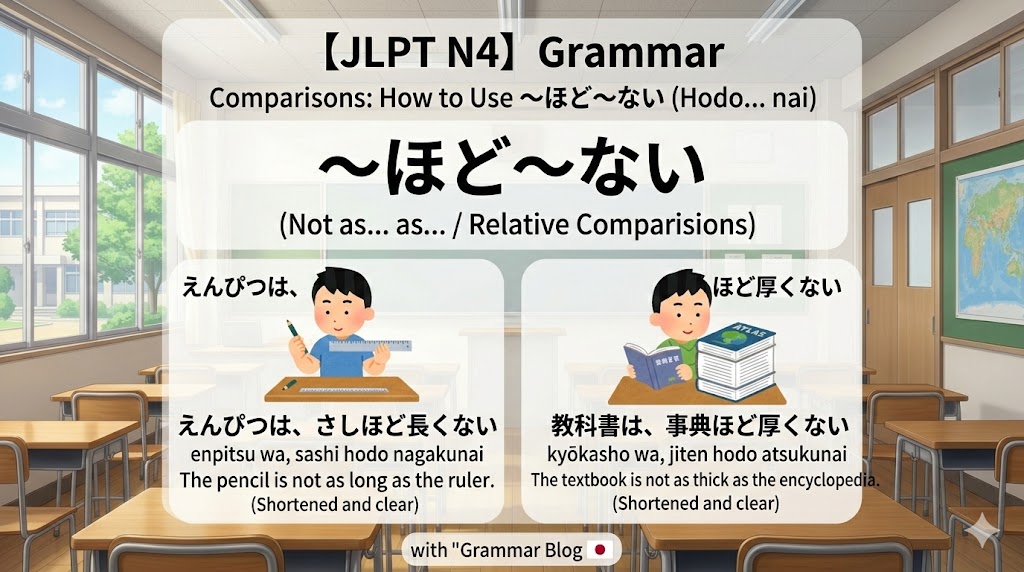
The core meaning of 〜ほど〜ない is “not as… as…” or “not so… as…”. It is used to indicate that the subject does not reach the same level or degree as the noun being compared to.
Think of it this way: when you use “yori,” you are saying A is greater than B. But when you use “hodo… nai,” you are saying B is the ultimate standard, and A just doesn’t quite get there. It highlights the high degree of the standard (the noun before hodo).
The Sentence Structure
The structure is actually quite straightforward, but you must remember one golden rule: the sentence must end in a negative form.
[Noun A] は [Noun B] ほど [Adjective/Verb Negative]
- Noun A: The thing you are talking about (the subject).
- Noun B: The standard of comparison (the “high” level).
- ほど (Hodo): To the extent of / as much as.
- Negative: Not… (ない, くない, ではない).
For example, if you want to say “Tokyo isn’t as cold as Hokkaido,” you are setting Hokkaido as the “standard of coldness” and saying Tokyo doesn’t reach that level.
東京は北海道ほど寒くない。 (Tokyo wa Hokkaido hodo samukunai.)
Everyday Examples to Bring the Grammar to Life
To truly understand how this works, we need to see it in action. Here are three common scenarios where you’ll hear this grammar used in daily life in Japan.
Scenario 1: Comparing Difficulty
Imagine you just finished a Japanese proficiency test. You were terrified of the Kanji section, but after finishing, you realized the Grammar section was actually much harder. You might say to your friend:
漢字は文法ほど難しくなかった。
(Kanji wa bunpō hodo muzukashiku nakatta.)
Translation: The Kanji was not as difficult as the grammar.
In this case, the grammar was the “peak” of difficulty. The Kanji, while perhaps still hard, didn’t reach that same peak.
Scenario 2: Talking About Busy Schedules
Japanese culture often revolves around being busy (isogashii). If someone asks you if you are busy today, but yesterday was your truly “hellish” day at work, you could say:
今日は昨日ほど忙しくありません。
(Kyō wa kinō hodo isogashiku arimasen.)
Translation: I am not as busy today as I was yesterday.
This implies that yesterday was the standard for being extremely busy. Today is better by comparison.
Scenario 3: Expressing Personal Preferences and Talent
Let’s say you love cooking, but your mother is a professional chef. You might be humble about your skills when someone praises your food:
私は母ほど料理が上手ではありません。
(Watashi wa haha hodo ryōri ga jōzu de wa arimasen.)
Translation: I am not as good at cooking as my mother is.
Here, you are using your mother’s skill level as the benchmark that you haven’t reached yet.
Important Nuances and Common Pitfalls
Even though the structure seems simple, there are a few traps that learners often fall into. Let’s look at the “hidden rules” of 〜ほど〜ない.
The Importance of the Negative Ending
This is the most common mistake for JLPT test-takers. You cannot use ほど (hodo) in a direct comparison like this with a positive ending.
❌ Correct: A は B ほど [Negative]
❌ Incorrect: A は B ほど [Positive]
If you want to say “A is as good as B” (positive), you would usually use と同じくらい (to onaji kurai). Hodo… nai is specifically designed to show that something is less than something else.
Hodo vs. Yori: What’s the difference?
You might be wondering: “Can’t I just use yori for everything?” Technically, you could change the sentence structure to mean the same thing, but the feeling is different.
Consider these two sentences:
1. 昨日は今日より暑かった。 (Yesterday was hotter than today.)
2. 今日は昨日ほど暑くない。 (Today is not as hot as yesterday.)
Sentence 1 focuses on Yesterday and the fact that it was hot. Sentence 2 focuses on the fact that Today is relatively comfortable compared to the extreme heat of yesterday. Native speakers use hodo… nai when they want to emphasize that the comparison point (yesterday) was quite extreme or significant.
Don’t Confuse it with the Other “Hodo”
As you get into N2 and N1, you’ll see ほど used in other ways, like “The more… the more…” (〜ば〜ほど). While they share the same word, the grammar pattern is completely different. Don’t let those more complex patterns confuse you when you see a simple comparison! If you see a noun followed by ほど and then a negative at the end of the sentence, it’s almost always this comparison pattern.
Why Native Speakers Prefer This Pattern
One of the biggest hurdles in moving from “textbook Japanese” to “natural Japanese” is learning how to be humble or indirect. Using 〜ほど〜ない is a great way to do this. By focusing on what something isn’t, rather than what it is, you often sound softer and more observant.
For instance, if someone asks, “Is the new movie bad?” saying “It’s bad” is very direct. But saying “It’s not as good as the first one” (前作ほど良くない) sounds like a more thoughtful, nuanced critique. It acknowledges that the first movie was the standard of quality, and the new one just fell a bit short.
How to Practice and Internalize This Grammar
Studying grammar isn’t just about memorizing rules; it’s about building “muscle memory” in your brain. Here are a few ways you can make 〜ほど〜ない a natural part of your vocabulary:
1. Compare Your Past and Present
Think about your life now versus five years ago. Are you as energetic? Is your city as quiet?
“Now is not as quiet as before.” (今は前ほど静かじゃない。)
2. Review Your JLPT Progress
Compare the different levels of the JLPT.
“N3 wasn’t as hard as I thought.” (N3は思っていたほど難しくなかった。)
3. Use it for Weather and Food
These are the two most common topics in daily Japanese conversation.
“This ramen isn’t as spicy as that one.” (このラーメンはあれほど辛くない。)
“This winter isn’t as cold as last year.” (今年の冬は去年ほど寒くない。)
Final Thoughts
The 〜ほど〜ない pattern is a powerful tool in your Japanese arsenal. It allows you to make sophisticated comparisons, express disappointment or relief, and speak with a level of nuance that 〜より simply can’t provide.
Remember:
1. Always end with a negative.
2. The noun before ほど is the “high standard.”
3. Use it when you want to emphasize that something doesn’t reach a certain level.
Keep practicing, and don’t be afraid to make mistakes. The more you use it in your writing and speaking, the sooner it will feel like second nature. You’re doing a great job on your JLPT journey—keep going! You’ve got this!
Happy studying! (勉強頑張ってください!)
IPPO, JLPT training platform is always here to help you to pass the JLPT!!

We offer the Best Online Japanese Learning (All Free), and our goal is to facilitate the adoption into life in Japan. Our service “IPPO” is made by native Japanese teachers and professionals. The tips we share with you can help you to learn Japanese efficiently and pass JLPT (Japanese Language Proficiency Test).