

📌 What You’ll Learn in This Guide
- The JLPT N2 passing score and minimum section requirements
- Full exam format: sections, time limits, and number of questions
- 7 proven study tips for grammar, vocabulary, reading, and listening
- How to build a daily study schedule and use mock tests effectively
To pass JLPT N2, you need a total of 90 out of 180 points, with a minimum of 19 points in each section. The key to passing is not studying more — it is studying smart by knowing exactly what each section tests and where to direct your energy.
Table of Contents
What Is the Passing Score for JLPT N2?
The JLPT N2 passing score is 90 out of 180 points, with a minimum section score required in each area. You cannot pass by acing one section and failing another — all three sections must meet the minimum threshold.
| Section | Score Range | Minimum Required |
|---|---|---|
| Language Knowledge (Vocab/Grammar) | 0–60 | 19 |
| Reading | 0–60 | 19 |
| Listening | 0–60 | 19 |
| Total | 0–180 | 90 |
What Does the JLPT N2 Exam Look Like?
Before building your study plan, it is important to understand what the exam actually covers. JLPT N2 tests your ability to understand Japanese used in everyday situations and in a variety of contexts — including business environments where you need to respond flexibly and accurately.
Exam sections and time limits
The exam is divided into two parts:
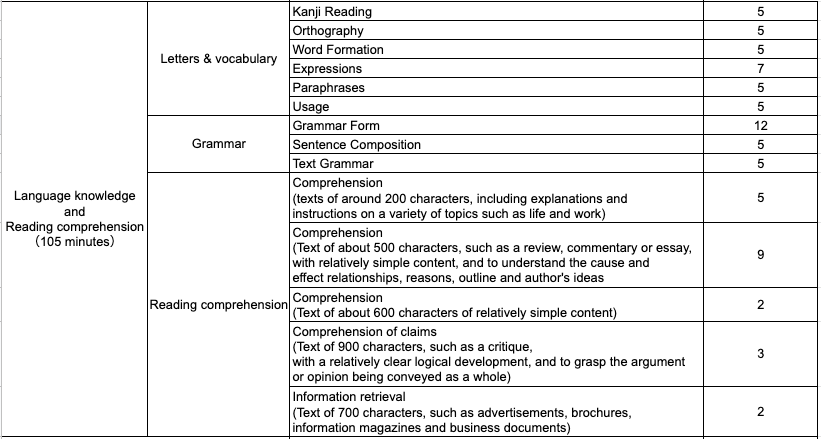
① 【105 minutes】Language Knowledge and Reading Comprehension
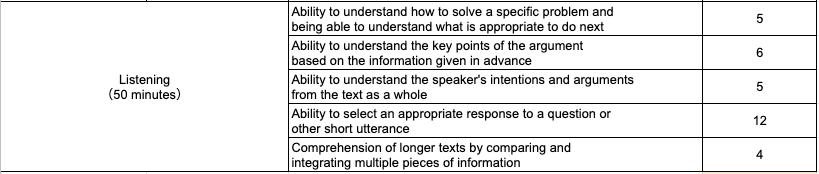
② 【40 minutes】Listening
Here are detailed tips for JLPT N2 listening.
Total number of questions
The total number of questions is 107, broken down as follows:
【75 questions】Language Knowledge and Reading Comprehension
【32 questions】Listening
Since you must meet the minimum score in every section, you need to answer correctly at least:
【18 / 54 questions】Vocabulary & Grammar
【7 / 21 questions】Reading Comprehension
【11 / 32 questions】Listening
At N2 and N1 levels, unlike lower levels, no question can be a clue to another — so every question must be answered on its own merit.
Why Is JLPT N2 Important for Your Career in Japan?
Even though the JLPT does not perfectly measure your practical Japanese skills, many Japanese companies use N2 as a hiring benchmark. Holding an N2 certificate signals that you can handle complex workplace situations — paraphrasing, dealing with customer problems, and discussing topics like business, politics, and economics.
In short, the ability to respond flexibly and correctly in a business environment is what the JLPT N2 is really testing. Keep this in mind throughout your preparation.
If you want to know more about the N3 level first, check out this article. 👇

How to Study Efficiently for JLPT N2?
Now that you understand the exam format and passing requirements, here are 7 proven study tips to help you pass JLPT N2 as efficiently as possible.
Plan your time during the exam
The biggest challenge at N2 is time pressure. With 75 questions in 105 minutes for the Language Knowledge and Reading section, you need a clear time plan before exam day — not on it.
Here is the recommended time allocation:
・54 Grammar questions = 42 minutes in total
・5 Reading questions (150–200 words) = 10 minutes in total
・9 Reading questions (350 words) = 18 minutes in total
・2 Reading questions (550 words) = 10 minutes in total
・3 Reading questions (Claims) = 10 minutes in total
・2 Reading questions (Information retrieval) = 10 minutes in total
Recommendation: 100 minutes to answer all questions + 5 minutes to review.
Practice this time allocation consistently during mock tests so that quick decisions become second nature on exam day.
Grammar — Pay attention to collocations
Many learners try to memorize grammar points in isolation, but this approach is inefficient at N2 level. The more powerful habit is learning how grammar patterns connect to other words and expressions — this is called “collocation.”
For instance, look at this example. The correct answer is「1. しかない」. Can you explain why?
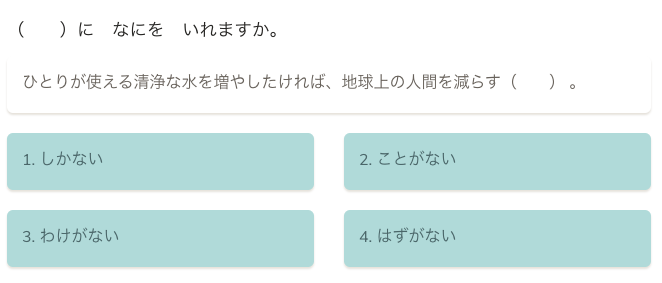
Each expression is usually connected to a certain pattern. If you know the collocation, it helps you choose the correct answer quickly and save time.
- しかない。 : There is no other way but…
- ことがない。: have never been/done…
- わけがない。: It can’t be…
- はずがない。: It can’t be…
「ひとりが使える清潔な水を増やしたければ、地球上の人間を減らす( )。」can be translated as “If we want to increase the quantity of pure water each person can use, ( ) decreasing the number of people on earth.” Now it is easier to choose the correct answer, right?
When you encounter a question where you choose the ending of a sentence, always check the connection between phrases. Here,「たければ」means “If ~ want to…” — so you can learn that「しかない」collocates with「~したければ」.
⭐️ JLPTに受かりたければ、毎日コツコツ勉強するしかない (If you want to pass JLPT, there is no other way but studying hard every day)!!⭐️
Reading — Use paraphrase as your guide
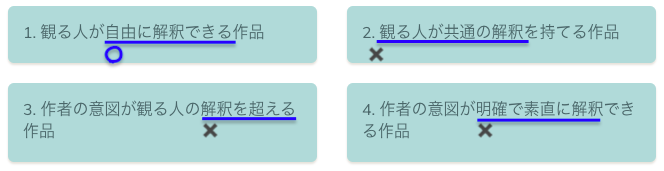
In JLPT N2 reading passages, the author’s key opinion is almost always expressed through paraphrase — the same idea is rephrased using different words. If you know how to spot this, you can answer comprehension questions much faster.
Here is how to approach a reading question:
- Read the question first — before reading the passage. This tells you what to look for.
- Find the paraphrased expression — the correct answer option will rephrase something from the text, not copy it word for word.
- Do not be misled by examples — examples in the passage support the main argument but are not the author’s core opinion.
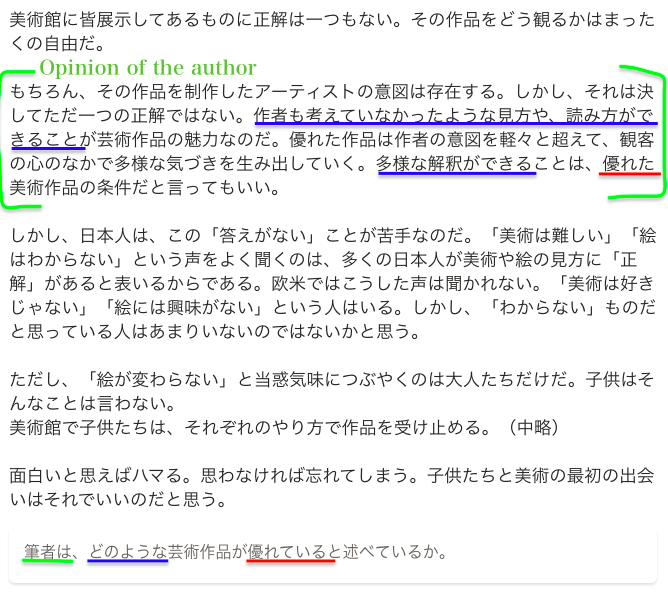
Do not be afraid of difficult passages. The point the author wants to emphasise is always paraphrased somewhere in the text — all you have to do is recognise where it appears.
Vocabulary — Study words in context, not in isolation
JLPT N2 requires knowledge of approximately 6,000 vocabulary words — roughly double the N3 requirement. Trying to memorize these as a bare list is one of the most common mistakes learners make.
Instead, study vocabulary this way:
- Learn words with example sentences — seeing a word used in context makes it easier to recall under exam pressure.
- Group words by theme — work-related expressions, emotional vocabulary, and set phrases each form natural clusters that reinforce each other.
- Use spaced repetition — apps like Anki allow you to review words at the exact moment you are about to forget them, which is far more efficient than re-reading word lists.
- Study kanji together with vocabulary — at N2 level, knowing the kanji for a word dramatically helps with reading speed and word recognition.
Aim to encounter each word in at least three different contexts before the exam so your recognition becomes automatic rather than effortful.
Listening — Train your ears for natural speed
The listening section of JLPT N2 uses natural, fast-paced Japanese. Unlike reading, you cannot control the pace — which means your ears need to be trained before exam day, not on it.
Here is how to build your listening ability effectively:
- Listen daily — even 15 minutes of Japanese podcasts, YouTube videos, or drama clips compounds quickly over weeks.
- Practise shadowing — repeat what you hear at the same speed. This forces your brain to process Japanese at native pace and improves both listening and speaking.
- Focus on key information — JLPT listening questions always ask about a specific detail (what someone will do next, what the correct reason is, etc.). Train yourself to catch these target points on the first listen.
- Use official JLPT listening materials — the question format and audio style in official practice books closely match the real exam.
For detailed tips and practice exercises, visit our JLPT N2 listening guide.
Build a consistent daily study routine
Passing N2 typically requires 900–1,200 study hours in total. Rather than cramming, a steady daily routine will get you there more reliably and with less stress.
Here is a sample daily study allocation:
| Study Area | Daily Time |
|---|---|
| Vocabulary (spaced repetition / Anki) | 20 minutes |
| Grammar (drills + example sentences) | 30 minutes |
| Reading (one short passage) | 20 minutes |
| Listening (podcast / shadowing) | 15 minutes |
This adds up to roughly 85 minutes per day. At this pace, you can accumulate 900+ study hours in under a year. Consistency matters far more than occasional long sessions.
Take full mock tests regularly
Understanding grammar and vocabulary is necessary — but it is not enough. You also need to experience exam conditions repeatedly so that time pressure and question formats feel familiar rather than stressful.
- Aim for at least 5–10 full mock tests before your exam date.
- Review every wrong answer carefully — understanding why an answer is wrong is more valuable than getting it right by chance.
- Use official JLPT practice workbooks — they are the most accurate reflection of the real exam format and difficulty.
- Simulate exam conditions — sit in a quiet place, use a timer, and avoid pausing. The more realistic your practice, the calmer you will feel on the actual test day.
Conclusion
Passing JLPT N2 is absolutely achievable with the right strategy. To summarise the 7 tips from this guide:
- Plan your time allocation for each question type before the exam
- Master grammar through collocations, not isolated memorisation
- Approach reading by identifying paraphrased expressions
- Build vocabulary in context using spaced repetition
- Train your listening with daily native-speed input
- Follow a consistent daily study routine of around 85 minutes
- Take full mock tests regularly under real exam conditions
If you are looking for a structured way to practise all of these skills in one place, our Japanese learning platform offers free study materials from N5 to N1 — including flashcards, mini-tests, grammar lectures, and listening training.
© 2021 GLOBAL ASTRA Inc. All Rights Reserved.

We offer the Best Online Japanese Learning (All Free), and our goal is to facilitate the adoption into life in Japan. Our service “IPPO” is made by native Japanese teachers and professionals. The tips we share with you can help you to learn Japanese efficiently and pass JLPT (Japanese Language Proficiency Test).