みたいだ(Mitaida)
If you have been studying for the JLPT N3 or N2, you have probably hit a bit of a wall when it comes to “guessing” grammar. In English, we simply say “it seems like” or “it looks like,” and we are done with it. But in Japanese? You have ~souda, ~youda, ~rashii, and of course, ~mitaida. It is enough to make any learner want to close their textbook and take a long nap.
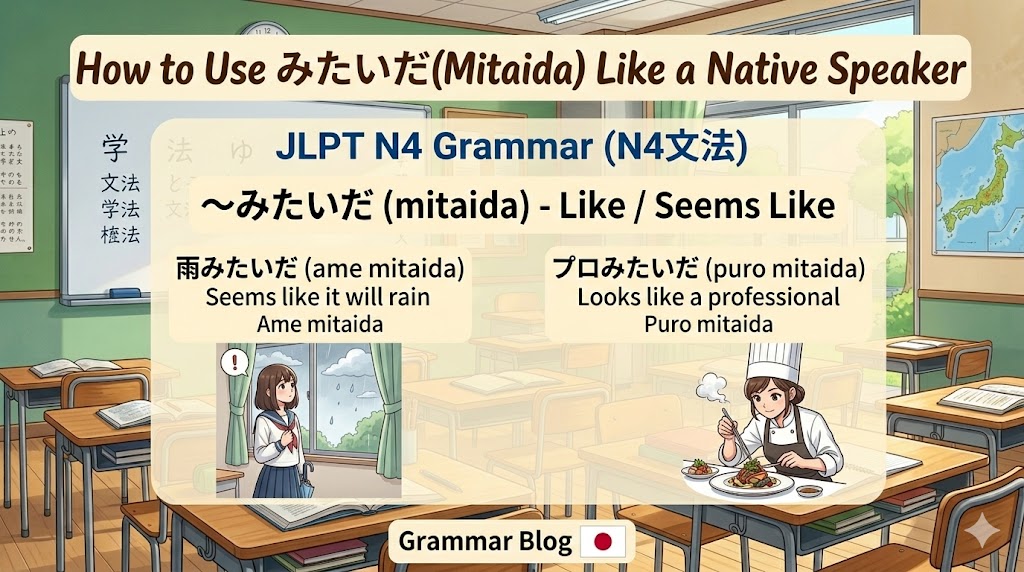
I remember when I first moved to Japan, I would constantly mix these up. I would tell my landlord that the weather “seemed” like rain using the wrong grammar, and he would look at me with a face full of polite confusion. The struggle is real. However, once you grasp the nuance of ~mitaida (〜みたいだ), a whole new world of expression opens up. 〜みたいだ means “it seems like,” as in 雨が降ったみたいだ (It seems like it rained). It is one of the most versatile, common, and “natural-sounding” ways to express an inference based on what you see, hear, or feel.
Before diving into the grammar detail, here is the JLPT N4 complete guide:
The Ultimate JLPT N4 Complete Guide: Your Gateway to Working and Living in Japan
- 〜みたいだ (~mitaida) means “it seems like” or “it looks like.” 〜みたいだ gives your own guess based on what you see, hear, or feel: 夜の間に、雨が降ったみたいだ (It seems like it rained during the night).
- To form 〜みたいだ, attach it directly to the plain form of verbs and i-adjectives (降ったみたいだ, 忙しいみたいだ), and directly to nouns and na-adjectives with no の or な (夢みたいだ, 暇みたいだ).
- 〜みたいだ is common in daily conversation. In casual speech it is often shortened to 〜みたい, and 〜みたいです is the polite form.
- 〜みたいだ and 〜ようだ are almost identical in meaning, but 〜ようだ sounds formal. 〜そうだ is for an immediate visual impression, and 〜らしい is often used for hearsay.
- A common mistake with 〜みたいだ is adding の or な: 子供のみたいだ and きれいなみたいだ are wrong, so say 子供みたいだ and きれいみたいだ.
How do you form 〜みたいだ?
To form ~mitaida, attach みたいだ directly to the plain form of verbs, nouns, and adjectives, with no “no” or “na” in between. Unlike some other Japanese grammar points that require complex conjugations or specific particles like “no” or “na,” ~mitaida is very “plug-and-play.”
Think of ~mitaida as a way to say “Based on the evidence I have right now, this is my subjective guess.” It behaves very much like a na-adjective in terms of grammar, but you attach it directly to the plain form of words.
Connecting to Verbs
You use the dictionary form (plain form) of the verb. This can be present, past, or negative.
- Dictionary: 降る (furu – to rain) + みたいだ → 降るみたいだ (It looks like it will rain.)
- Past: 降った (futta – rained) + みたいだ → 降ったみたいだ (It looks like it rained.)
- Negative: 来ない (konai – not come) + みたいだ → 来ないみたいだ (It looks like they aren’t coming.)
Connecting to Nouns
This is where ~mitaida shines because it is so simple. You do not need any particles between the noun and mitaida. This is a common mistake for those used to ~youda (which requires “no”).
- Noun: 夢 (yume – dream) + みたいだ → 夢みたいだ (It’s like a dream.)
- Noun: 休み (yasumi – holiday) + みたいだ → 休みみたいだ (It seems like a holiday.)
Connecting to Adjectives
For both i-adjectives and na-adjectives, you use the plain base form.
- i-Adjective: 忙しい (isogashii – busy) + みたいだ → 忙しいみたいだ (He seems busy.)
- na-Adjective: 暇 (hima – free/bored) + みたいだ → 暇みたいだ (He seems free.) Note: Do not use “na” here!
In casual conversation, the “da” at the end is often dropped (~mitai) or replaced with “desu” (~mitai desu) to be polite. If you are taking the JLPT, you will likely see the full ~mitaida or ~mitai desu forms.
When do you use 〜みたいだ in daily life?
You use ~mitaida in daily life whenever you make a guess from what you notice, such as wet ground after a night of rain, a boss who looks busy, or a package that has not arrived. Here are three distinct scenarios where ~mitaida is the perfect choice for expressing an inference or a guess.
The Detective at the Window
Imagine you wake up, open your curtains, and see that the ground is soaking wet. There are puddles everywhere, but the sun is currently shining. You weren’t awake to see the rain, but the evidence is right there.
Example: 夜の間に、雨が降ったみたいだ。
(Yoru no aida ni, ame ga futta mitaida.)
Translation: It seems like it rained during the night.
In this case, you are making a logical conclusion based on visual evidence. You didn’t see the action (the raining), but you see the result (the wet ground). This is the “detective” use of ~mitaida.
Reading the Room
You are at the office, and you see your boss walking back and forth, checking his watch every ten seconds and frowning at his computer screen. You turn to your colleague and whisper your observation.
Example: 部長は、今とても忙しいみたいだね。
(Buchou wa, ima totemo isogashii mitaida ne.)
Translation: It looks like the manager is really busy right now, doesn’t it?
Here, you are sensing an atmosphere or a state of being. You aren’t 100% sure he is busy—maybe he’s just lost his keys—but based on his behavior, your intuition tells you he’s swamped.
The Disappointing Delivery
You ordered a package, and the tracking app says “Delivered.” You go to your front door, look around, but there is nothing there. You check the mailbox—empty. You check behind the plant—nothing.
Example: 荷物はまだ届いていないみたいです。
(Nimotsu wa mada todoite inai mitai desu.)
Translation: It seems like the package hasn’t arrived yet.
This is a great example of using the negative form. You are inferring a situation (“not arrived”) based on the lack of a package. Using ~mitai desu here makes it sound soft and natural, rather than a hard, factual statement like “It hasn’t arrived.”
How is 〜みたいだ different from 〜ようだ, 〜そうだ, and 〜らしい?
~mitaida is the casual, spoken way to give your own guess from evidence. ~youda is its formal version, ~souda is for immediate visual impressions, and ~rashii is often used for hearsay. The biggest hurdle for JLPT students isn’t learning what ~mitaida means, but learning when not to use it compared to its cousins.
What is the difference between 〜みたいだ and 〜ようだ?
~mitaida and ~youda are almost identical in meaning, but ~youda sounds formal and ~mitaida sounds casual. They both represent a subjective inference based on evidence. However, the “vibe” is completely different. ~Youda is the stiff, formal version you find in newspapers, literature, or formal speeches. If you use ~youda while grabbing a beer with friends, you might sound like a character from an old novel. ~Mitaida is the go-to for daily conversation. It’s friendly, approachable, and very common in spoken Japanese.
What is the difference between 〜みたいだ and 〜そうだ?
~souda is used for an immediate visual impression, while ~mitaida is a guess that comes from reasoning about evidence. Beginners often confuse ~souda (looks like) with ~mitaida, and this is the most common mistake.
Remember this: ~souda is used for immediate visual impressions or things about to happen. If you see a cake and say “Oishisou!” (It looks delicious!), you are using your eyes to judge the immediate appearance.
But if you see a long line of people outside a bakery, you would say “Ano mise, oishii mitai da ne” (It seems that shop is delicious). You aren’t looking at the food; you are inferring its quality based on the crowd. Mitaida requires a bit more “thinking” or “reasoning” than the gut-reaction souda.
What is the difference between 〜みたいだ and 〜らしい?
~Rashii is often used for hearsay—things you heard from someone else or read on the internet—while ~mitaida is based on your own observation. While ~mitaida can sometimes overlap with this, ~mitaida is much more about your personal feeling and your observation. If a friend tells you “I heard Tanaka-san is quitting,” you would use rashii. If you see Tanaka-san packing his desk into a cardboard box, you would use mitaida.
What mistakes do learners make with 〜みたいだ?
Learners make three common mistakes with ~mitaida: adding “no” after a noun, adding “na” after a na-adjective, and using it for 100% objective facts. To ensure you pass those tricky JLPT multiple-choice questions, keep these three warnings in mind.
Do you need の before 〜みたいだ with nouns?
No. 〜みたいだ attaches directly to a noun. When you use ~youda with a noun, you must say “Noun + no + youda.” Many students carry this habit over to ~mitaida.
Wrong: Kodomo no mitaida.
Right: Kodomo mitaida. (He’s like a child.)
Adding that “no” is a dead giveaway that you are overthinking the grammar. Keep it simple: Noun + Mitai.
Do you need な before 〜みたいだ with na-adjectives?
No. Do not add “na” before mitaida.
Wrong: Kirei na mitaida.
Right: Kirei mitaida. (It seems beautiful.)
Think of mitaida as absorbing the “na” or “no” that other grammar points require. It is a very “clean” connector.
Can you use 〜みたいだ for objective facts?
No. Avoid using ~mitaida for things that are 100% factual and objective. If the thermometer says it is 40 degrees Celsius, you don’t say “It seems hot” using mitaida in a factual report. You use it when there is a margin of doubt or when you are expressing your personal take on a situation. It is an “opinionated” guess.
Conclusion: Bringing It All Together
Mastering ~mitaida is a huge milestone in your Japanese journey. It moves you away from the robotic, factual sentences of beginner textbooks and into the nuanced, expressive world of real-life Japanese conversation. It allows you to speculate, to be polite by softening your claims, and to describe the world as you perceive it.
To wrap up, remember the “Detective Rule”:
- Gather your evidence (visuals, sounds, feelings).
- Process it in your head.
- State your conclusion with ~mitaida.
Whether you are trying to figure out if a store is closed, if a friend is upset, or if your favorite ramen shop has changed its recipe, ~mitaida is your best friend. Keep practicing, don’t be afraid to make mistakes, and soon enough, using this grammar will feel as natural as breathing.
Good luck with your JLPT studies! You’ve got this!
IPPO, JLPT training platform is always here to help you to pass the JLPT!!

We offer the Best Online Japanese Learning (All Free), and our goal is to facilitate the adoption into life in Japan. Our service “IPPO” is made by native Japanese teachers and professionals. The tips we share with you can help you to learn Japanese efficiently and pass JLPT (Japanese Language Proficiency Test).