~まま(Mama)
If you’ve been studying for the JLPT N3 or N4, you’ve likely stumbled across the word 〜まま (~mama). At first glance, it seems simple enough. Your textbook probably tells you it means “as is” or “leaving something in a certain state.” But then you try to use it in a conversation, and suddenly, you’re second-guessing yourself. Should I use the dictionary form or the past tense? Can I use it with nouns? Why did the cashier just ask me “Kono mama de yoroshii desu ka?”
Learning Japanese isn’t just about memorizing formulas; it’s about capturing the “vibe” of how native speakers perceive the world. The grammar point 〜まま is one of those beautiful expressions that bridges the gap between a simple action and a lasting condition. Whether you’re talking about falling asleep with your glasses on, or wanting to be loved “just the way you are,” this grammar is your key to sounding more natural and nuanced.
Before diving into the grammar detail, here is the JLPT N4 complete guide:
The Ultimate JLPT N4 Complete Guide: Your Gateway to Working and Living in Japan
- 〜まま (mama) means “as is” or “while still…” It describes a state that continues unchanged while something else happens.
- To form 〜まま, use a verb in the ta-form or nai-form (つけたまま, 食べないまま), a noun + の (昔のまま), an い-adjective as it is, or a な-adjective + な (きれいなまま).
- 〜まま often suggests something unusual or left undone, as in 電気をつけたまま寝てしまいました. このままで大丈夫です tells a cashier you don’t need a bag.
- 〜ながら is for two actions happening at the same time, while 〜まま is for a state kept while another action happens. 〜っぱなし is close to 〜まま but almost always negative.
- A common mistake with 〜まま is using the dictionary form of a verb: 開けるまま is almost always wrong, and 開けたまま is correct.
What does 〜まま mean?
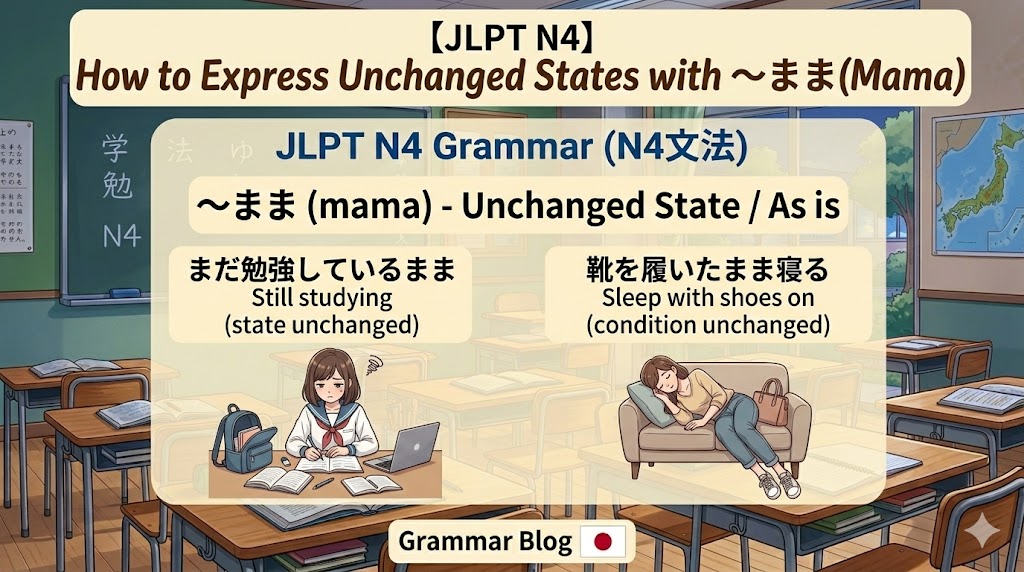
〜まま (mama) means “as is” or “while still…”: 〜まま describes a situation where a state or action continues without changing. Imagine taking a snapshot of a moment and then hitting the “pause” button while the rest of the world keeps moving. That “paused” state is exactly what 〜まま expresses.
In English, we often translate this as:
- “While still…”
- “Leaving it as it is…”
- “With (something) still on/open/in place…”
- “Just like…”
The nuance often implies that something is unusual or left undone. For example, if you leave the door open, it’s just a fact. But if you leave the house with the door still open, that implies a specific state that was maintained when it probably shouldn’t have been. That’s the “mama” sweet spot.
How do you form 〜まま?
To form 〜まま, use a verb in the ta-form or nai-form, a noun + の, an い-adjective as it is, or a な-adjective + な. Knowing which form goes before 〜まま is one of the biggest hurdles for students, so here is the breakdown:
Using Verbs with ~Mama
This is the most common usage. You almost always use the Past Tense (Ta-form) or the Negative Form (Nai-form). Why the past tense? Because the action that created the state has already happened.
Verb (Ta-form) + まま
Example: Aketamama (Left it open)
Verb (Nai-form) + まま
Example: Tabenai mama (Without eating / Having not eaten)
Using Nouns with ~Mama
When you want to use a noun, you need the particle の (no) to bridge them. This is often used for “as it is” or “in that condition.”
Noun + の + まま
Example: Mukashi no mama (Just like the old days / Unchanged from the past)
Using Adjectives with ~Mama
Adjectives are straightforward, but remember to keep the “na” for Na-adjectives.
I-Adjective + まま
Example: Atsui mama (While it’s still hot)
Na-Adjective + な + まま
Example: Kirei na mama (Staying beautiful/clean)
How is 〜まま used in daily life?
In everyday Japanese, people use 〜まま to talk about falling asleep with the lights on, to tell a cashier このままで大丈夫です, and to describe a place that hasn’t changed. I’ve picked these three scenarios because you’ll likely encounter them or want to talk about them.
Example 1: The Accidental Nap
We’ve all been there. You’re watching Netflix or studying for the JLPT late at night, and you suddenly wake up at 3 AM with your glasses still on your face and the lights blinding you.
Japanese: 昨日は、電気をつけたまま寝てしまいました。
Romaji: Kinou wa, denki o tsuketa mama nete shimaimashita.
English: Yesterday, I accidentally fell asleep with the lights still on.
Breakdown: Here, “tsuketa” (turned on) is in the Ta-form. By adding “mama,” you’re saying that the state of the lights being “on” continued throughout your sleep. The “nete shimaimashita” adds that feeling of regret or “oops, I did it.”
Example 2: At the Register
When you buy a single item at a Japanese convenience store (konbini) like a bottle of tea, the staff might ask you if you want a bag. If you don’t need one, you can use this very natural phrase.
Japanese: このままで大丈夫です。
Romaji: Kono mama de daijoubu desu.
English: It’s fine just like this (as it is).
Breakdown: “Kono mama” means “this state.” By saying this, you are telling the cashier, “I will take it exactly as it sits on the counter, no bag required.” It’s polite, efficient, and makes you sound like a local.
Example 3: The Frozen-in-Time Hometown
Imagine visiting your childhood home after ten years and realizing nothing has changed. The old park is there, the tiny candy shop is still open, and even the smell of the air is the same.
Japanese: この町は、昔のままですね。
Romaji: Kono machi wa, mukashi no mama desu ne.
English: This town is just like it was in the old days, isn’t it?
Breakdown: Using “Mukashi (past/old times) + no + mama” expresses that the town has maintained its old state despite the passage of time. It carries a sense of nostalgia.
What mistakes do learners make with 〜まま?
Learners make three common mistakes with 〜まま: confusing it with 〜ながら, using the dictionary form of a verb, and overlooking its slightly negative nuance. Let’s clear those up so you can use 〜まま with confidence.
What is the difference between 〜まま and 〜ながら?
〜まま and 〜ながら can both be translated as “while,” but they are fundamentally different. 〜ながら (~nagara) is used for two actions happening simultaneously (e.g., walking while talking). 〜まま (~mama) is about a state that is being ignored or maintained while another action happens.
Incorrect: Aruita mama hanashimasu. (This sounds like you are “walking” and that walk-state is frozen… which is weird.)
Correct: Aruki nagara hanashimasu. (I talk while walking.)
Use 〜まま when the first thing is a condition that usually changes or shouldn’t be that way (like wearing shoes inside or leaving a window open).
Can you use the dictionary form with 〜まま?
Almost never. Many learners try to say “Akeru mama” (While opening), but with 〜まま this is almost always wrong. Remember: for verbs, it has to be the result of the action. You have to “finish” opening the door before the “open state” can exist. Therefore, it must be Aketamama (opened-state).
Does 〜まま have a negative nuance?
Often, yes. While 〜まま can be neutral, it often carries a slight nuance of “neglect” or “impropriety.” For example, “Kutsushita o haita mama neru” (Sleeping with socks on) is a classic use because usually, people take their socks off to sleep. If you use 〜まま for something totally normal and expected, it might sound a bit stiff.
What is the difference between 〜まま and 〜っぱなし?
〜っぱなし (~ppanashi) also means leaving something in a certain state, but unlike 〜まま, 〜っぱなし is almost always negative. For those of you aiming for N3 and above, 〜っぱなし is the unruly cousin of 〜まま.
〜っぱなし implies that you were messy, careless, or forgot to do something you were supposed to do. For example:
- Terebi o tsuketa mama: I left the TV on (Neutral/Fact). Maybe I fell asleep.
- Terebi o tsuke-ppanashi: I left the TV on (Critical). “Who left the TV running? What a waste of electricity!”
If you want to complain about your roommate leaving their clothes on the floor, 〜っぱなし is your go-to. If you’re just describing a situation, stick with 〜まま.
The Cultural Significance of “Ari no Mama”
You can’t talk about 〜まま without mentioning the phrase ありのまま (Ari no mama). If you’ve ever watched the Japanese version of Disney’s Frozen, the famous song “Let It Go” is translated as “Ari no Mama de.”
Ari no mama means “as things truly are” or “one’s true self.”
- Ari no mama no jibun o aishite. (Love me for who I truly am.)
In a society that often values tatemae (public face) and honne (true feelings), the concept of ari no mama—existing exactly as you are without decoration or hiding—is a powerful and emotive concept. It shows that 〜まま isn’t just a grammar point for chores; it’s a word used to describe the essence of being.
How to Practice ~Mama Effectively
To truly master this, you need to start noticing it in the wild. Here’s a little homework for you:
- Observe your morning: Did you leave the house with the heater on? (Heetaa o tsuketa mama…) Did you leave your bed unmade? (Beddo o sono mama ni shite…)
- Watch J-Dramas: Listen for the word “Kono mama.” Characters often say this during emotional scenes, like “Kono mama issho ni itai” (I want to stay together just like this/forever).
- Check the labels: Sometimes food packaging will say “Reizoko de hiyashita mama…” (While keeping it chilled in the fridge…).
Summary
The grammar point 〜まま (~mama) is an essential tool for any Japanese learner moving into the intermediate level. It allows you to describe ongoing states and conditions with a level of sophistication that simple tenses can’t match.
Quick Recap:
- Verbs: Use Ta-form (for states) or Nai-form (for things not done).
- Nouns: Use the particle “no.”
- Adjectives: Keep “i” or “na.”
- Meaning: Something remains unchanged while something else happens.
- Practical Tip: Use “Kono mama de” to tell shop staff you don’t need a bag!
Don’t be afraid of making mistakes. Language is a living thing, and the more you try to use 〜まま in your daily life, the more natural it will feel. Whether you’re describing your “as-is” messy room or your “as-is” true feelings, you’re now one step closer to Japanese fluency.
Good luck with your JLPT studies, and keep going—just as you are (sono mama de)!
IPPO, JLPT training platform is always here to help you to pass the JLPT!!

We offer the Best Online Japanese Learning (All Free), and our goal is to facilitate the adoption into life in Japan. Our service “IPPO” is made by native Japanese teachers and professionals. The tips we share with you can help you to learn Japanese efficiently and pass JLPT (Japanese Language Proficiency Test).