
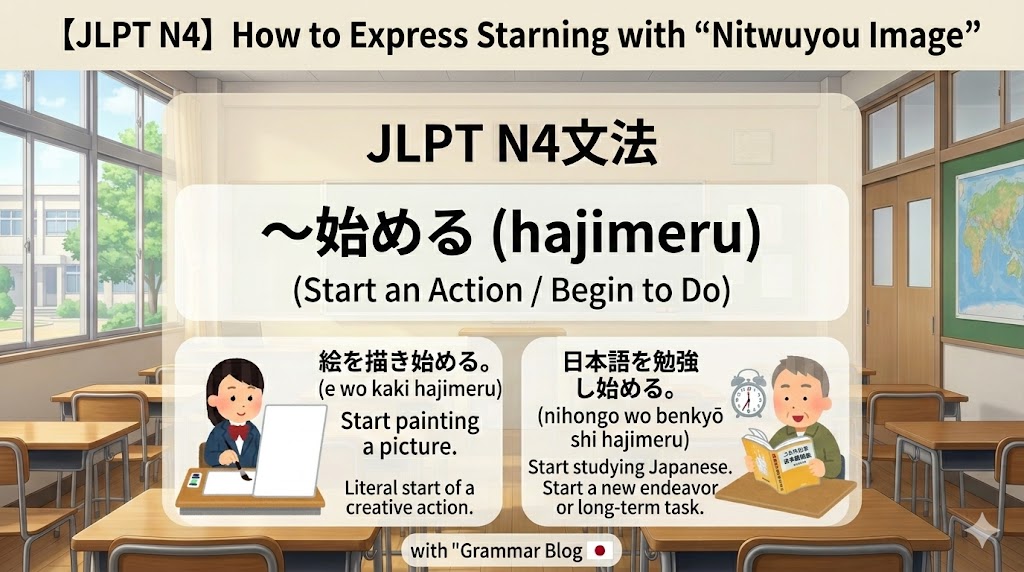
始める(Hajimeru)
If you have been studying Japanese for a while, you probably know the word hajimeru (始める). You likely learned it early on as the verb “to start” or “to begin.” For example, “I start my homework” (shukudai o hajimeru). But as you move from the beginner N5 level into the intermediate N4 and N3 territory, you start seeing this word behaving a little differently. Instead of standing alone, it starts sticking to the ends of other verbs like a piece of Velcro.
Suddenly, you aren’t just “starting”; you are “start-reading,” “start-eating,” or “start-raining.” This is what we call a compound verb, and it is one of the most essential tools in your Japanese toolkit for sounding more natural and fluent. If you’ve ever felt like your Japanese sounds a bit “choppy”—like you’re speaking in short, robotic bursts—mastering the ~hajimeru structure is going to be a game-changer for you.
In this guide, we are going to break down exactly how to use this grammar point, the subtle nuances that textbooks often skip, and how to avoid the common mistakes that trip up even the most dedicated JLPT students. Let’s dive in!
Before diving into the grammar detail, here is the JLPT N4 complete guide:
The Ultimate JLPT N4 Complete Guide: Your Gateway to Working and Living in Japan
The Basic Rules of Connecting Verbs to Hajimeru
The beauty of the ~hajimeru grammar point lies in its simplicity once you understand the “Stem Form.” In Japanese grammar, the stem form (often called the masu-form stem) acts as the bridge that allows two verbs to join together to create a new, more specific meaning.
The rule is straightforward: Verb (Stem Form) + 始める (hajimeru).
To get the stem form, you simply take the polite -masu form of any verb and drop the -masu. Here is how it looks in practice across the different verb groups:
Group 1: U-Verbs (Godan Verbs)
For these verbs, the last syllable changes to an “i” sound before adding -masu. To use ~hajimeru, just keep that “i” sound and drop the -masu.
- Yomu (To read) → Yomimasu → Yomi + hajimeru = Yomihajimeru (To start reading)
- Kaku (To write) → Kakimasu → Kaki + hajimeru = Kakihajimeru (To start writing)
- Furu (To fall/rain) → Furimasu → Furi + hajimeru = Furihajimeru (To start raining)
Group 2: Ru-Verbs (Ichidan Verbs)
These are even easier. You just remove the -ru (or the -masu) and add ~hajimeru.
- Taberu (To eat) → Tabemasu → Tabe + hajimeru = Tabehajimeru (To start eating)
- Miru (To watch/see) → Mimasu → Mi + hajimeru = Mihajimeru (To start watching)
- Oshieru (To teach) → Oshiemasu → Oshie + hajimeru = Oshiehajimeru (To start teaching)
Group 3: Irregular Verbs
There are only two main ones you need to worry about, and they follow the same stem rule.
- Suru (To do) → Shimasu → Shi + hajimeru = Shihajimeru (To start doing)
- Kuru (To come) → Kimasu → Ki + hajimeru = Kihajimeru (To start coming/appearing)
Pro-Tip: Once you attach hajimeru to your main verb, the entire compound verb now functions as a Group 2 (Ru-verb). This means you can conjugate the “hajimeru” part into any form you need: hajimeta (started), hajimenai (don’t start), hajimetai (want to start), and so on.
Real Life Examples to Use in Your Daily Conversations
Understanding the grammar is one thing, but knowing when to actually say it is another. The ~hajimeru structure is used when an action has a certain duration or when you want to focus on the moment a process begins. Here are three common scenarios where this grammar point shines.
Talking About New Habits or Hobbies
In English, we often say, “I started learning Japanese last year.” In Japanese, using the compound verb makes the sentence flow much better than using two separate clauses.
Example:
「去年の4月から、日本語を習い始めました。」
(Kyonen no shigatsu kara, nihongo o narai-hajimemashita.)
English: I started learning Japanese last April.
In this case, narau (to learn) becomes narai-hajimemashita. This implies that the process of learning began at that point and likely continued afterward.
Describing Natural Phenomena and Weather
We often use this when a change in the environment happens. It’s perfect for those moments when you notice something shifting in the world around you.
Example:
「急に雨が降り始めました。傘を持っていますか?」
(Kyuu ni ame ga furi-hajimemashita. Kasa o motte imasu ka?)
English: It suddenly started raining. Do you have an umbrella?
Here, furu (to fall/rain) becomes furi-hajimeru. It describes the transition from “not raining” to “raining.”
Describing Daily Life and Routines
Think about your typical day. When do you start eating lunch? When did you start living in your current apartment? This grammar point is perfect for setting a timeline for your actions.
Example:
「赤ちゃんがやっと歩き始めました!」
(Akachan ga yatto aruki-hajimemashita!)
English: The baby has finally started walking!
This is a great example of a process. The baby didn’t just “walk” in a single moment; they entered the stage of life where walking is an ongoing action they have begun to perform.
The Subtle Nuances and Common Pitfalls to Avoid
Japanese is a language of nuances. While ~hajimeru is quite versatile, there are a few traps that foreign learners often fall into. Let’s clear those up so you can use this like a pro.
Hajimeru vs. Dasu: What is the Difference?
This is perhaps the biggest hurdle for JLPT N4 and N3 students. Both ~hajimeru and ~dasu (〜出す) can be translated as “to start,” but they feel very different to a Japanese speaker.
~Hajimeru is used for intentional actions or actions that have a clear, gradual beginning. It is often planned or expected. For example, “I started studying” (benkyou-shihajimeta).
~Dasu, on the other hand, implies a sudden, unexpected, or outward burst of action. If you say ame ga furidashita, it sounds like the rain suddenly poured down out of nowhere. If someone suddenly starts crying, you would use nakidashita, not nakihajimeta (unless they were slowly sobbing into a full cry over time).
Don’t Use it with Momentary Verbs
You generally cannot use ~hajimeru with verbs that happen in an instant and don’t have a “process.” For example, the verb “to wake up” (okiru) happens in a split second. You are either asleep or awake. Therefore, saying okihajimeru sounds very strange in Japanese (unless you are describing a very slow, multi-stage waking process in a poetic way). Similarly, “to find” (mitsukeru) is an instant event. You don’t “start finding” something; you either find it or you don’t.
Hajimaru vs. Hajimeru
Remember that hajimeru is the transitive version (someone starts something). Even when used as a compound verb, it retains this feeling of an action being initiated. If you are talking about a movie starting, you use the intransitive hajimaru (Eiga ga hajimaru). However, if you are talking about the action within the movie starting, like “The hero started running,” you would use hashirihajimeta. Don’t confuse the standalone intransitive verb with the compound grammar structure!
The Conjugation Confusion
I mentioned this earlier, but it bears repeating: once you add hajimeru, the whole word becomes a Ru-verb. A common mistake I see is people trying to conjugate the first verb.
❌ Yonda-hajimeru (Incorrect)
✅ Yomi-hajimeru (Correct)
Always use the Stem Form. Think of the stem as the glue. Without it, the verbs won’t stick together.
Why Compound Verbs are Your Secret Weapon for the JLPT
When you are sitting in the JLPT exam hall, the grammar section isn’t just testing if you know words; it’s testing if you understand how Japanese people connect ideas. The ~hajimeru structure often appears in the “Reading Comprehension” section to indicate a turning point in a story.
For example, you might see a sentence like: “When the protagonist moved to Tokyo, they started feeling (kanji-hajimeta) lonely.” This small grammar point tells you exactly when the emotional state of the character changed. If you miss the ~hajimeru part, you might think they were always lonely, which could lead you to the wrong answer on a multiple-choice question.
Additionally, in the listening section, speakers will use compound verbs constantly. They are more efficient. Instead of saying “I turned on the TV and then the show started,” they might say “The show started playing” (nagare-hajimeta). Training your ears to hear that ~hajimeru tail at the end of a verb will significantly boost your listening scores.
How to Practice Using This Today
The best way to make a grammar point stick is to apply it to your own life immediately. Here is a small exercise you can do right now:
- Think of three things you started doing this week. Maybe you started a new Netflix series, started a new chapter in your textbook, or started drinking more water.
- Find the verb for that action. (Watch = miru, Read = yomu, Drink = nomu).
- Turn them into the stem form. (Mi-, Yomi-, Nomi-).
- Add ~hajimeta (past tense).
- Say the full sentence out loud: “Kono dorama o mi-hajimeta!”
By connecting the grammar to real memories and actions in your life, you bypass the “translation” phase in your brain and move straight to “understanding.”
Summary
Using ~hajimeru is like unlocking a new level in a video game. It allows you to describe the world not just as a series of static events, but as a dynamic flow of actions beginning and evolving.
Let’s recap the key points:
- Structure: Verb Stem + 始める (hajimeru).
- Meaning: To start or begin an ongoing action or process.
- Conjugation: The entire compound verb conjugates as a Group 2 (Ru-verb).
- Nuance: Use it for intentional or gradual starts. Use ~dasu for sudden, unexpected starts.
- Check: Make sure the verb isn’t a momentary “one-and-done” action like “to wake up” or “to find.”
Don’t be afraid to make mistakes! Every time you accidentally use ~hajimeru when you should have used ~dasu, or when you trip over a stem conjugation, you are one step closer to fluency. The fact that you are reading this and trying to improve means you have already started becoming (nari-hajimeta) a better Japanese speaker.
Keep practicing, keep speaking, and most importantly, keep starting new things in your Japanese journey. You’ve got this!
Are you preparing for the JLPT? What other grammar points are giving you trouble? Leave a comment below, and let’s master Japanese together!
IPPO, JLPT training platform is always here to help you to pass the JLPT!!

We offer the Best Online Japanese Learning (All Free), and our goal is to facilitate the adoption into life in Japan. Our service “IPPO” is made by native Japanese teachers and professionals. The tips we share with you can help you to learn Japanese efficiently and pass JLPT (Japanese Language Proficiency Test).