
Introduction
The Japanese Language Proficiency Test (JLPT) is an esteemed examination that assesses your Japanese language abilities, offering personal and professional growth opportunities for successful candidates.
- The JLPT has five levels, from N5 (easiest) to N1 (most difficult), and each level tests grammar, vocabulary, kanji, listening, and reading comprehension.
- The JLPT is made up of multiple-choice questions, so regular practice tests are the best way to gauge your progress and adjust your study schedule.
- For JLPT grammar, vocabulary, and kanji, study the structures for your target level, use flashcards and apps such as Anki, and learn kanji inside your vocabulary to see how they are used.
- For JLPT listening and reading, use podcasts, TV shows, graded readers, and news articles at your level, and take notes or read out loud to engage actively.
- Set a daily JLPT study schedule based on your target level and exam date, practice with native speakers, and learn from the study methods of people who have passed.
What is the JLPT test format?
The JLPT is divided into five levels, from N5 (easiest) to N1 (most difficult). Each level evaluates your knowledge of grammar, vocabulary, kanji, listening, and reading comprehension. The exam is composed of multiple-choice questions and is typically administered twice a year, in July and December.
How should you study for each JLPT level?
To study for any JLPT level, use the right study materials for that level, practice grammar, vocabulary, kanji, listening, and reading with focused techniques, and follow a clear study schedule. Here are some recommendations for each level:
- Techniques to Master Grammar, Vocabulary, and Kanji
- Grammar: Study grammar structures relevant to your target JLPT level using textbooks and online resources. Practice with exercises and quizzes to reinforce your understanding.
- Vocabulary: Learn new words through flashcards, language apps like “IPPO’s word” and “Anki,” and by consuming Japanese media to encounter vocabulary in context.
- Kanji: Focus on learning the most common kanji for your JLPT level. Use resources like “WaniKani” and “Kanji Study” for practice, and incorporate kanji into your vocabulary studies to understand their usage in context.
- Strategies for Improving Listening and Reading Skills
- Listening: Expose yourself to various Japanese audio materials, such as podcasts, TV shows, and movies, to improve your listening skills. Use online resources like “IPPO” for level-specific listening practice, and actively engage with the content by taking notes and summarizing what you hear.
- Reading: Enhance your reading comprehension by engaging with level-appropriate texts, like graded readers, news articles, and short stories. Practice reading out loud to improve your pronunciation and fluency, and use online resources like “IPPO” and “Satori Reader” for additional content.
- Tips for Effective Test Preparation
- Create a study schedule: Set realistic goals based on your target JLPT level and exam date, and allocate daily practice time for grammar, vocabulary, kanji, listening, and reading comprehension.
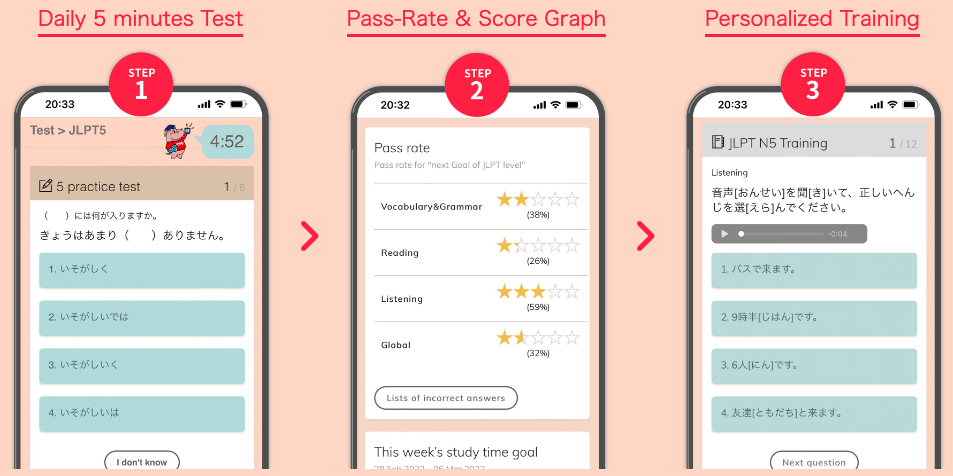
- Monitor your progress: Regularly take practice tests to gauge your progress and adjust your study schedule as needed.
- Engage with native speakers: Practice speaking with native Japanese speakers, either in-person or through language exchange platforms, to improve your listening and speaking skills.
- Learn from Success Stories
Reading or listening to success stories from individuals who have passed the JLPT can offer valuable insights and motivation. Analyze their study methods and resources, and consider incorporating their strategies into your own preparation plan.
Conclusion
Achieving success on the JLPT requires diligent preparation, the right resources, and a commitment to mastering the various aspects of the Japanese language. By understanding the test format, utilizing level-specific study resources, and employing effective techniques for grammar, vocabulary, kanji, listening, and reading comprehension, you can increase your chances of acing the JLPT. There is no doubt that IPPO is the best way to obtain the JLPT. Additionally, engaging with native speakers, learning from success stories, and following a well-structured study schedule can further enhance your preparation. Embrace the challenge of the JLPT with confidence, stay motivated, and enjoy the journey toward Japanese language proficiency.

We offer the Best Online Japanese Learning (All Free), and our goal is to facilitate the adoption into life in Japan. Our service “IPPO” is made by native Japanese teachers and professionals. The tips we share with you can help you to learn Japanese efficiently and pass JLPT (Japanese Language Proficiency Test).