Table of Contents
なかなか〜ない(Nakanaka Nai)
Have you ever stood at a bus stop in the pouring rain, checking your watch every thirty seconds, wondering why the bus—which is usually on time—is nowhere to be seen? Or perhaps you’ve been sitting at your desk for three hours, staring at a list of twenty new Kanji characters, and no matter how many times you write them down, they just won’t stick in your memory? If you’ve felt that specific blend of frustration, impatience, and the feeling that something is taking much longer than it should, then you are already familiar with the spirit of the Japanese grammar point なかなか〜ない (Nakanaka ~ nai).
For many of us studying Japanese, the journey feels exactly like this grammar point. We study, we practice, and yet fluency nakanaka doesn’t come as quickly as we’d like. But don’t worry. Understanding this expression isn’t just about passing the JLPT N4 or N3; it’s about capturing a very “Japanese” way of expressing the gap between expectation and reality. Today, we’re going to dive deep into how to use this phrase, why it’s different from a simple “not,” and how you can use it to sound much more natural in your daily conversations.
Before diving into the grammar detail, here is the JLPT N4 complete guide:
The Ultimate JLPT N4 Complete Guide: Your Gateway to Working and Living in Japan
The Heart of the Expression
When you first learn Japanese, you learn how to make a sentence negative by using 〜ない (nai). For example, “I don’t eat” is Tabenai. “The bus doesn’t come” is Basu ga konai. This is a simple statement of fact. However, life is rarely just a collection of simple facts. Usually, there are feelings involved—expectations that aren’t being met, or effort that isn’t yielding results. This is where なかなか (nakanaka) enters the room.
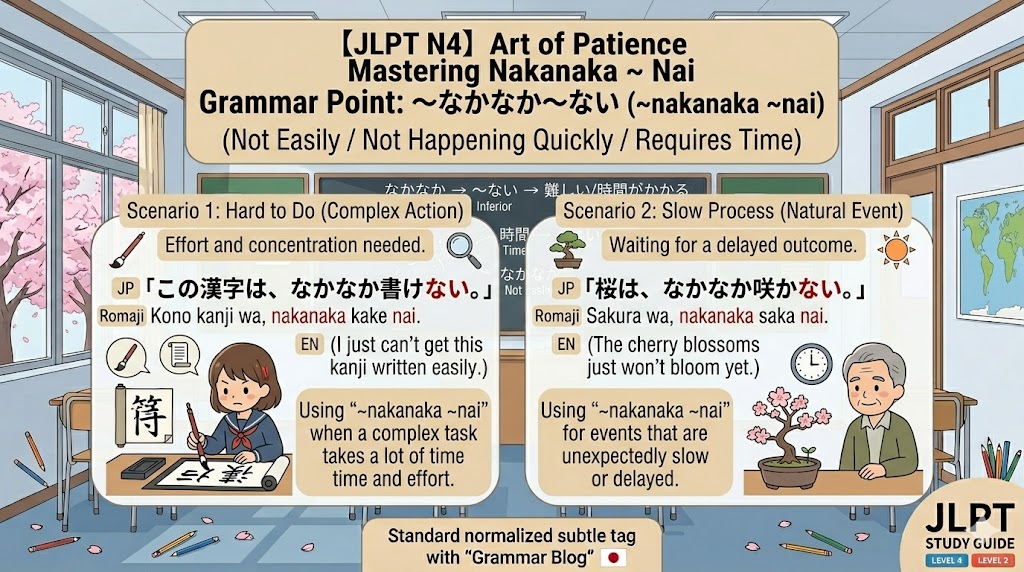
When you add nakanaka before a negative verb, the meaning shifts from a simple “not” to “not easily,” “not readily,” or “not happening despite expectations.” It implies that you’ve been waiting, you’ve been trying, or you expected the action to have happened by now, but for some reason, it’s being stubborn.
Think of it as the “stubbornness” particle. It describes a situation where there is a barrier or a delay that is preventing the natural conclusion of an event. Whether it’s a physical delay (like a train) or a mental block (like understanding a difficult concept), nakanaka ~ nai is your go-to phrase for expressing that lingering “still not yet” feeling.
The Basic Rule and Sentence Structure
The beauty of this grammar point lies in its simplicity. You don’t need to learn complex conjugations or worry about dozens of exceptions. The structure is incredibly consistent. To use it correctly, you just need to remember this pattern:
なかなか + Verb [Nai-form]
That’s it. You take the nai-form of any verb (the plain negative form) and place nakanaka right before it. If you want to be more polite, which is common in work or formal situations, you can use the masen-form instead. The meaning remains the same.
Let’s look at the two variations:
- Casual: なかなか漢字が覚えられない (Nakanaka kanji ga oboerarenai) – I can’t easily remember Kanji.
- Polite: なかなか漢字が覚えられません (Nakanaka kanji ga oboeraremasen) – I cannot easily remember Kanji.
One important thing to note is that nakanaka is often used with the potential form of verbs (like oboe-rareru instead of oboe-ru). This is because we often use this phrase to talk about things we *can’t* do easily, rather than things we just *don’t* do. When you say you “nakanaka” can’t do something, it shows that you are trying, but the result isn’t coming through. This nuance of effort is key to sounding like a native speaker.
Why Nakanaka Nai is Different from Mada
A question that many students ask is: “What’s the difference between Nakanaka ~ nai and Mada ~te imasen?” Both can be translated as “not yet,” but the feeling behind them is very different.
まだ〜ていません (Mada ~te imasen) is a neutral statement. It means something hasn’t happened yet, but it might happen soon, or it just hasn’t occurred in the flow of time. For example: “Mada hirugohan o tabete imasen” (I haven’t eaten lunch yet). There’s no real drama there. You just haven’t eaten yet.
However, if you say “Nakanaka hirugohan ga taberarenai,” it implies a struggle. Maybe you’ve been so busy with meetings that you keep trying to grab a sandwich, but the phone keeps ringing. It suggests that you want to eat, or you tried to eat, but something is stopping you. Nakanaka carries the weight of the delay.
In short: Mada is about time. Nakanaka is about the difficulty or the unexpected delay. Understanding this distinction will help you express your emotions more clearly when you’re frustrated or stuck in a situation.
Practical Examples for Your Daily Life
To really get a feel for how this works, let’s look at three scenarios that you will likely encounter while living or traveling in Japan. These examples show the variety of ways nakanaka ~ nai can be applied.
The Frustrated Commuter
Imagine you are standing on a platform in Tokyo during a snowy day. Usually, the trains come every three minutes, but today, the board says there is a delay. You’ve been standing there for ten minutes, and the crowd is growing.
Sentence: 雪のせいで、電車がなかなか来ません。
Reading: Yuki no sei de, densha ga nakanaka kimasen.
Translation: Because of the snow, the train just won’t come / is taking forever to come.
In this case, using “nakanaka” tells the listener that the train is late and that you are waiting for it. It captures that feeling of looking down the tracks and seeing nothing but empty rails. It’s much more expressive than simply saying “the train isn’t here.”
The Language Learner’s Struggle
We’ve all been here. You’ve been studying a specific grammar point—maybe even this one!—but when you try to use it in a conversation, your mind goes blank. You’ve been studying for months, yet you feel like your speaking skills are stuck in the same place.
Sentence: 毎日練習していますが、日本語がなかなか上手になりません。
Reading: Mainichi renshuu shite imasu ga, Nihongo ga nakanaka jouzu ni narimasen.
Translation: I practice every day, but my Japanese just isn’t getting better (despite my effort).
This is a classic use of the phrase. It highlights the contrast: “I am doing the work (Mainichi renshuu), but the result is not appearing (jouzu ni narimasen).” It’s a very humble and common way to talk about your progress in Japanese culture.
The Indecisive Decision Maker
Have you ever gone out to dinner with a group of friends, and there’s that one person who stares at the menu for fifteen minutes, unable to decide between the ramen or the sushi? Or perhaps you are trying to buy a new car, and you just can’t make up your mind.
Sentence: メニューの種類が多くて、食べるものがなかなか決められない。
Reading: Menyuu no shurui ga ookute, taberu mono ga nakanaka kimerarenai.
Translation: There are so many items on the menu, I can’t easily decide what to eat.
Here, the “difficulty” isn’t external (like a train delay); it’s internal. You are trying to make a choice, but the variety is making it hard. Using “nakanaka” here softens the statement and explains why you are taking so long. It makes you sound more human and less like you’re just being slow for no reason.
Common Pitfalls and How to Avoid Them
While nakanaka ~ nai is a relatively straightforward grammar point, there are a few traps that learners often fall into. Let’s clear those up so you can use the phrase with confidence.
The Positive Nakanaka
One of the most confusing things for beginners is that nakanaka can also be used in positive sentences. However, when it’s used in a positive sentence, the meaning changes completely. It doesn’t mean “easily”; it means “quite,” “fairly,” or “unexpectedly good.”
For example:
Kono ramen wa nakanaka oishii desu!
This doesn’t mean “This ramen is not easily delicious.” It means “This ramen is actually quite good!” (perhaps better than you expected).
The rule is simple: if the sentence ends in a negative, it means “not easily.” If the sentence ends in a positive, it means “quite/very.” Always check the end of the sentence before you interpret the meaning!
Nakanaka is not for Impossibilities
Another common mistake is using nakanaka ~ nai for things that are simply impossible or will never happen. Remember, this phrase implies that something should happen or you want it to happen, but it’s just taking time or effort.
You wouldn’t say: “Neko wa nakanaka Nihongo o hanashimasen” (The cat doesn’t easily speak Japanese). Why? Because a cat is never going to speak Japanese! “Nakanaka” is for things that are delayed or difficult, not things that are logically impossible. Use it for the bus, for your grades, for a wound healing, or for a friend arriving late. Don’t use it for things that are out of the realm of possibility.
Don’t Forget the Particle
While nakanaka is an adverb and doesn’t technically require a particle after it, beginners sometimes try to stick “wa” or “ga” after it because they feel like it needs one. Resist the urge! It stands alone. Just drop it in before your verb phrase and you’re good to go.
The Nuance of Social Politeness
In Japanese society, being direct can sometimes be seen as a bit harsh. If someone asks you, “Can you come to the party on Saturday?” and you say “Ikenai” (I can’t go), it sounds very final and perhaps a bit cold. It’s like slamming a door shut.
This is where nakanaka becomes a social lifesaver. By saying, “Zannen desu ga, nakanaka jikan ga tsukurenai desu” (It’s a shame, but I can’t easily make time), you are signaling that you want to go, and you’ve tried to see if you could make it work, but circumstances are making it difficult. It adds a layer of “I tried, but I failed” which is much more polite than a flat “No.”
Using this grammar point shows that you understand the “wa” (harmony) of Japanese social interaction. It acknowledges the effort and the desire, even when the outcome is negative. If you’re working in a Japanese office, you’ll hear this constantly. “Nakanaka susumimasen” (It’s not progressing easily) is a common way to report that a project is facing hurdles without sounding like you’re just giving up.
Summary
Learning Japanese is a marathon, not a sprint. There will be days when you feel like you’re flying, and there will be days when the words nakanaka detekonai (don’t easily come out). But that’s the beauty of the language—it has a specific word for that exact feeling.
To recap what we’ve covered today:
- Structure: Always use nakanaka with a negative verb (nai-form or masen-form).
- Meaning: It expresses that something is not happening easily, taking longer than expected, or requiring more effort than anticipated.
- Comparison: Unlike mada, which is a neutral “not yet,” nakanaka carries a sense of frustration, struggle, or unmet expectation.
- Social Use: It’s a great way to be polite and show that you’ve made an effort, even if you can’t achieve a certain result.
- The Positive Trap: Remember that in a positive sentence, nakanaka means “quite” or “very.” Always look at the verb ending!
The next time you’re stuck in traffic, struggling with a difficult article, or waiting for a friend who is notoriously late, try thinking of the situation using nakanaka ~ nai. Not only will it help you practice your grammar, but it might also give you a little bit of that Zen-like Japanese patience. After all, if the language has a special word for things taking a long time, maybe it’s okay that your progress takes a little time too.
Keep studying, keep practicing, and don’t be discouraged if things nakanaka don’t go perfectly right away. You’re doing great. Ganbatte kudasai!
IPPO, JLPT training platform is always here to help you to pass the JLPT!!

We offer the Best Online Japanese Learning (All Free), and our goal is to facilitate the adoption into life in Japan. Our service “IPPO” is made by native Japanese teachers and professionals. The tips we share with you can help you to learn Japanese efficiently and pass JLPT (Japanese Language Proficiency Test).