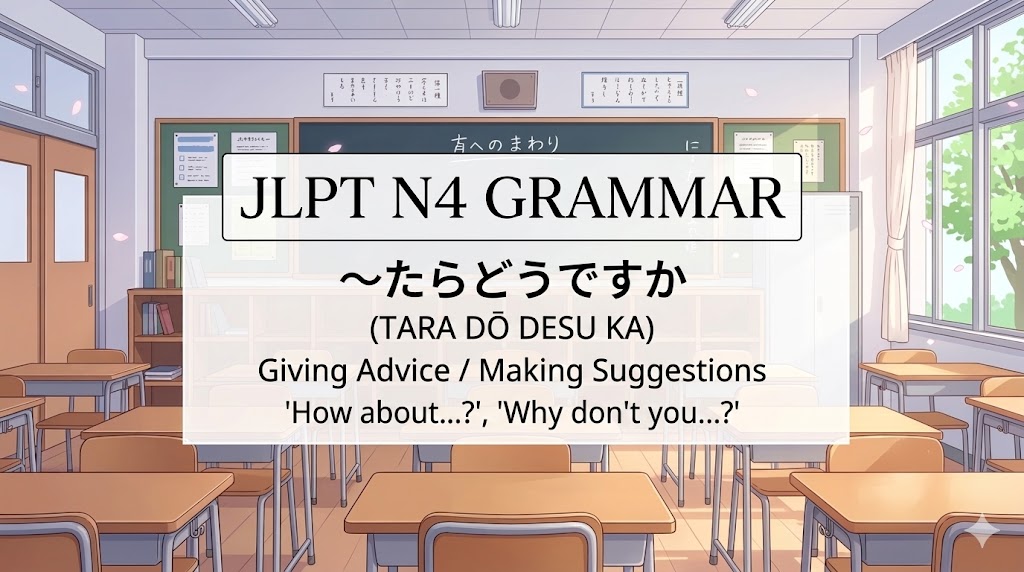
〜たらどうですか
Giving advice in any language is tricky, but in Japanese, where social hierarchy and subtle communication are paramount, the stakes are even higher. How do you tell your friend to study harder, or recommend a better restaurant to a colleague, while maintaining the harmony that Japanese culture values so highly?
If you’ve ever struggled to find the perfect phrasing when offering a suggestion, leading you to default to the blunt 〜ほうがいい (which can sometimes sound like a stern command), then you are in the right place. Today, we are diving deep into a beautifully nuanced structure that allows you to offer strong, helpful guidance while keeping your tone friendly and approachable: 〜たらどうですか (Tara dō desu ka).
This structure is essential for the JLPT because it tests your understanding of situational appropriateness (which is often more important than just literal meaning!). Grab your notes, because we are going to unlock the secrets of polite and effective recommendation!
Before diving into the grammar detail, here is the JLPT N4 complete guide:
The Ultimate JLPT N4 Complete Guide: Your Gateway to Working and Living in Japan
The Foundation: Deconstructing 〜たらどうですか
At its core, 〜たらどうですか functions as a polite and thoughtful suggestion. While often translated simply as “Why don’t you…?”, the Japanese construction carries a slight implication that the speaker believes this suggestion is a good, practical solution to a problem or situation the listener is currently facing.
The Basic Structure and Function
The beauty of this grammar point lies in its simplicity of structure combined with its complexity of tone. You simply take the verb describing the recommended action, put it into its past tense form (the Ta-form), add the conditional particle ら, and finish with the question phrase どうですか.
[Verb in Ta-Form] + ら + どうですか
For example, if the verb is 食べる (taberu / to eat):
- Ta-Form: 食べた (tabeta)
- Suggestion: 食べたらどうですか。 (Tabetara dō desu ka?)
- Meaning: Why don’t you eat? / How about eating?
The construction literally means: “If you do [X], how is that?” By presenting the action (X) as a condition and then asking for the listener’s evaluation (“how is that?”), the speaker softens the advice. It makes the listener feel like they are still making the final decision, even though the speaker has strongly proposed the idea.
Why Not Just Use 〜ほうがいい? (The Critical Nuance)
Many learners confuse 〜たらどうですか with 〜ほうがいい (hō ga ii), which also means “It would be better to…” or “You should…” However, the subtle difference is massive in terms of social interaction:
1. 〜ほうがいい (Hō ga ii):
- Tone: Stronger, often sounds like a definitive judgment or rule.
- Usage: Best used for general, objective advice (e.g., “It’s better to wear a mask,” or “You should study hard for the test.”). If used with close friends or subordinates, it’s fine, but using it with colleagues or superiors can sound overly decisive and even rude, implying the listener is clearly doing something wrong.
2. 〜たらどうですか (Tara dō desu ka):
- Tone: Softer, inquisitive, and suggests an option rather than dictating a rule.
- Usage: Used when the speaker is presenting a potential solution to a personal dilemma or offering a viable alternative. It is much safer to use in professional or casual settings where politeness is required, as it invites discussion rather than shutting it down.
In short, use 〜たらどうですか when you want to sound helpful and considerate, not demanding or authoritative.
Conjugation Checklist: Reviewing the Ta-Form
Since the entire structure hinges on correctly forming the Ta-form (past tense/conditional form) of the verb, a quick review is critical for JLPT success. Remember, the Ta-form follows the same rules as the Te-form, just with ‘ta’ instead of ‘te’.
Godan Verbs (U-Verbs)
These are the tricky ones! They undergo sound changes:
- Ends in く/ぐ: Write/go (書く/行く).
- → いた/いだ. (e.g., 書いたらどうですか)
- *Note: 行く is irregular but follows the pattern: 行く → 行ったらどうですか.
- Ends in む/ぶ/ぬ: Drink (飲む).
- → んだ. (e.g., 飲んだらどうですか)
- Ends in る/う/つ: Return/buy/stand (帰る/買う/待つ).
- → った. (e.g., 帰ったらどうですか)
- Ends in す: Talk (話す).
- → した. (e.g., 話したらどうですか)
Ichidan Verbs (Ru-Verbs)
These are the easy ones—just drop the る and add た:
- 食べる (Taberu) → 食べたらどうですか。
- 見る (Miru) → 見たらどうですか。
- 教える (Oshieru) → 教えたらどうですか。
Irregular Verbs
You only need to remember two primary irregular verbs:
- する (Suru / To do) → したらどうですか。
- 来る (Kuru / To come) → 来たらどうですか。
Mastering this Ta-form is step one. Once you can form the Ta-form reflexively, you can instantly produce sophisticated suggestions using 〜たらどうですか.
Practical Application: Scenarios Where 〜たらどうですか Shines
To truly cement this grammar point for the JLPT, we must look at how it functions in specific, everyday situations. The JLPT often tests whether you can use a grammatical pattern correctly within a given context.
Example 1: Offering Personal Advice (Health & Well-being)
Imagine your friend, Kenji, looks utterly exhausted. He mentions he’s been struggling to focus because he hasn’t been sleeping well due to stress.
Situation Dialogue
Kenji: 昨日は全然眠れなくて、頭が痛いです。(Kinō wa zenzen nemurenakute, atama ga itai desu.)
You: それは大変ですね。今日は早く仕事を終えたらどうですか。そして、寝る前に温かいミルクを飲んだらどうですか。
Analysis
- Japanese: 早く仕事を終えたらどうですか。
- Ta-Form: 終わる (Owaru – to finish) → 終わった (Owatta)
- English Translation: That sounds tough. Why don’t you finish work early today? And how about drinking warm milk before bed?
Why it works: You are not commanding Kenji to go home (which would be rude). By using 〜たらどうですか, you are presenting a compassionate, practical option. You show concern and suggest a concrete action (finishing work early) as a way to solve his sleep problem. If you had said 早く仕事を終えるべきだ (Owaru beki da – You must finish work early), it would sound like you are forcing him, which is inappropriate among friends unless the situation is dire.
Example 2: Suggesting an Alternative Plan (Study & Problem-Solving)
You are in a study group, and your classmate, Maria, is struggling immensely with remembering the N3 vocabulary lists using the current method (flashcards). She seems frustrated and on the verge of giving up.
Situation Dialogue
Maria: この単語、何回見ても覚えられないの。私にはフラッシュカードが合わないみたい。(Kono tango, nankai mitemo oboerarenai no. Watashi ni wa furasshukādo ga awanai mitai.)
You: そうなんだ。じゃあ、単語を暗記しようとするより、短い文章をたくさん作ってみたらどうですか?文章の中で使ったらどうですか。
Analysis
- Japanese: 短い文章をたくさん作ってみたらどうですか?
- Ta-Form: 作る (Tsukuru – to make) → 作った (Tsukutta)
- English Translation: I see. Well then, instead of trying to memorize the words, why don’t you try making lots of short sentences? How about using them within sentences?
Why it works: You recognize Maria’s struggle (the flashcard method isn’t working). You are offering an alternative learning strategy (making sentences). Because you frame it with 〜たらどうですか, the suggestion comes across as encouragement and a creative solution, rather than a critique of her current study habits. The verb 作ってみる (tsukutte miru), meaning “to try making,” further softens the suggestion, implying, “Just give it a try and see if it helps.”
Example 3: Professional Recommendation (Customer Service & Travel)
You are working at a travel agency. A customer, Mr. Tanaka, wants to book a trip to Hokkaido in August, but you know the prices are exorbitant and the most beautiful scenery is actually in October.
Situation Dialogue
Mr. Tanaka: 8月に北海道旅行を予約したいのですが、一番安いプランはありますか?(Hachi-gatsu ni Hokkaido ryokō o yoyaku shitai no desu ga, ichiban yasui puran wa arimasu ka?)
You: 8月は大変人気で少々高くなっております。もしよろしければ、紅葉が綺麗な10月に日程を変更されたらいかがですか?少しお安くなりますよ。
Analysis
- Japanese: 10月に日程を変更されたらいかがですか?
- Ta-Form: 変更する (Henkō suru – to change) → 変更した (Henkō shita) + Passive/Honorific form される (sareru)
- Politeness Level: Note the shift from どうですか to the highly polite いかがですか (ikaga desu ka), often paired with the honorific passive form されたら.
- English Translation: August is very popular and slightly expensive. If you wouldn’t mind, how about changing the date to October, when the autumn leaves are beautiful? It will be a bit cheaper.
Why it works: In a professional setting, blunt advice is unacceptable. By elevating どうですか to いかがですか, and ideally using honorific language (as seen in the example: 変更されたら), you show respect to the customer while clearly giving strong, valuable advice. You are solving the customer’s problem (high price) by offering a superior alternative (better scenery and lower cost).
Navigating the Pitfalls: Common Mistakes and Nuances
While 〜たらどうですか is a versatile and useful pattern, learners often misuse it, usually due to applying English grammar logic or overlooking the importance of tone.
Mistake 1: Using it with Superiors (Tone Mismatch)
The single biggest mistake learners make is using 〜たらどうですか with a boss, a senior colleague (せんぱい), or someone much older. While it is polite compared to 〜ほうがいい, the direct phrasing of どうですか still places the speaker in a position of offering unsolicited advice.
❌ INCORRECT (to your boss): 課長、この企画書はもっと簡単に書いたらどうですか?
(Kachō, kono kikakusho wa motto kantan ni kashitara dō desu ka? / Manager, why don’t you write this proposal more simply?)
✅ CORRECT (More polite alternatives):
Instead, use the more formal variations or rephrase the entire suggestion to make it seem like a question seeking permission or a humble suggestion:
- 〜たらいかがですか: This is the safe professional alternative. (例: 書いたらいかがですか?)
- 〜たらどうでしょう/いかがでしょう: Even softer and more formal, often used in presentations or official documents.
- 謙譲語 (Humble Language): Better yet, phrase it as “May I suggest…” (例: こちらの件について、簡単にご説明させていただけないでしょうか。/ Could I be allowed to explain this matter simply?)
Key takeaway: Reserve 〜たらどうですか for friends, family, juniors, or people of equal social standing.
Mistake 2: Confusing Advisory vs. Conditional
Remember, the base of this structure is the conditional form 〜たら, which means “if/when.” Sometimes, learners use the full structure 〜たらどうですか when they simply mean to ask what the result of a condition will be, not offer advice.
For example, you are waiting for a train.
❌ INCORRECT Usage: 電車が来たらどうですか? (Densha ga kitara dō desu ka? / If the train comes, why don’t you…?) — This makes no sense as advice.
✅ CORRECT Conditional Usage (Simple 〜たら): 電車が来たら、すぐ乗りましょう。(Densha ga kitara, sugu norimashō. / When the train comes, let’s get on right away.)
✅ CORRECT Advisory Usage: 電車が遅いですね。タクシーに乗ったらどうですか? (Densha ga osoi desu ne. Takushī ni nottara dō desu ka? / The train is late, isn’t it? Why don’t you take a taxi?)
The difference is the intent: 〜たらどうですか is only used when the action being suggested is a proposed solution or alternative course of action.
Politeness Spectrum: Understanding the Variations
Your ability to adjust the politeness level (often tested heavily in the JLPT) determines whether your suggestion is appropriate for the situation.
1. Casual and Direct Suggestion (Friends/Family)
In highly casual speech, the どうですか can be shortened, or even dropped entirely, relying heavily on context and rising intonation:
- 〜たら? (Tara?): The most casual form. Very common among close friends.
- 例: 疲れてるみたい。少し休んだら? (Tsukareteru mitai. Sukoshi yasundara?) / You look tired. Why don’t you rest a little?
- 〜たらどう? (Tara dō?): Slightly less blunt than just 〜たら?
2. Standard Suggestion (Colleagues/Acquaintances)
This is the standard form we have been studying:
- 〜たらどうですか (Tara dō desu ka): Standard polite advice. Appropriate for N3/N2 general conversation.
3. Formal and Respectful Suggestion (Seniors/Customers)
This elevates the respect level, essential for business Japanese and N1/N2 high-level situational questions:
- 〜たらいかがですか (Tara ikaga desu ka): The most common formal alternative. いかが is the polite form of どう.
- 〜たらどうでしょう (Tara dō deshō): A slightly more rhetorical and thoughtful way of presenting the suggestion, often used when inviting others to consider the idea.
When studying for the JLPT, always look for the context cues (who is speaking to whom?) to determine which variation is the most suitable response.
Deeper Linguistic Dive: The Conditional Power of たら
To fully appreciate 〜たらどうですか, we must briefly consider the sheer conditional power of the particle たら itself. Unlike ば (ba) or と (to), たら implies a sequence of events: “Upon completing X, Y happens.”
When used in advice, this temporal sequence is key:
[Action X (your suggestion)] + たら + [Y (the evaluation/question)]
The speaker is implicitly saying: “First, you perform the action (X). Then, we will evaluate the result (How is it?).” This framing makes the suggestion feel less like an imposition and more like a carefully considered experiment the speaker wants the listener to undertake. It’s a linguistic soft landing for potentially unwanted advice.
Consider the psychological difference:
- 〜なさい (Nasai – Command): Do X!
- 〜ほうがいい (Hō ga ii – Strong recommendation): X is better!
- 〜たらどうですか (Tara dō desu ka – Gentle suggestion): Why don’t you try X and see what happens?
This soft, trial-based approach is often favored in Japanese conversation where direct confrontation or absolute assertion is avoided.
Conclusion: Integrating 〜たらどうですか into Your JLPT Toolkit
Congratulations! You have now thoroughly explored 〜たらどうですか—a grammar point that is much more than just a simple translation of “why don’t you?” It is a vital tool for expressing empathy, offering practical solutions, and navigating the complexities of social interaction in Japanese.
For your JLPT preparation, remember these key points:
- Form: Always ensure the correct Ta-form conjugation.
- Function: It is advice, not just a casual condition. It implies the speaker believes this is a worthwhile course of action.
- Context: Avoid using どうですか with people significantly higher than you in status. Upgrade to いかがですか or どうでしょう when formality is required.
Practice using this structure the next time a study partner is struggling, or a friend is debating a decision. The more naturally you can incorporate 〜たらどうですか into your dialogue, the closer you will be to passing the conversational sections of the JLPT with flying colors. Keep practicing, and don’t forget to review the conjugation rules regularly! Good luck on your studies!
IPPO, JLPT training platform is always here to help you to pass the JLPT!!

We offer the Best Online Japanese Learning (All Free), and our goal is to facilitate the adoption into life in Japan. Our service “IPPO” is made by native Japanese teachers and professionals. The tips we share with you can help you to learn Japanese efficiently and pass JLPT (Japanese Language Proficiency Test).