
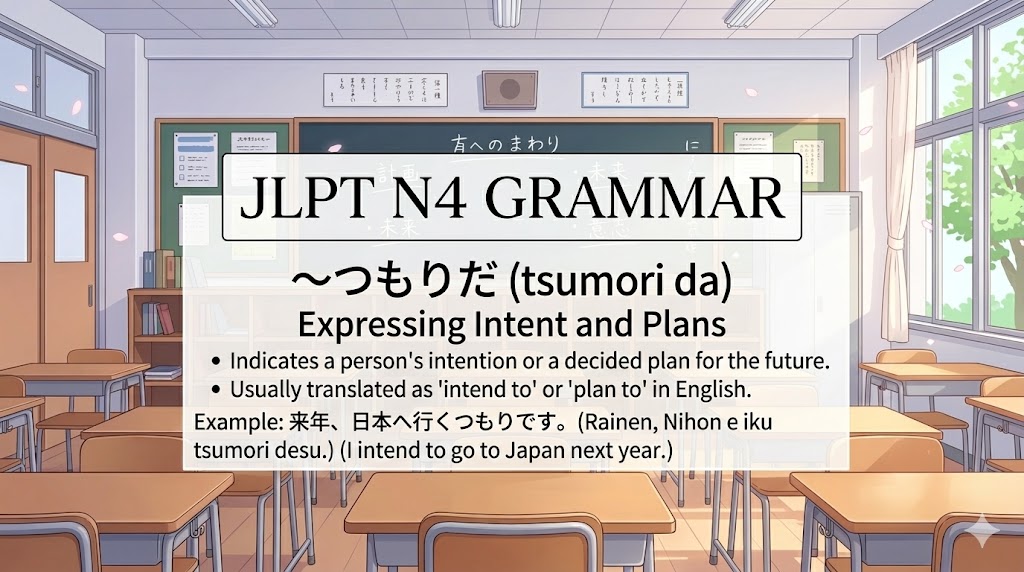
- 〜つもりだ (tsumori da)
- The Core Mechanics: How to Form and Understand 〜Tsumori Da
- Diving Deeper: The Power of Personal Resolution
- Essential Example Sentences for Daily Life and the JLPT
- A Critical Comparison: 〜Tsumori Da vs. 〜Yotei Da vs. 〜Tai
- Navigating Common Pitfalls: Mistakes to Avoid on the JLPT
- Final Thoughts: Integrating 〜Tsumori Da into Your Japanese Life
〜つもりだ (tsumori da)
Are you studying for the JLPT N4 or N3? As you advance in Japanese, you start to encounter a variety of ways to talk about the future, expressing everything from desires and vague possibilities to firm schedules and absolute resolutions. It’s exciting, but often confusing!
Among these crucial expressions is 〜つもりだ (tsumori da). This structure is foundational for clearly communicating your intentions, setting goals, and even describing complex personal assumptions.
If you’ve ever struggled with deciding whether to use 〜たい (〜tai), 〜予定だ (〜yotei da), or this mysterious 〜つもりだ, you are definitely not alone. Many learners hit a wall here, often resulting in sentences that sound either too weak or inappropriately scheduled. Don’t worry, this comprehensive guide is designed to clarify the nuances of 〜つもりだ, ensuring you can use it confidently both on the JLPT and in daily conversation.
By the end of this article, you will not only understand the grammar rules but also grasp the subtle difference between a concrete schedule and a strong personal decision—a distinction vital for sounding natural in Japanese.
The Core Mechanics: How to Form and Understand 〜Tsumori Da
At its heart, 〜つもりだ primarily conveys the speaker’s personal intention or resolution. Unlike expressing a mere hope or desire, using つもり means the speaker has made a decision and plans to act on it.
Rule 1: The Basic Connection (Connecting Verbs)
The structure for expressing intent is quite straightforward. You attach つもりだ to the plain forms of verbs.
- Positive Intent: Verb Dictionary Form + つもりだ
- Negative Intent: Verb Negative (Nai) Form + つもりだ
Let’s look at the basic conjugations using the verb 行く (iku – to go):
Affirmative Intent:
Plain Form: 行く + つもりだ (iku tsumori da)Meaning: I intend to go. / I plan to go.
Negative Intent:
Negative Form: 行かない + つもりだ (ikanai tsumori da)Meaning: I do not intend to go. / I don't plan to go.
JLPT Quick Tip: Always remember to use the plain forms (dictionary form or nai form) when attaching つもりだ. Using the polite -masu form before つもりだ is grammatically incorrect and will cost you points!
Rule 2: Expressing Belief or Pretense (The Advanced Use)
While the primary function of つもりだ is to talk about future plans, it has a crucial secondary meaning often encountered at the N3/N2 level: believing or assuming something is true, or pretending to be something. This usage requires a slightly different connection, often involving nouns or adjectives.
When used in this advanced way, the statement often implies that the reality is different from the speaker’s belief or action.
Connection with Nouns:
Noun + の + つもりだ
Example:
私はまだ若者のつもりだ。(Watashi wa mada wakamono no tsumori da.)
Meaning: I still consider myself a young person. (Even though I might be old.)
Connection with Past Actions (Belief about a finished action):
Verb Past Tense (Ta Form) + つもりだ
This structure is critical for expressing that you thought you had completed something, but perhaps you didn’t.
Example:
書類はもう提出したつもりだった。(Shorui wa mou teishutsu shita tsumori datta.)
Meaning: I thought I had already submitted the documents. (But later realized I hadn't, or someone told me they weren't received.)
Understanding this dual nature of 〜つもりだ—future intent versus current assumption/pretense—is key to mastering this versatile structure.
Diving Deeper: The Power of Personal Resolution
Let’s focus on the primary usage: expressing a strong, personal decision. This is where 〜つもりだ truly shines compared to other future expressions.
Tsumori Conveys a Firm Decision, Not Just a Wish
When you use つもりだ, you are telling the listener that the action has been resolved in your mind. It’s not just something you hope will happen; it’s something you are committed to making happen.
Think of it as drawing a line in the sand. If you say:
日本語を毎日勉強するつもりだ。 (Nihongo o mainichi benkyou suru tsumori da.)
This doesn’t just mean, “I want to study Japanese every day” (which would be 〜たい). It means, “I have decided and am resolved to study Japanese every day.” This implies a higher level of personal accountability and commitment.
The Role of Tsumori in Setting Long-Term Goals
Because it emphasizes resolution, つもりだ is frequently used when discussing major life changes, long-term educational plans, or career decisions—all common topics on the JLPT.
For example, if you are discussing your JLPT strategy with a study buddy:
N1に合格するまで、日本に滞在するつもりです。 (N1 ni goukaku suru made, Nihon ni taizai suru tsumori desu.)
Translation: I intend to stay in Japan until I pass the N1 exam.
The use of つもり here emphasizes that this is your definitive plan and personal goal, showing determination and focus.
Essential Example Sentences for Daily Life and the JLPT
To solidify your understanding, let’s explore three practical examples covering the most common situations where 〜つもりだ is indispensable.
Example 1: Positive Intent (A Clear Future Plan)
Imagine you are talking to your host family or colleagues about a major purchase or financial decision.
Japanese Sentence:
来年、車を買うために、毎月貯金するつもりです。
(Rainen, kuruma o kau tame ni, maitsuki chokin suru tsumori desu.)
Grammatical Breakdown:
- 買う (kau): Dictionary form of the verb “to buy.”
- 貯金する (chokin suru): Dictionary form of the verb “to save money.”
English Translation:
I intend to save money every month in order to buy a car next year.
Why Tsumori Works Here: This isn’t just a fleeting hope; it’s a fixed financial plan that the speaker has committed to. It signals a concrete, self-imposed objective.
Example 2: Negative Intent (A Firm Decision to Stop or Not Do Something)
〜つもりだ is highly effective for communicating firm negative resolutions, such as quitting a habit or declining an invitation permanently.
Japanese Sentence:
健康のために、もうタバコは二度と吸わないつもりだ。
(Kenkō no tame ni, mou tabako wa nidoto suwanai tsumori da.)
Grammatical Breakdown:
- 吸わない (suwanai): Negative form of the verb “to smoke.”
- 二度と (nidoto): Emphasizes “never again.”
English Translation:
For the sake of my health, I do not intend to smoke cigarettes ever again.
Why Tsumori Works Here: By using the nai form + tsumori da, the speaker expresses a powerful, unwavering resolution. This is much stronger than just saying “I don’t want to smoke.”
Example 3: Advanced Usage (Belief or Misunderstanding)
This example demonstrates the usage where the speaker expresses an assumption or belief about an action that has already occurred, often implying that the belief may be mistaken.
Japanese Sentence:
彼女にしっかりと謝ったつもりだったが、まだ怒っているらしい。
(Kanojo ni shikkari to ayamatta tsumori datta ga, mada okotte iru rashii.)
Grammatical Breakdown:
- 謝った (ayamatta): Past tense (Ta form) of the verb “to apologize.”
- つもりだった (tsumori datta): Past tense of tsumori da, meaning “I intended/believed.”
English Translation:
I thought I had properly apologized to her, but apparently, she is still angry.
Why Tsumori Works Here: The speaker believed their apology was sufficient (their intention was fulfilled), but the second part of the sentence (まだ怒っているらしい) reveals a conflict with reality. This structure is perfect for conveying personal belief contradicted by external facts.
A Critical Comparison: 〜Tsumori Da vs. 〜Yotei Da vs. 〜Tai
To truly master 〜つもりだ for the JLPT, you must be able to differentiate it from other common expressions of futurity. These distinctions are frequent test points because they test your understanding of nuance.
Tsumori Da vs. Yotei Da (Intent vs. Schedule)
This is arguably the most common source of confusion for intermediate learners. While both translate to “plan to,” they describe different sources of planning.
〜つもりだ (Tsumori Da): Subjective Intent and Resolution
- Focus: The speaker’s personal will, commitment, and decision.
- Nature: Internal and psychological. It’s what you have decided for yourself.
- Flexibility: High. It can change if the speaker changes their mind.
- Use Case: Expressing personal goals, resolutions, and strong decisions (e.g., “I intend to quit my job,” “I intend to study abroad”).
〜予定だ (Yotei Da): Objective Schedule and External Plan
- Focus: A pre-arranged schedule, itinerary, or external plan that involves timing or formal arrangement.
- Nature: External and objective. Often involves someone else’s schedule or a fixed timetable.
- Flexibility: Low. It implies something is already booked or scheduled (e.g., “The train is scheduled to arrive at 8,” “My meeting is scheduled for 10 AM”).
Consider the difference:
Scenario 1: Your trip to Hokkaido.
(A) 来週、北海道に行くつもりだ。(Raishū, Hokkaido ni iku tsumori da.)Meaning: I intend/have decided to go to Hokkaido next week. (Maybe I haven’t bought tickets yet, but the decision is firm.)
(B) 来週、北海道に行く予定だ。(Raishū, Hokkaido ni iku yotei da.)Meaning: I am scheduled to go to Hokkaido next week. (Implies tickets are bought, plans are fixed, and the date is set.)
If you are explaining a business itinerary to a client, you should use 予定だ. If you are telling a friend about your long-term life goal, use つもりだ.
Tsumori Da vs. 〜Tai (Resolution vs. Desire)
The difference here is the strength of the commitment.
〜たい (〜Tai): Expresses a personal desire, wish, or want. It’s a feeling.
新しい携帯電話が買いたい。(Atarashii keitai denwa ga kaitai.)Meaning: I want to buy a new mobile phone. (But I haven’t decided if or when I will.)
〜つもりだ (Tsumori Da): Expresses a strong resolution or intention. It’s a decision to act.
新しい携帯電話を買うつもりだ。(Atarashii keitai denwa o kau tsumori da.)Meaning: I intend/plan to buy a new mobile phone. (The decision has been made.)
While 〜たい is softer and focuses on the internal feeling, 〜つもりだ is an outward declaration of a decided course of action.
Tsumori Da vs. 〜Ou/You (Strong Will vs. Vague Plan or Suggestion)
The volitional form ($\sim$ou/you) also expresses intent, but it is generally weaker than 〜つもりだ.
The volitional form often conveys a spontaneous decision (“I think I’ll buy it”) or is used to suggest an action to others (“Let’s go!”). When used in the first person singular, it suggests a less defined, more immediate, or less serious plan.
昼ご飯はそばを食べよう。(Hirugohan wa soba o tabeyou.)Meaning: I think I'll eat soba for lunch. (A spontaneous, immediate decision.)
昼ご飯はそばを食べるつもりだ。(Hirugohan wa soba o taberu tsumori da.)Meaning: I intend to eat soba for lunch. (A pre-determined plan or commitment.)
The volitional form is useful for quick, minor intentions, whereas つもりだ is better suited for significant, pre-meditated plans or resolutions.
Navigating Common Pitfalls: Mistakes to Avoid on the JLPT
Even after understanding the basic structure, learners often make specific mistakes that the JLPT frequently tests. Be mindful of these three traps!
Mistake 1: Using Tsumori for Others’ Intentions
Since 〜つもりだ expresses a speaker’s personal, internal resolution, it is primarily used in the first person (I/we).
Incorrect Usage:
❌ 私の先生は来月結婚するつもりだ。(My teacher intends to get married next month.)
Why is this wrong? You cannot definitively know the internal, personal resolution of another person unless they told you explicitly. Even then, using 〜つもりだ for a third party sounds unnatural, almost like you are speaking for them.
Correct Alternatives:
If the plan is fixed:
✅ 私の先生は来月結婚する予定だ。(Yotei da - My teacher is scheduled/expected to get married next month.)
If you heard the intention from them:
✅ 私の先生は来月結婚すると言っていた。(To itteita - My teacher said they would get married next month.)
Exception: You can use it in a rhetorical sense (e.g., in an argument, “Do you think you are Superman?” — あなたはスーパーマンのつもりですか?), but for simple future planning, stick to the first person.
Mistake 2: Confusing Tsumori with Simple Past Facts
Remember that the “Ta Form + つもりだ” structure is used specifically to express a mistaken belief or assumption about a past action (Example 3).
If you simply want to state a past intention that you followed through with, you do not need つもりだ; just use the past tense of the main verb.
Unnecessary Usage:
❌ 昨日、図書館で勉強するつもりだったから、勉強しました。(I intended to study at the library yesterday, so I studied.)
The inclusion of つもりだ here is redundant and weakens the statement, unless you are contrasting it with something else (e.g., “I intended to study, but I got distracted”).
Simple and Correct:
✅ 昨日、図書館で勉強しました。(Kinō, toshokan de benkyō shimashita.)
Use つもりだった only when the intention was not fulfilled or the belief was incorrect.
Mistake 3: Forgetting “No” When Connecting to Nouns
When using 〜つもりだ in its advanced context to mean “believing oneself to be” or “acting as,” and connecting it to a noun, the particle の (no) is mandatory.
Incorrect Usage:
❌ 私はプロだつもりだ。(I believe I am a professional.)
Correct Usage:
✅ 私はプロのつもりだ。(Watashi wa puro no tsumori da.)
Treating つもり like a regular noun following a noun requires the connecting particle の.
Final Thoughts: Integrating 〜Tsumori Da into Your Japanese Life
Congratulations! You have now internalized the comprehensive rules and intricate nuances of 〜つもりだ. This structure is far more than just a way to talk about the future; it is a declaration of your personal will and resolution.
For your JLPT preparation, remember these key takeaways:
- Intent vs. Schedule: Use つもりだ for your personal, internal decisions; use 予定だ for external, fixed schedules.
- Negative Strength: Use the nai form + つもりだ to express a strong commitment not to do something.
- Advanced Usage: Be prepared for the N3/N2 questions that utilize 〜つもりだ to mean “belief” or “pretense” (e.g., 〜た つもりだ).
- Focus on Self: Use つもりだ primarily for the first person (I/we).
The journey to Japanese fluency requires precision. By differentiating your desires (〜たい) from your resolutions (〜つもりだ) and your resolutions from your fixed schedules (〜予定だ), you will not only score higher on the JLPT but also communicate with far greater clarity and confidence in your daily life in Japan.
Start practicing today by stating your study resolutions using this grammar. For example: 「今日は単語を50個覚えるつもりです!」 (Kyou wa tango o gojukkko oboeru tsumori desu! – I intend to memorize 50 vocabulary words today!).
Keep up the great work. Your dedication to understanding these subtleties is what separates a good learner from a great one. Good luck with your studies and your JLPT!
IPPO, JLPT training platform is always here to help you to pass the JLPT!!

We offer the Best Online Japanese Learning (All Free), and our goal is to facilitate the adoption into life in Japan. Our service “IPPO” is made by native Japanese teachers and professionals. The tips we share with you can help you to learn Japanese efficiently and pass JLPT (Japanese Language Proficiency Test).