- 〜て form
- Understanding the Core Function: When Does 〜て Mean “Because”?
- The Golden Rule of Restriction: The Critical Constraint of 〜て (Reason)
- In-Depth Analysis: Everyday Examples of 〜て (Cause)
- Navigating the Minefield: Common Mistakes and Advanced Distinctions
- Advanced Application: Describing Conditions and States with 〜て
- Review and Final Tips for JLPT Success
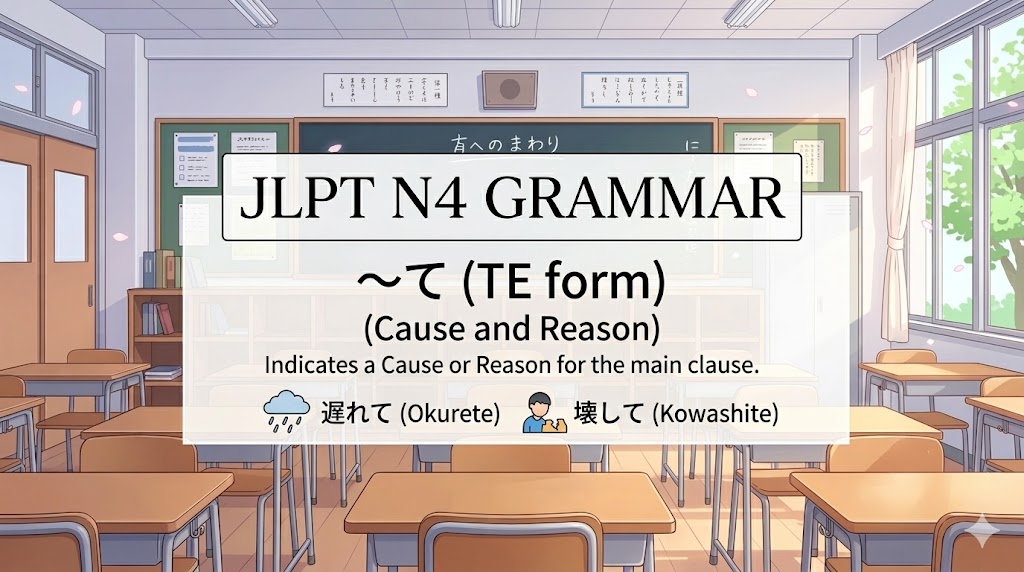
〜て form
If you are navigating the complex world of Japanese grammar, especially as you prepare for the JLPT N4 or N3 exams, you know that expressing cause and reason is a major hurdle. Japanese offers a buffet of options—〜から, 〜ので, 〜ために, and many others—each with its own subtle rules and restrictions. It often feels like you need a secret decoder ring just to decide which one fits the situation!
Among these common structures, the usage of the 〜て form (the connective form of verbs and adjectives) to express cause and reason is perhaps the most deceptive. It looks simple, but its application is severely limited, and using it incorrectly can instantly make your Japanese sound unnatural, or worse, completely wrong.
Don’t worry. This comprehensive guide is designed to clarify exactly when and how to use the 〜て form for cause and reason. We will dive deep into its core function, explore its critical limitations, and arm you with the confidence to use this essential structure flawlessly in your daily conversations and on exam day.
Before diving into the grammar detail, here is the JLPT N4 complete guide:
The Ultimate JLPT N4 Complete Guide: Your Gateway to Working and Living in Japan
Understanding the Core Function: When Does 〜て Mean “Because”?
We usually learn the 〜て form first as a way to list actions (e.g., ご飯を食べて、寝ます – I eat and then sleep) or to indicate means (e.g., バスに乗って行きます – I go by taking the bus). However, when two clauses are connected by the 〜て form, it inherently carries a sense of connection, and that connection is often causal.
The fundamental principle when 〜て expresses cause is this: The first clause (the reason) led naturally and often unavoidably to the second clause (the result).
Unlike 〜から or 〜ので, which can express a speaker’s subjective opinion or justification for an action, 〜て is used primarily for reasons that are:
- Natural Consequences: Something that happens without the speaker’s conscious choice.
- Emotional States: How the speaker or subject feels as a direct result of the cause.
- Uncontrolled Events: Natural phenomena, accidents, or established conditions.
The Mechanics: How to Connect Clauses Using 〜て
The connection rules follow the standard rules for forming the 〜て form for each part of speech. It connects the reason clause (Clause A) to the result clause (Clause B).
1. Connecting Verbs (動詞)
Convert the verb into its 〜て form (e.g., 行く → 行って, 待つ → 待って).
Example: 電車が遅れて、会議に間に合いませんでした。 (The train was late, so I didn’t make it to the meeting.)
2. Connecting い-Adjectives (い形容詞)
Replace the final い with 〜くて (e.g., 忙しい → 忙しくて, 寒い → 寒くて).
Example: 今日はとても暑くて、何もしたくないです。 (It is very hot today, so I don’t want to do anything.)
3. Connecting な-Adjectives and Nouns (な形容詞・名詞)
For both, use 〜で (which is the て form of the copula です/だ).
- Na-Adjective: 好きだ → 好きで (Example: 彼は親切で、皆に好かれています。)
- Noun: 病気だ → 病気で (Example: 風邪で、学校を休みました。)
The Golden Rule of Restriction: The Critical Constraint of 〜て (Reason)
This is the section where many JLPT candidates stumble. While 〜て can express cause, it comes with a major, non-negotiable restriction regarding the type of sentence that can follow it. Mastering this restriction is the key to differentiating 〜て from 〜から and 〜ので.
The Unacceptable Results: No Volitional Expressions
The 〜て form absolutely cannot be used when the result clause (Clause B) expresses the speaker’s strong will, intention, command, request, invitation, or suggestion. This is because 〜て describes a natural chain of events, which is incompatible with a conclusion that requires the active choice or intervention of a human.
You cannot use 〜て to connect to sentences ending in:
- Request/Command: 〜てください, 〜なさい, 〜ろ
- Suggestion/Invitation: 〜ましょう, 〜ませんか
- Volitional/Intention: 〜たいです, 〜つもりです, 〜う/よう (volitional form)
- Judgment/Advice based on reason: 〜ほうがいい, 〜べきだ
Example of a Common Mistake and Correction
❌ INCORRECT: 寒いくて、窓を閉めてください。
(Reason: ‘Please close the window’ is a request, which shows intention.)
✅ CORRECT (Using から): 寒いから、窓を閉めてください。
(The speaker decides to ask for the action.)
✅ CORRECT (Using て for natural result): 寒くて、震えています。
(The result ‘shivering’ is an uncontrolled, natural reaction.)
When you feel the need to express a personal command, desire, or intention based on a reason, you must switch to 〜から or 〜ので.
In-Depth Analysis: Everyday Examples of 〜て (Cause)
To truly cement your understanding, let’s examine three detailed examples that showcase the typical usage of 〜て for cause and reason. Notice how the second clause in each example describes a state, an emotion, or an outcome that is generally outside the speaker’s immediate control.
Example 1: Expressing Strong Feelings and Emotional States
The 〜て form is perhaps most frequently used to connect a cause to a resulting emotion, psychological state, or physical sensation.
日本語: 合格の知らせを聞いて、とても嬉しかったです。
Romaji: Gōkaku no shirase o kiite, totemo ureshikatta desu.
English Translation: I heard the news of passing, and I was very happy (because of that).
Analysis of Usage:
- Cause (Clause A): 合格の知らせを聞きました (I heard the passing news).
- Result (Clause B): とても嬉しかったです (I was very happy).
Why 〜て works: Happiness is a natural, non-volitional reaction to good news. You don’t choose to be happy; you simply are. Since the result is a spontaneous, passive emotional state, 〜て is the most natural connector. While 〜から could also be used here, 〜て suggests a direct, immediate, and unavoidable emotional chain reaction.
Example 2: Explaining Non-Volitional Conditions or Status
This structure is excellent for linking a current condition (often described using a Noun + で or a Verb in the て form of being) to a subsequent outcome.
日本語: 仕事が忙しくて、先週は全く寝る時間がありませんでした。
Romaji: Shigoto ga isogashikute, senshū wa mattaku neru jikan ga arimasen deshita.
English Translation: Because my work was busy, I had absolutely no time to sleep last week.
Analysis of Usage:
- Cause (Clause A): 仕事が忙しい (Work is busy). (い-adjective + くて)
- Result (Clause B): 寝る時間がありませんでした (I had no time to sleep).
Why 〜て works: The ‘busy work’ is an established condition (a state of being). The lack of sleep is a direct, unavoidable consequence of that condition. It’s not a decision or a request; it’s a statement of fact about the circumstances. This structure elegantly links the established state to the resulting problem.
Example 3: Describing Accidents, Natural Events, and Incidents
When the cause is an unexpected event, a natural phenomenon, or an accident, 〜て is highly appropriate because these causes are entirely outside human control.
日本語: 交通事故に遭って、入院することになりました。
Romaji: Kōtsū jiko ni atte, nyūin suru koto ni narimashita.
English Translation: I was involved in a traffic accident, and consequently, I ended up being hospitalized.
Analysis of Usage:
- Cause (Clause A): 交通事故に遭いました (I was involved in a traffic accident). (Verb + て)
- Result (Clause B): 入院することになりました (I ended up being hospitalized).
Why 〜て works: Traffic accidents and subsequent hospitalization are involuntary and consequential events. Clause B describes the unavoidable outcome of the event in Clause A. This phrasing sounds very objective and matter-of-fact, simply stating the chain of events.
Navigating the Minefield: Common Mistakes and Advanced Distinctions
Now that we have covered the basics, let’s tackle the advanced distinctions—the subtle differences that truly separate a fluent speaker from a hesitant one.
Distinction 1: 〜て vs. 〜から (Subjectivity and Volition)
The most frequent error is confusing 〜て with 〜から.
〜から (Kara)
〜から is highly versatile. It can connect virtually any two clauses, including those where the result is a command, request, or intention. It places strong emphasis on the reason and often implies the speaker’s subjective opinion or justification for their subsequent action.
Example (Subjective Choice): 頭が痛いから、今日は早く帰ります。 (My head hurts, so I am going home early.)
(The decision to go home is the speaker’s volitional choice, justified by the reason.)
〜て (Te)
〜て is objective. It connects events where the result is an unavoidable consequence, state, or emotion. It cannot justify an action that the speaker willingly chooses to take.
Example (Objective Consequence): 頭が痛くて、授業に集中できませんでした。 (My head hurt, so I couldn’t concentrate in class.)
(Inability to concentrate is a natural, unavoidable consequence.)
Distinction 2: 〜て vs. 〜ので (Formality and Restriction)
〜ので is slightly more formal and softer than 〜から. While 〜ので is also generally restricted from preceding strong commands or requests, it is often accepted in situations where 〜て would be inappropriate, particularly when the reason is known or established.
However, the key difference lies in the breadth of use:
- 〜て: Focuses on emotional reactions, established conditions, and involuntary consequences.
- 〜ので: Focuses on providing a logical, often socially acceptable, reason for an action or situation.
Consider this tricky scenario:
Situation: The meeting starts at 9:00 AM. You are late.
Preferred apology using ので: 電車が遅れたので、遅刻してしまいました。 (Since the train was late, I ended up being late.)
(This is a standard, polite explanation.)
Possible, but less common using て: 電車が遅れて、遅刻してしまいました。
(While grammatically correct as a chain of events, 〜ので is usually chosen in apologies because it sounds like you are offering a reasonable justification for the inconvenience.)
Distinction 3: The Danger of Double Interpretation
Since the 〜て form has multiple functions (listing, means, time sequence), you must ensure the context clearly signals a cause/reason relationship.
Compare these two sentences:
1. Time Sequence/Means: 橋を渡って、家に帰りました。 (I crossed the bridge and went home.)
2. Cause/Reason: 橋が壊れて、家に帰れなくなりました。 (The bridge was broken, so I couldn’t go home.)
In Sentence 1, the action of crossing the bridge precedes the action of going home. In Sentence 2, the state of the bridge (壊れている) is the direct, passive cause of the inability to go home. The meaning hinges entirely on whether the second clause is a volitional action or an involuntary state/result.
Advanced Application: Describing Conditions and States with 〜て
The use of the 〜て form for expressing conditions is not just for simple adjectives or verbs; it is also crucial when linking two descriptive clauses that form a single overall impression.
For Noun + Noun or Adjective + Adjective chains, the 〜で or 〜くて form connects the properties, implying that the combination of these properties leads to a conclusion.
このレストランは、料理が美味しくて、雰囲気も良いです。(This restaurant’s food is delicious, and consequently, the atmosphere is also good.)
あの人は、真面目で、優しいです。(That person is serious/diligent, and consequently, kind.)
While often translated simply as “and,” the inherent connection often carries the implication that these combined qualities create the speaker’s positive overall impression. If you remove the 〜て form and use two separate sentences, the connection feels looser. The 〜て form binds the attributes together.
Review and Final Tips for JLPT Success
The 〜て form used for cause and reason is a fundamental structure for describing the unavoidable flow of events, emotional reactions, and states of being in Japanese. To ensure you use it correctly on the JLPT and in real life, internalize these final three points:
1. The Volition Test is Absolute
Always ask yourself: Does the result clause (Clause B) express a request, command, intention, or personal desire? If the answer is yes, do not use 〜て. Use 〜から or 〜ので instead.
- Acceptable results (Non-Volitional): States (〜ている, 〜でした), Emotions (嬉しい, 悲しい), Passive Voice (〜られる), Potential Form (〜できる), Involuntary Change (〜になる).
2. Prioritize Natural Consequences
Reserve 〜て for reasons that lead naturally and passively to the result. Think of weather, accidents, illness, psychological reactions, or inherent qualities of an object or person.
3. Practice Conversion
Practice converting sentences involving different parts of speech into the 〜て form for cause:
- Verb: 道に迷いて、遅れました。
- I-Adjective: 気持ちが悪くて、早退しました。
- Na-Adjective: この街は静かで、住みやすいです。
- Noun: 事故で、電車が止まりました。
You have now grasped the most challenging aspect of the 〜て form for cause. By recognizing its strict limitations, especially regarding volitional expressions, you can use it precisely when describing natural, unavoidable events and states. Keep practicing these distinctions, and you’ll master this essential element of JLPT grammar in no time!
頑張ってください! (Good luck!)
IPPO, JLPT training platform is always here to help you to pass the JLPT!!

We offer the Best Online Japanese Learning (All Free), and our goal is to facilitate the adoption into life in Japan. Our service “IPPO” is made by native Japanese teachers and professionals. The tips we share with you can help you to learn Japanese efficiently and pass JLPT (Japanese Language Proficiency Test).