〜ば(Ba)
If you have been studying Japanese for a while, you have likely hit that inevitable wall where you realize that “if” isn’t as simple as a single word. In English, we just say “if” and move on with our lives. But in Japanese? You have ~tara, ~to, ~nara, and the one we are focusing on today: ~ba.
I know exactly how you feel. You are sitting there with your JLPT practice workbook, looking at a multiple-choice question where three of the options mean “if,” and you are pulling your hair out trying to figure out the nuance. It feels like a riddle. You might be thinking, “Why can’t I just use ~tara for everything? Everyone understands me when I use ~tara!”
While it’s true that ~tara is the “Swiss Army knife” of conditionals, mastering the ~ba form is what takes you from “someone who speaks Japanese” to “someone who truly understands the logic of the language.” It is essential for the JLPT N4 and N3 levels, and it appears constantly in formal writing, proverbs, and specific conversational patterns that make you sound much more natural. In this guide, we are going to break down the ~ba form so it finally clicks.
Before diving into the grammar detail, here is the JLPT N4 complete guide:
The Ultimate JLPT N4 Complete Guide: Your Gateway to Working and Living in Japan
The Logical Foundation of the Ba Form
To understand the ~ba form, stop thinking of it as just “if.” Instead, think of it as a logical prerequisite. It creates a bridge between a condition and a result. If Part A happens, then Part B will naturally or logically follow. Unlike ~tara, which focuses more on the sequence of events (after A happens, then B), the ~ba form focuses on the dependency: Part B cannot happen without Part A.
Let’s look at the basic conjugation rules. I promise they are more consistent than most Japanese grammar points, so once you memorize the pattern, you’re set.
Conjugating Verbs into the Ba Form
For verbs, the ~ba form is often called the “provisional” form. The trick here is to look at the dictionary form of the verb and move the final vowel to the “e” column of the hiragana chart, then add ba.
Group 1 (U-Verbs): Change the final -u sound to an -e sound and add ba.
- Iku (To go) → Ike + ba = Ikeba
- Nomu (To drink) → Nome + ba = Nomeba
- Hanasu (To speak) → Hanase + ba = Hanaseba
- Kau (To buy) → Kae + ba = Kaeba
Group 2 (Ru-Verbs): Drop the final -ru and add -reba.
- Taberu (To eat) → Tabereba
- Miru (To see) → Mireba
- Neru (To sleep) → Nereba
Group 3 (Irregular Verbs): Just memorize these two.
- Suru (To do) → Sureba
- Kuru (To come) → Kureba
Conjugating Adjectives and Negatives
This is where students sometimes get tripped up, but the rule is actually very similar to how we change -i adjectives into the past tense or negative form.
I-Adjectives: Drop the final -i and add -kereba.
- Oishii (Delicious) → Oishikereba
- Samui (Cold) → Samukereba
- Takai (Expensive) → Takakereba
- Note: For Ii (Good), it becomes Yokereba (using the “Yoi” root).
Na-Adjectives and Nouns: Usually, we use nara for these, but in formal or written contexts, you can add de areba. However, for the JLPT N4/N3 level, focusing on nara for nouns is usually sufficient. If you do want to use the “ba” sound, you use de areba (the formal version of “desu”).
- Kirei (Beautiful) → Kirei de areba
- Gakusei (Student) → Gakusei de areba
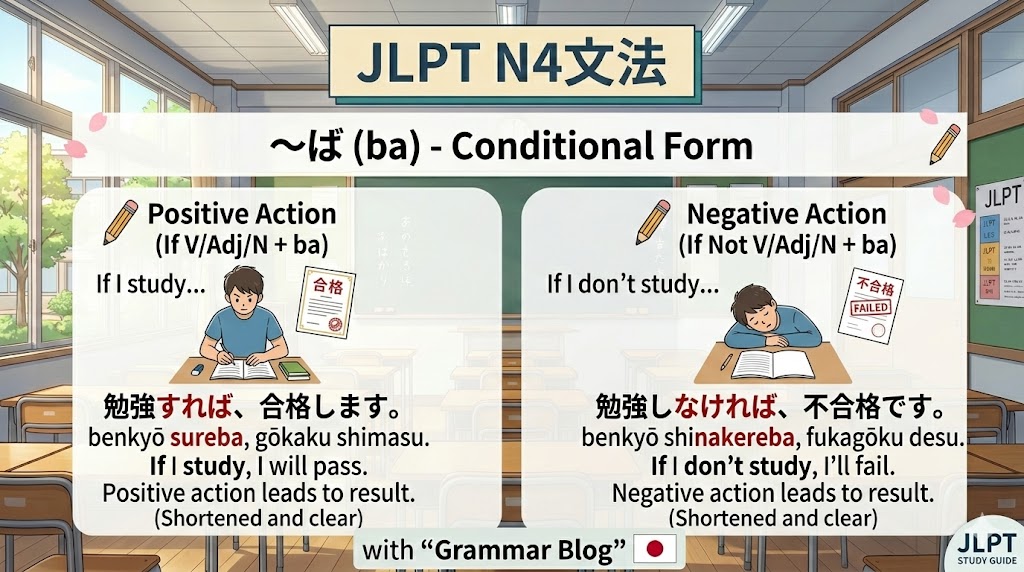
Negative Forms (If you don’t…): This is very common. You take the negative -nai form, treat it like an -i adjective, and change it to nakereba.
- Tabenai (Don’t eat) → Tabenakereba (If you don’t eat)
- Ikanai (Don’t go) → Ikanakereba (If you don’t go)
Practical Examples for Daily Life
Theory is all well and good, but you need to see how this actually functions in a sentence. The ~ba form carries a nuance of “as long as” or “provided that.” It sets the stage for a specific outcome. Let’s look at three scenarios you might actually encounter.
Asking for Directions or Advice
In Japan, you’ll often hear people use ~ba when they are looking for the “best” way to do something. It implies that “if I do this specific action, will the result be what I want?”
Example Sentence:
駅へはどう行けばいいですか?
(Eki e wa dou ikeba ii desu ka?)
English Translation: How should I go to the station? (Literally: If I go how, is it good?)
This is a classic phrase. You are asking for the specific condition (the route) that will lead to the desired result (getting to the station). Using ~ba here is much more natural than using ~tara because you are looking for a logical solution.
Expressing Necessary Conditions
The ~ba form is perfect for expressing a simple cause-and-effect relationship, especially when it comes to things that are generally true or logical conclusions.
Example Sentence:
安ければ、買います。
(Yasukereba, kaimasu.)
English Translation: If it’s cheap, I’ll buy it.
In this case, the condition “cheapness” is the deciding factor. If the price tag meets the “cheap” criteria, the action “buy” will happen. It’s a very clear-cut, logical connection. Note that if you were talking about a one-time, accidental discovery, you might use ~tara, but ~ba emphasizes the price as the primary condition.
The “More and More” Pattern
One of the most useful advanced patterns involving ~ba is the ~eba… hodo grammar point. This is used to say “the more [A], the more [B].”
Example Sentence:
日本語は、勉強すればするほど難しくなります。
(Nihongo wa, benkyou sureba suru hodo muzukashiku narimasu.)
English Translation: As for Japanese, the more you study, the harder it becomes.
This pattern is everywhere in Japanese conversations. Whether you are talking about food (the more you eat, the better it tastes) or practice (the more you practice, the better you get), this is a “level-up” phrase that will impress native speakers and is a frequent guest on the JLPT.
Crucial Restrictions and Common Mistakes
This is the section you really need to pay attention to for the JLPT. Many students lose points because they don’t realize that ~ba has one very specific, very annoying rule: The Will/Volition Constraint.
In many cases, you cannot use a verb expressing will, a command, or a request in the second half of a ~ba sentence.
Let’s look at a wrong example:
❌ Jikan ga areba, kaimono ni ikou! (If there is time, let’s go shopping!)
In this sentence, “ikou” (let’s go) is an expression of will/invitation. Generally, Japanese speakers find it awkward to use ~ba here because ~ba is supposed to be a logical condition, not a trigger for a personal choice.
The Fix: Use ~tara for personal choices, requests, and commands.
✅ Jikan ga attara, kaimono ni ikou! (If there is time, let’s go shopping!)
The Exception to the Rule
There is an exception (because of course there is!). You can use a command or will in the second half if the first half uses a state (like an adjective or the verb aru) or if the subjects of the two clauses are different.
Example of an acceptable “will” sentence with ~ba:
✅ Yasukereba, kaimasu. (If it is cheap, I will buy it.)
Since “cheap” is an adjective (a state), it’s okay to follow it with “I will buy it.”
Don’t Confuse Ba with To
Another common mistake is mixing up ~ba and ~to.
~To is used for natural laws and automatic results (e.g., “If you push this button, the water comes out” or “If it becomes spring, the flowers bloom”).
~Ba is used for conditions that are more about a choice of path or a specific requirement.
If you say Haru ni nareba, hana ga saku, it’s not grammatically “wrong,” but it sounds like you are focusing on the requirement of it being spring. Usually, for nature, ~to is the go-to choice.
How to Choose Between Ba and Tara
If you are feeling overwhelmed, here is a rule of thumb for the JLPT:
- If the second part of the sentence is a command, request, or suggestion (~te kudasai, ~mashou, ~nasai), use ~tara.
- If you are talking about the past (e.g., “If I had known…”), use ~tara. ~Ba is almost never used for past-tense “if” scenarios in modern conversational Japanese.
- If you are looking for advice (How should I…?), or using adjectives to set a condition (If it’s cold…), ~ba is your best friend.
Think of ~tara as the “Time” conditional (Once A happens, then B). Think of ~ba as the “Logic” conditional (Given A, B follows).
The Cultural Nuance of Ba
Beyond just the grammar rules, using ~ba can change the “vibe” of your Japanese. It often sounds a bit more intellectual or formal than ~tara. You will see it in many Japanese proverbs (kotowaza).
For example: “Chiri mo tsumoreba yama to naru” (Even dust, if it piles up, becomes a mountain).
The use of ~ba here gives it a feeling of an inevitable logical truth. If you used ~tara, it would sound more like a specific story about some specific dust. ~Ba makes it a universal law.
When you use ~ba correctly in a conversation, it shows that you aren’t just translating English “if” in your head. It shows you understand that Japanese is a language of conditions and contexts. It helps you sound less like a textbook and more like a person who understands how Japanese logic flows.
Summary and Final Tips for the JLPT
We’ve covered a lot of ground! Let’s recap the most important points so you can walk into your exam with confidence.
- Conjugation: For verbs, it’s the “e” column + ba. For I-adjectives, it’s -kereba.
- The Core Meaning: It’s a logical prerequisite. “If and only if A happens, then B.”
- The Big No-No: Avoid using ~ba with commands (~te kudasai) or invitations (~mashou) unless the first part of the sentence is a state/adjective.
- The Pro Tip: Memorize the ~eba… hodo pattern. It’s a guaranteed point-scorer on the JLPT and incredibly useful in real life.
Learning Japanese grammar is a marathon, not a sprint. Don’t worry if you still find yourself reaching for ~tara occasionally—even native speakers use ~tara in most casual situations. But as you continue to read Japanese news, watch anime, or listen to podcasts, start looking for the ~ba form. Notice when it is used and why the speaker chose it over other conditionals.
The more you see it in the wild, the more it will start to feel natural to you. Keep practicing your conjugations, don’t be afraid to make mistakes, and remember: Benkyou sureba, jouzu ni narimasu! (If you study, you will get better!)
Good luck with your JLPT studies!
IPPO, JLPT training platform is always here to help you to pass the JLPT!!

We offer the Best Online Japanese Learning (All Free), and our goal is to facilitate the adoption into life in Japan. Our service “IPPO” is made by native Japanese teachers and professionals. The tips we share with you can help you to learn Japanese efficiently and pass JLPT (Japanese Language Proficiency Test).