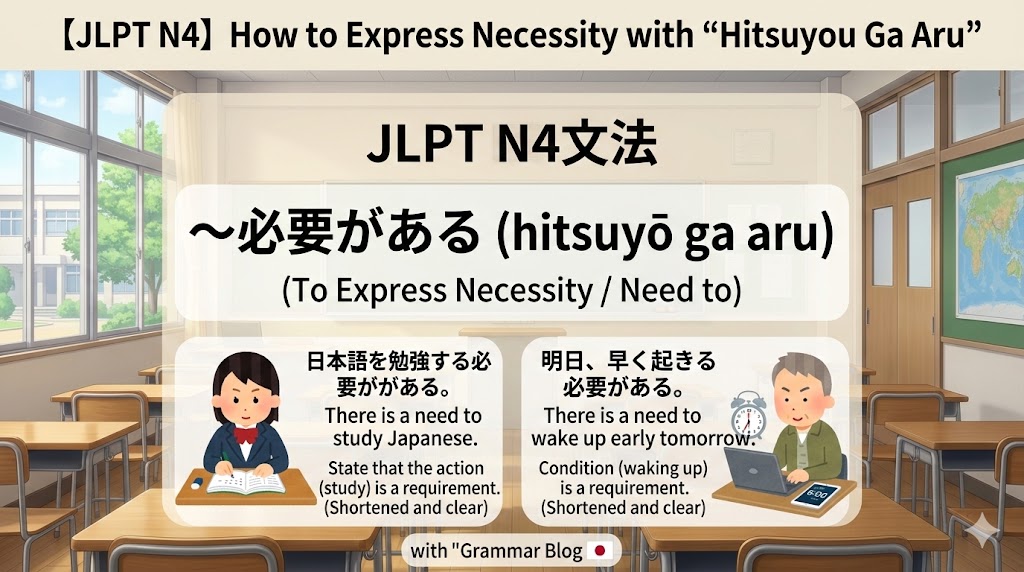
〜必要がある (hitsuyou ga aru)
If you have been studying Japanese for a while, you have likely reached a point where you feel like you are “stuck” using the same basic phrases. You know how to say you want something (hoshii) and you know how to say you have to do something (nakereba naranai). But what about those moments when you need to sound more objective? What if you are explaining a requirement for a visa, a rule at work, or a step in a recipe?
This is where many learners struggle. In English, we use the word “need” for almost everything. “I need water,” “I need to go,” “It is necessary to wait.” In Japanese, however, the way you express “need” changes depending on the context and who you are talking to. One of the most important structures you will encounter as you move toward the JLPT N3 and N2 levels is 〜必要がある (hitsuyou ga aru).
In this guide, we are going to break down this grammar point so thoroughly that you’ll feel confident using it in your next conversation or on your next exam. We aren’t just looking at the textbook definition; we are looking at the soul of the phrase—how it feels to a Japanese ear.
Before diving into the grammar detail, here is the JLPT N4 complete guide:
The Ultimate JLPT N4 Complete Guide: Your Gateway to Working and Living in Japan
Understanding the Basics of Hitsuyou Ga Aru
At its core, 〜必要がある (hitsuyou ga aru) translates to “there is a necessity to…” or simply “it is necessary to…” It comes from two words: 必要 (hitsuyou), which is a noun meaning “necessity” or “need,” and ある (aru), the verb meaning “to exist” or “to be.”
When you combine them, you are literally saying “The necessity exists.” Because this structure uses a noun (hitsuyou), it feels much more objective and factual than the typical “must” forms like ~nakereba naranai. It is often used in formal writing, news reports, and professional settings, but you will also hear it in daily life when someone is explaining a logical requirement.
The Grammatical Construction
The beauty of this grammar point is its simplicity. You don’t need to conjugate verbs into complex forms. You simply use the Dictionary Form (the plain/casual form) of the verb.
Verb (Dictionary Form) + 必要がある
Let’s look at how this looks in different politeness levels:
- Casual: 食べる必要がある (Taberu hitsuyou ga aru) – It’s necessary to eat.
- Polite/Standard: 食べる必要があります (Taberu hitsuyou ga arimasu) – It is necessary to eat.
- Past Tense: 食べる必要があった (Taberu hitsuyou ga atta) – It was necessary to eat.
- Negative: 食べる必要はない (Taberu hitsuyou wa nai) – There is no need to eat.
Note that in the negative form, the particle が (ga) often changes to は (wa) to add emphasis to the lack of necessity: hitsuyou wa nai.
Real-Life Examples of Hitsuyou Ga Aru in Action
To truly understand how to use a grammar point, you need to see it in context. Here are three common scenarios where you would use this phrase instead of other “must” forms.
Applying for a Document
Imagine you are at the city office (kuyakusho) trying to renew your health insurance or register your address. The clerk might say:
「この書類にサインをする必要があります。」
(Kono shorui ni sain o suru hitsuyou ga arimasu.)
Translation: It is necessary to sign this document.
In this case, the clerk isn’t giving you a personal command. They are stating a procedural requirement. Using hitsuyou ga arimasu makes it sound professional and objective.
Health and Well-being
If you go to a doctor and they are giving you advice, they might use this form to emphasize the logical need for a certain action to get better.
「毎食後、この薬を飲む必要があります。」
(Maishokugo, kono kusuri o nomu hitsuyou ga arimasu.)
Translation: It is necessary to take this medicine after every meal.
Again, this isn’t just a “must” (like a rule); it’s a necessity based on the goal of recovering your health.
Studying for the JLPT
Let’s talk about your studies! If you want to pass the N2, you can’t just wish for it. You have to put in the work.
「合格するために、毎日単語を覚える必要がある。」
(Goukaku suru tame ni, mainichi tango o oboeru hitsuyou ga aru.)
Translation: In order to pass, it is necessary to memorize vocabulary every day.
This is a statement of fact. If “Pass” is the goal, “Study” is the necessary step to get there.
The Nuance Difference: Why Not Just Use Nakereba Naranai?
This is the question that trips up most intermediate learners. In English, “I have to go” and “It is necessary for me to go” mean basically the same thing. In Japanese, the nuance is quite different.
Nakereba Naranai (The Feeling of Obligation)
When you use 〜なければならない (~nakereba naranai), it often carries a sense of social pressure, duty, or a personal sense of obligation. It feels a bit heavier. It’s like saying, “If I don’t do this, things will go wrong” or “It is my duty.”
Hitsuyou Ga Aru (The Feeling of Logical Necessity)
When you use 〜必要がある (hitsuyou ga aru), you are taking the “emotion” or “personal pressure” out of it. You are simply stating a condition. Think of it as a logical “if-then” statement. If you want X, then Y is a necessary requirement. This is why it is used so often in manuals, instructions, and formal speeches. It sounds more intellectual and detached.
Example:
1. 行かなければならない (I must go): I promised my mom, or I have a meeting I can’t miss. I feel the pressure.
2. 行く必要がある (It is necessary to go): I need to go to the store because we are out of milk. It’s just a fact of life.
Common Mistakes and Cautions
While the grammar is straightforward, there are a few traps that learners often fall into. Let’s make sure you avoid them!
Forgetting the Particle “No” with Nouns
We’ve focused on verbs (Verb + hitsuyou ga aru), but what if you want to say “The necessity of [Noun]”? You cannot just put the noun next to hitsuyou. You must use the particle の (no).
Incorrect: 練習必要あります (Renshuu hitsuyou arimasu)
Correct: 練習の必要があります (Renshuu no hitsuyou ga arimasu) – There is a need for practice.
Confusing “Hoshī” with “Hitsuyou”
In English, we often say “I need a coffee” when we really mean “I want a coffee.” In Japanese, you should be careful. Hitsuyou ga aru is very strong and literal. If you say “Koohii no hitsuyou ga aru,” it sounds like you might die or collapse without it for medical reasons! If you just have a craving, stick to “Koohii ga hoshii” or “Koohii ga nomitai.”
The Negative Nuance: Hitsuyou wa nai
When you want to say “You don’t need to…” or “There is no need to…”, using 〜必要はない (hitsuyou wa nai) is very common. However, be careful with your tone. Because it is an objective statement, it can sometimes sound a bit cold or dismissive if used toward a superior.
If your boss is apologizing and you say “Ayamaru hitsuyou wa arimasen” (There is no need to apologize), it might sound a bit too clinical. In casual or friendly situations, it’s perfect for reassuring someone: “Shinpai suru hitsuyou wa nai yo!” (There’s no need to worry!).
Don’t Overuse It in Casual Conversation
Because hitsuyou ga aru sounds a bit formal and objective, using it constantly with your friends might make you sound like a textbook or a robot. In casual speech with friends, people often prefer shorter forms like 〜なきゃ (~nakya) or just 〜ないと (~naito). Save hitsuyou ga aru for when you want to sound clear, logical, or professional.
Expanding Your Vocabulary: Related Expressions
To truly master the concept of necessity, it helps to know a few other words that live in the same neighborhood as hitsuyou ga aru.
Fukaketsu (Indispensable)
If something isn’t just “necessary” but is “absolutely essential/indispensable,” you use the word 不可欠 (fukaketsu). You will often see this in writing: “Mizu wa ningen ni totte fukaketsu da” (Water is indispensable for humans).
Beki (Should)
If you want to say someone “should” do something because it’s the right thing to do morally or socially, use 〜べきだ (~beki da). Hitsuyou ga aru is about logic; beki da is about ethics and expectations.
Nakutemo ii (Don’t have to)
While hitsuyou wa nai means “there is no necessity,” 〜なくてもいい (~nakutemo ii) is the common way to say “it’s okay if you don’t.” It feels much softer and more permissive.
Summary and Final Tips for Success
Learning Japanese grammar is like building a house. You started with the foundation (basic particles and verbs), and now you are adding the specific tools that allow you to express complex thoughts. 〜必要がある (hitsuyou ga aru) is one of those essential tools that moves you from “basic communication” to “nuanced expression.”
Here is a quick recap:
- Use it for objective necessity: Use it when the requirement comes from logic, rules, or the situation, not just your personal feelings.
- Structure: [Dictionary Form Verb] + 必要がある.
- Negative: [Dictionary Form Verb] + 必要はない (No need to…).
- Nouns: Use the particle の (no) between a noun and hitsuyou.
- Tone: It sounds more formal and professional than nakereba naranai.
The best way to make this grammar stick is to start looking for it. The next time you are reading a Japanese news article, looking at a train station sign, or listening to a formal announcement, listen for “hitsuyou.” You will start to see it everywhere! Practice writing three sentences of your own today using this form—maybe about your work, your visa, or your goals. By using it actively, you turn a “grammar rule” into a “speaking skill.”
Keep pushing forward in your JLPT journey. Every new structure you learn brings you one step closer to fluency. You’ve got this!
IPPO, JLPT training platform is always here to help you to pass the JLPT!!

We offer the Best Online Japanese Learning (All Free), and our goal is to facilitate the adoption into life in Japan. Our service “IPPO” is made by native Japanese teachers and professionals. The tips we share with you can help you to learn Japanese efficiently and pass JLPT (Japanese Language Proficiency Test).