Table of Contents
のに(Noni)
Have you ever had one of those days where everything seemed to go exactly the opposite of how it was supposed to? You studied for hours, yet the exam felt like it was written in a different language. You checked the weather forecast, which promised clear skies, yet you got soaked in a downpour five minutes after leaving the house. Or maybe you finally worked up the courage to go to that famous ramen shop, only to find it closed on its “scheduled” open day.
In English, we usually handle these situations with words like “even though,” “despite,” or “although.” But in Japanese, there is a specific grammar point that carries a much heavier emotional weight: 〜のに (noni). If you are studying for the JLPT N3, you’ve likely encountered this word already. It’s one of those essential tools that moves you beyond just stating facts and allows you to express your feelings—specifically, your surprise, regret, or even a bit of grumpiness when things don’t go as planned.
In this guide, we are going to break down everything you need to know about noni. We will look at how to build it, how it differs from other “buts,” and how to use it so you sound like a natural speaker rather than a textbook.
Before diving into the grammar detail, here is the JLPT N4 complete guide:
The Ultimate JLPT N4 Complete Guide: Your Gateway to Working and Living in Japan
The Basic Rules of Using Noni
Before we get into the “soul” of the grammar, we need to make sure the “skeleton” is correct. The structure of noni is relatively straightforward, but there is one specific trap that catches many students—especially when it comes to nouns and na-adjectives.
The general rule is that noni follows the plain form (dictionary form) of verbs and adjectives. However, let’s look at the specific breakdowns:
Verbs
For verbs, you use the dictionary form, the negative form (nai-form), or the past tense (ta-form).
- Dictionary Form: 食べるのに (taberu noni) – Even though I eat…
- Negative Form: 食べないのに (tabenai noni) – Even though I don’t eat…
- Past Form: 食べたのに (tabeta noni) – Even though I ate…
I-Adjectives
I-adjectives are simple. Just add noni directly after the adjective.
- Present: 高いのに (takai noni) – Even though it is expensive…
- Past: 高かったのに (takakatta noni) – Even though it was expensive…
Na-Adjectives and Nouns
This is the most important part! When you use a na-adjective or a noun in the present tense, you must add な (na) before noni. If you forget this “na,” your Japanese will sound broken.
- Na-Adjective: 好きなのに (suki na noni) – Even though I like it…
- Noun: 日曜日なのに (nichiyoubi na noni) – Even though it is Sunday…
Note: If you are using the past tense for nouns or na-adjectives (datta), you don’t need the “na.” You just say だったのに (datta noni).
Practical Examples for Everyday Life
To really understand noni, you have to see it in action. Remember, noni isn’t just a bridge between two sentences; it’s a signal that the second half of the sentence is unexpected or unsatisfactory based on the first half.
Example 1: The Failed Effort
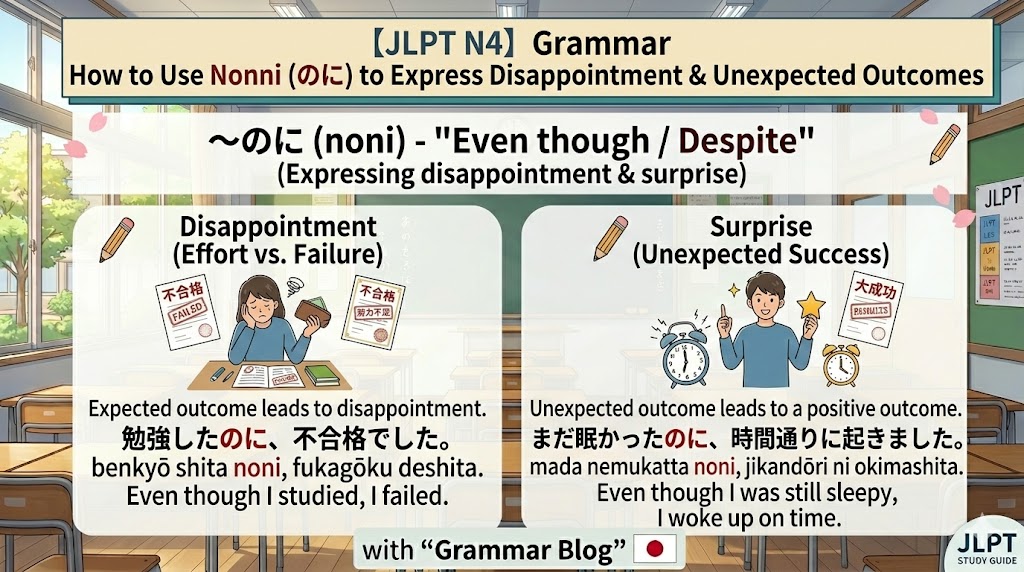
Imagine you stayed up until 2 AM studying for your kanji test. You feel confident. You walk into the classroom, take the test, and… you fail. This is the perfect time for noni.
一生懸命勉強したのに、試験に落ちてしまいました。
(Isshoukenmei benkyou shita noni, shiken ni ochite shimaimashita.)
Translation: Even though I studied as hard as I could, I ended up failing the exam.
In this sentence, the speaker is expressing a sense of “Why? It shouldn’t be this way!” There is a nuance of disappointment that wouldn’t be as strong if they used a different connector like ga or keredo.
Example 2: The Weather Betrayal
Japanese weather forecasts are usually very accurate, which makes it even more frustrating when they are wrong. If you see a blue sky in the morning but it rains anyway, you would say:
今日はいい天気なのに、傘を持っていかないといけません。
(Kyou wa ii tenki na noni, kasa o motte ikanai to ikemasen.)
Translation: Even though the weather is nice today, I have to take an umbrella (perhaps because the forecast changed or it’s cloudy elsewhere).
Notice the な (na) after tenki because tenki is a noun!
Example 3: Unexpected Personality Traits
We often use noni to talk about people who act differently than we expect based on their appearance or status.
彼はもう大人なのに、まだ子供みたいなことを言っています。
(Kare wa mou otona na noni, mada kodomo mitai na koto o itte imasu.)
Translation: Even though he is already an adult, he is still saying things like a child.
Again, because otona (adult) is a noun, we use na noni. This sentence carries a tone of criticism or disbelief.
Understanding the Emotional Nuance of Noni
One of the biggest hurdles for English speakers learning Japanese is that we have so many words for “but.” You already know ga, keredo, demo, and shikashi. So, why do we need noni?
The secret lies in the emotion. If you use ga or keredo, you are simply contrasting two facts. It’s objective. It’s like a robot stating data.
For example:
“It is raining, but I will go out.” (Ame ga futte imasu ga, dekakemasu.)
This is just a statement of your plans.
However, when you use noni, you are adding your personal feelings to the mix. It implies that the situation is contrary to your expectations, desires, or common sense. It often contains a hint of:
- Regret: “I wish it weren’t so.”
- Surprise: “I can’t believe this is happening!”
- Complaint: “This isn’t fair!”
If you tell your boss, “I worked hard but I didn’t finish,” using keredo sounds like a professional explanation. If you use noni, it sounds like you are complaining or seeking sympathy because you feel your hard work should have resulted in success. This is why you need to be careful with noni in very formal or polite situations—it can sometimes make you sound like you are whining if you aren’t careful with your tone!
Common Mistakes and How to Avoid Them
Even advanced learners trip up on noni sometimes. Here are the three most common pitfalls you should watch out for.
Mistake 1: Forgetting the “Na”
I mentioned this earlier, but it’s worth repeating because it’s the #1 error on the JLPT.
Incorrect: 休みのに、仕事があります。 (Yasumi noni…)
Correct: 休みなのに、仕事があります。 (Yasumi na noni…)
Remember: Nouns and Na-Adjectives need “na”!
Mistake 2: Using Noni with Requests or Commands
This is a subtle but vital rule. You cannot use noni if the second part of the sentence is a request, a command, a suggestion, or a statement of will/intention.
For example, you cannot say:
Incorrect: 雨が降っているのに、外に行きましょう。 (Even though it’s raining, let’s go out.)
Why? Because “Let’s go” (ikimashou) is a suggestion.
In this case, you should use 〜ても (temo):
Correct: 雨が降っていても、外に行きましょう。 (Even if it’s raining, let’s go out.)
Noni is for stating things that actually happened or are currently happening which are unexpected. It is not used for future plans or inviting someone to do something.
Mistake 3: Confusing “Noni” for Contrast vs. “Noni” for Purpose
Wait, there’s another noni? Yes, but don’t panic! In Japanese, there is a structure used to describe what something is used “for.”
Example: このナイフはパンを切るのに使います。 (Kono naifu wa pan o kiru noni tsukaimasu.)
Translation: This knife is used for cutting bread.
In this case, noni means “for the purpose of.” You can tell the difference because the “purpose” noni is almost always followed by verbs like tsukau (use), benri (convenient), or jikan ga kakaru (takes time). Also, the “purpose” noni never takes the “na” for nouns. If you see na noni, it’s almost certainly the “even though” version.
Noni at the End of a Sentence: The Silent Emotion
In conversational Japanese, you will very often hear people end their sentence with noni and just… stop. They don’t finish the thought.
Example: “Ah, katte ita noni…” (Ah, I was winning, but…)
When a sentence ends with noni, the second half of the sentence is implied. Usually, the implied part is something negative, like “but I lost anyway” or “but it didn’t work out.” By leaving the sentence unfinished, the speaker is emphasizing their feeling of regret or frustration. It’s a very “Japanese” way of communicating—leaving the most painful part of the sentence unsaid so the listener can fill in the blanks with empathy.
If you’re watching anime or Japanese dramas, keep an ear out for this. You’ll hear characters sigh and say, “Zutto matteta noni…” (But I was waiting the whole time…). It’s much more poetic and emotional than finishing the sentence.
The Difference Between Noni, Keredo, and Ga
To help you choose the right word during your JLPT exam (or in a real conversation), let’s do a quick comparison.
1. Ga / Keredo (The Standard “But”)
These are the safest choices. They are used for simple contrast.
“I went to the store, but they didn’t have milk.”
This is just a fact. There is no special emotion here.
2. Noni (The Emotional “Even Though”)
Use this when there is a sense of surprise or complaint.
“I went to the store even though it was a typhoon!”
Here, you are emphasizing the effort you made and how crazy the situation was.
3. Temo (The “Even If”)
This is used for hypothetical situations or things that haven’t happened yet.
“Even if it rains tomorrow, I will go.”
You cannot use noni here because the rain hasn’t happened yet.
How to Practice Noni for the JLPT
If you want to master noni for your exam, you need to practice identifying the “unexpectedness.” When you read a practice question, look at the two parts of the sentence. Ask yourself: “Is the second part what I would expect based on the first part?”
- He is rich / He doesn’t spend money. (Unexpected -> Noni)
- It is cold / I am wearing a coat. (Expected -> Keredo or Ga)
If the result is the opposite of common sense, noni is your best friend. Also, pay close attention to the grammar right before noni. If it’s a noun and there’s no “na,” it’s a trap!
Summary
The grammar point 〜のに (noni) is more than just a conjunction; it’s a way to color your speech with human emotion. It bridges the gap between what we expect to happen and what actually happens, often highlighting the frustrations and surprises of daily life.
Quick Recap:
- Verbs/I-Adjectives: Use Plain Form + noni.
- Nouns/Na-Adjectives: Use [Noun/Adjective] + na + noni.
- Meaning: “Even though,” “Despite.”
- Nuance: Surprise, regret, or complaint.
- Restriction: Do not use with requests, suggestions, or commands.
Learning Japanese can be tough. 一生懸命勉強しているのに、なかなか覚えられない (Even though I’m studying hard, I just can’t remember everything) — we’ve all been there! But don’t let that stop you. The fact that you are looking up specific grammar points like this shows that you are making progress. Keep practicing, keep listening, and soon, using noni will feel as natural as saying konnichiwa.
Good luck with your JLPT studies! You’ve got this!
IPPO, JLPT training platform is always here to help you to pass the JLPT!!

We offer the Best Online Japanese Learning (All Free), and our goal is to facilitate the adoption into life in Japan. Our service “IPPO” is made by native Japanese teachers and professionals. The tips we share with you can help you to learn Japanese efficiently and pass JLPT (Japanese Language Proficiency Test).