Tips for JLPT from the Native Japanese Teacher

Tips to efficiently pass the JLPT - Advice from the native Japanese teacher - 1) Know the structure 2)Time managing 3) Daily training

→ Free Learning Platform ←

N4

article-jlpt-grammar

【JLPT N4】Nuances of Time with ところだ(Tokoro Da)

ところだ(Tokoro Da) If you have been studying Japanese for a while, you’ve probably reached that frustrating plateau whe...

2026.03.26
article-jlpt-grammar

【JLPT N4】Essential Japanese Grammar: How to Use 〜という (to iu)

〜という is used to define, name, or describe something. Think of it as a way to say "called," "named," or "the thing that is..." in English.
2026.03.26
article-jlpt-grammar

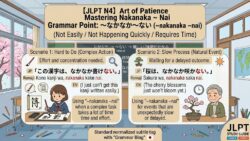
【JLPT N4】Art of Patience with なかなか〜ない(Nakanaka Nai)

Feeling that something is taking much longer than it should? Then you are already familiar with the spirit of the Japanese grammar point なかなか〜ない (Nakanaka~nai).
2026.03.26
article-jlpt-grammar

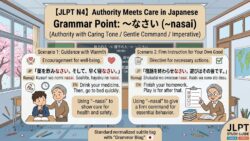
~なさい (~nasai) When Authority Meets Care in Japanese

~なさい is the imperative form of the honorific verb なさる (nasaru), which is the polite version of する (suru). However, it has evolved into a "soft imperative."
2026.03.26
article-jlpt-grammar

【JLPT N4】~にくい(Nikui) How to Express When Things Are Hard to Do

In English, 〜にくい (~nikui) is "hard to do" or "difficult to handle." In Japanese, however, there is a very specific point for these exact situations.
2026.03.26
article-jlpt-grammar

【JLPT N4】Mastering Conditionals: How to Use Nara Correctly

Unlike other conditionals, ~nara is used when you are picking up on a topic that someone else mentioned, or a situation that has just become apparent.
2026.03.26
article-jlpt-grammar

【JLPT N4】How to Use にする(Ni Suru) to Express Your Choices

〜にする (ni suru) translates most to "to decide on" or "to make it [something]." It’s the grammar used when we have options in front of us and we are picking one.
2026.03.26
article-jlpt-grammar

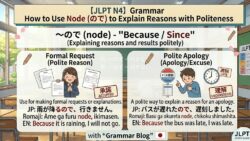
【JLPT N4】 “Node” to Explain Reasons with Politeness

"node" (ので) is used to connect a reason to a result. It is "because", however, unlike its cousin から, ので places the emphasis on the objective circumstances.
2026.03.26
article-jlpt-grammar

【JLPT N4】のに(Noni) to Express Disappointment & Unexpected
Outcomes

In English, "even though," "despite" or "although." But in Japanese, there is a specific grammar point that carries a much heavier emotional weight: 〜のに (noni).
2026.03.26
article-jlpt-grammar

【JLPT N4】How to Use the Japanese Grammar “No wa ~ Desu”

〜のは〜です is a way to turn a whole phrase or a verb into a noun so that you can talk about it as the subject. In English, we call this a "cleft sentence."
2026.03.26
Back to top
Copied title and URL